
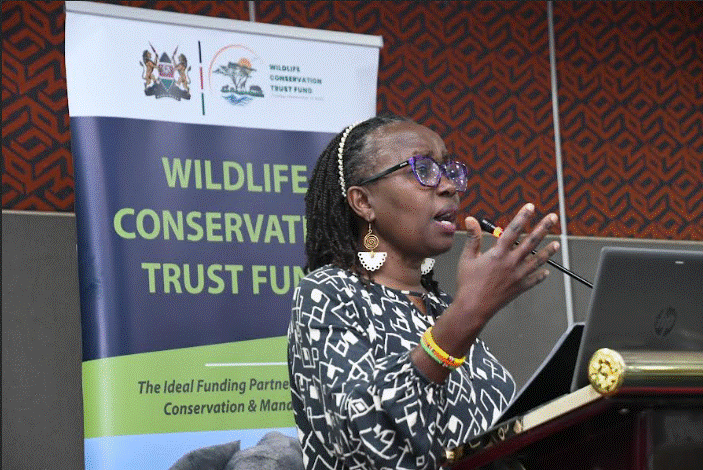
The Wildlife Conservation Trust Fund (WCTF) is exploring new financing mechanisms to strengthen wildlife conservation efforts and support communities bordering game parks.
Conservation stakeholders have called for sustainable financing to address the growing needs of wildlife conservation, a key pillar of Kenya’s economy as the Fund embarks on developing a new five-year strategic plan.
Speaking during a stakeholder engagement forum in Nairobi, Lucy Waruingi, Chairperson of the WCTF, urged stakeholders to identify sustainable sources of financing to support the Fund’s conservation priorities and ensure resources are directed to areas of greatest need.
According to Waruingi, the strategy will enable the WCTF to mobilize additional resources while establishing clear priorities for investing the funds to deliver tangible conservation outcomes.
Participants at the meeting noted that currently the country requires about Sh20 billion annually to meet its wildlife conservation needs but is currently able to mobilize only about Sh8 billion, leaving a financing deficit of approximately Sh12 billion, adding that the situation calls for more mobilization to ensure conservation efforts are delivered.
WCTF Board Member, Robert Wainaina, while backing the initiative said, the Fund is being established to mobilize and disburse conservation resources in a structured manner, with a focus on empowering conservancies and communities directly affected by wildlife.
He said through engagement, the Fund is consulting communities and conservancies, as part of the development of its strategic plan to ensure that their concerns and proposed solutions are reflected in its priorities.
“We want those people who are directly affected by human-wildlife conflict to actually give us ideas. How can we handle that?,” posed Wainaina.
He said the Fund will not directly implement conservation projects, but will work through established conservancies and other actors on the ground.
Wainaina said the consultations would help the Fund identify the factors driving human-wildlife conflict and determine how resources can be directed towards addressing them.
He added that Fund will also consider how communities can be supported during droughts, fires and other emergencies that affect wildlife and conservancies.
According to WCTF Board Member George Mosiori, the Fund’s role would be to support mitigation measures when such crises occur rather than directly manage disasters.
He said the Fund would provide a framework and resources to help address human-wildlife conflict, including facilitating timely compensation for victims.
“Whenever drought hits, and in cases of human-wildlife conflicts, this fund will provide the necessary framework and finances to compensate victims in good time and in the right amounts,” Mosiori said.
He added that the Fund would work with agencies such as the Kenya Wildlife Service (KWS) when emergencies, including severe fires, require specialized security and operational interventions.
Beyond emergency response, Mosiori said the Fund would support alternative livelihoods to reduce pressure on wildlife habitats and discourage activities such as farming and other forms of wildlife reserve encroachment.
The Fund is also expected to support community enterprises that can generate income without damaging wildlife habitats.
Mosiori cited beekeeping as one example of an alternative livelihood that can provide income while encouraging communities to maintain habitats.
He said the Fund could also support community enterprises linked to cultural practices, including beadwork and the production of products from indigenous plants, where such activities are sustainable and contribute to community livelihoods.
However, he emphasized that the Fund would not organize communities to undertake such activities.
Instead, communities and enterprises will be expected to submit proposals demonstrating how their activities contribute to sustainable livelihoods and wildlife conservation.
“Once their proposals are merited against our core values, then we will promote,” he said.
Mosiori said the Fund’s primary focus would remain wildlife conservation rather than tourism promotion, although he acknowledged the strong link between wildlife and Kenya’s tourism sector.
He said a significant proportion of Kenya’s wildlife exists outside formally protected areas, making community participation critical to conservation efforts.
The Fund proposes to support practices that enable communities and wildlife to coexist, including cultural practices that discourage hunting and consumption of wildlife and boost -land-use practices that maintain wildlife habitats.
Mosiori said communities whose traditional livelihoods allow livestock and wildlife to coexist could play an important role in conservation.
He said the Fund would seek to strengthen such practices where they contribute to protecting wildlife.
AB Entheos Managing Director and Co-founder Barbara Chesire highlighted the need for sustainable financing for human-wildlife conflict compensation and prevention measures to promote peaceful coexistence between communities and wildlife.
“The Wildlife Conservation Trust Fund can also invest in mitigation measures that support communities to protect themselves from wildlife and reduce the chances of human-wildlife conflict,” she said.
Chesire at the same time called on women and young people to actively engage in conservation financing and innovation.
The Managing Director said young Kenyans could contribute new ideas and technologies to conservation, including artificial intelligence, virtual reality, and other digital tools.
She proposed the development of virtual-reality tourism experiences that could generate revenue for conservation while creating opportunities for young people in technology and creative industries.
The conservation expert also called for mechanisms that would ensure communities benefit financially when their landscapes are used for films and other commercial productions.
She said young people from communities hosting film productions could be given opportunities to participate in the industry, while appropriate royalty mechanisms could ensure benefits flow back to the communities.
by Ian Chepkuto


Comments
No comments yet. Be the first to share your thoughts.