
Like thousands of hopeful young people from Elgeyo Marakwet seeking greener pastures in athletics, Everlyne Ruto arrived at a local training camp after completing her primary school education at Class 8.
In 2010, the young athlete met a Form Four leaver, fell in love, got married and soon welcomed their first child, but the relationship quickly became the catalyst for a predatory cycle of economic exploitation that traps many naive athletes.
Her breakthrough on the track came quickly because in 2011, she triumphed in a competitive local race and was handed a prize cheque.
“I didn’t know what to do with the cheque, I didn’t even know what it was,” she recalls.
In what felt like the most natural thing to do, she turned the winnings over to her husband, believing his higher education made him better suited to handle the finances.
Due to her low financial literacy she could not navigate the banking system and therefore, from the start she became entirely dependent on her partner to handle her earnings.
This initial phase established a damaging pattern as over the years she said she ran and won so many local races where she was awarded substantial prize money, but she never benefited from any of it because he would immediately take all of the money.
Together, Ms. Ruto said they would travel from their home to the bank in Eldoret town where he would point to the dotted lines, showing her where to sign and what to write but once the cash was cleared he would hand her just sh.1,000 for her journey back home to Iten, while he remained behind in Eldoret with the rest of the fortune.
She said her husband systematically siphoned every coin from her victories until the final devastating stage, when an injury in 2016
left her unable to run. The money obviously dried up and having no further financial value to him, he abandoned her, leaving her entirely alone with their children, who were four by then.
To survive, she said she was forced to take up grueling manual errands, washing clothes in the neighborhood just to put food on the table for her family. For years, she lived in despair, believing her running days and her life’s worth were long gone.
Then a friend introduced her to an organization called Strides for Africa. Fearful and deeply traumatized, Ms. Ruto refused to join at
first but when she finally agreed, it altered her path forever.
Through the organization, she found herself in a room filled with other female athletes who had endured identical patterns of domestic and economic abuse. Strides for Africa provided crucial weekly counseling every Friday, helping her mend her shattered confidence.
They also supplied her with essential training gear and covered her registration for the Eldoret City Race, where she remarkably crossed the finish line at position 28, this gave her hope that she could go back to athletics.
Now at 42 years old, Ms. Ruto is proving that talent does not disappear with age. She recently traveled to Tanzania, clinching a 3rd-place podium finish and earning prize money that has fully empowered her to provide for her four children.
“Speak up against GBV so that you can be assisted. If you keep quiet, you continue suffering and your talents are killed,” she told athletes living in abuse.
Her story is not unique. It is a story affecting so many other young female athletes which has attracted the civil society who, partnering with the media are advocating for sensitization of the athletes on their rights and what constitutes GBV.
Paul Masese from the Centre for Enhancing Democracy and Good Governance (CEDGG) an organization supported and funded by the United Nations Population Fund (UNFPA) notes that female athletes face severe GBV and economic exploitation daily.
According to Masese, many athletes simply do not know what constitutes GBV adding that “young scholarship athletes” who arrive at training camps completely unaccompanied are often left alone to take care of themselves, exposing them directly to sexual predators.
With funding from UNFPA, CEDGG has partnered with both national and county governments to craft policies for the detection, prevention, and response to GBV, especially sexual exploitation, abuse, and harassment.
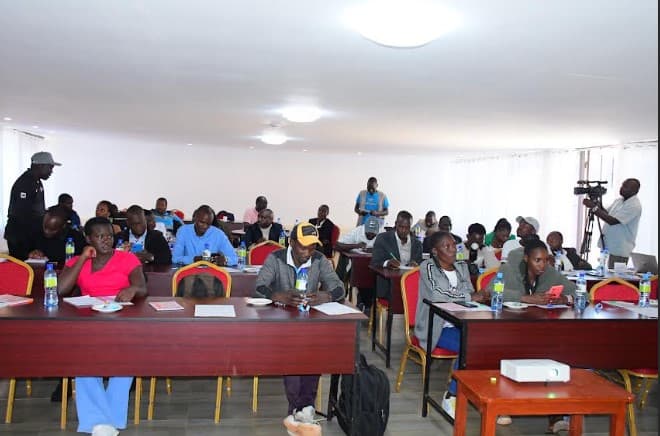
Masese says they are working directly with six training camps in the county to implement internal safeguarding policies. CEDGG has also sensitized coaches to be in the forefront in this fight, alongside the parents of scholarship athletes and the spouses of female athletes,since limited family support remains a major risk factor.
He is urgently calling on the county government to support widespread sensitization and establish infrastructure to enable athletes to train in a safe environment saying currently, many athletes practice on public roads that lack security lights and given that they must wake
up in the early morning hours to train, they face an extreme risk of being attacked.
With Kenya gearing up to host major international championships in 2029, Masese emphasizes that eliminating GBV must be a national priority.
Masese said fortunately, Kenya has numerous laws to fight GBV, alongside secure channels for reporting and encouraged athletes to utilize the dedicated gender desks at police stations and toll-free numbers to report abuse without facing social stigma adding that men are also encouraged to report instances of abuse.
Noting that there are many athletes who are not in any camp, Masese called on coaches to maintain a strict register of all athletes under their care and to make these records available to the authorities.
He said for Kenya’s running community, breaking the silence and enforcing these policies is no longer just about preserving athletic talent but a critical matter of saving lives.
Joseph Mecha from the Media Council of Kenya said that journalists must look beyond just reporting an abuse, pointing out that journalists are trained not just to report events as they happen, but also to focus deeply on challenges and possible solutions.
“Through the media, athletes can be sensitized on exactly what actions they are supposed to take”, he said.
by Alice Wanjiru

Comments
No comments yet. Be the first to share your thoughts.