
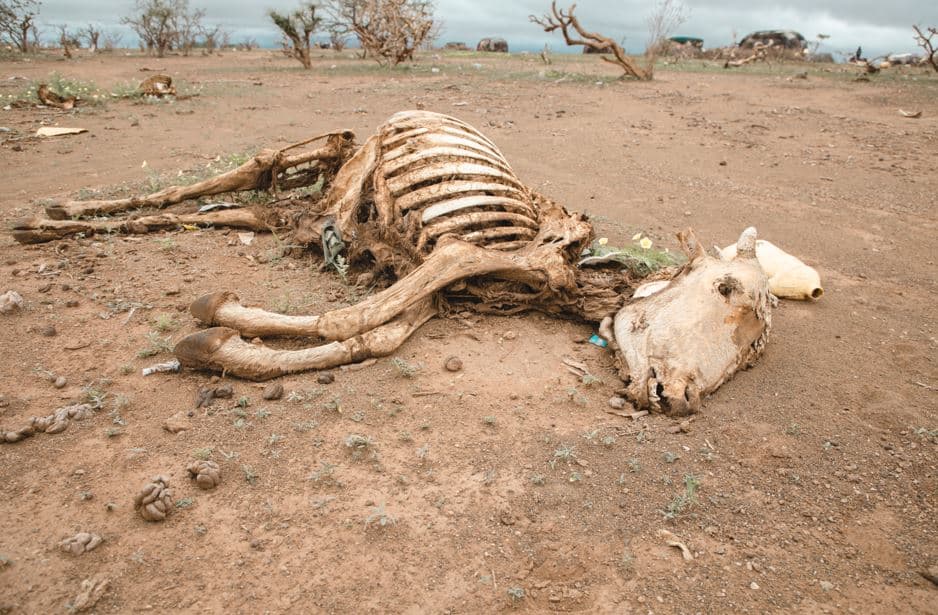
The livestock are gone, but a mother’s fight to feed her children in Marsabit continues

For pastoralist households, livestock are far more than income. They are milk and meat, and they are the means to buy everything else.
In Marsabit County, Kenya, prolonged drought is eating away at the food security, health and livelihoods of pastoralist families. With funding from the Kenya Humanitarian Fund, Concern Worldwide is supporting drought-affected communities with nutrition, water, sanitation and hygiene services.
Before the drought, Boku Wako Elema could hear her family’s livestock coming home from the grazing lands long before she saw them. The animals spent months away in the fora. When they came back, some had new young with them. Her children gathered to help with the milking, and each child might even have their own share of the milk from the animal they had milked. There was food for the family, milk to drink, and livestock to sell when money was needed.
Boku had 100 goats, 100 sheep and 10 camels. She remembers a time when she had enough animals to provide for her six children, and when she could look ahead with some confidence.
Today, at 37, Boku has lost all her livestock. She lives with her six children in a manyatta, a traditional settlement in Marsabit County. She has called it home for six years, and in that time the landscape has changed completely. The pasture that once drew families to the area has dwindled. Dry land and strong winds are what is left.
For pastoralist households, livestock are far more than income. They are milk and meat, and they are the means to buy everything else. When the animals die, a family loses its immediate food and also the assets it relies on to recover from a hard season. Rebuilding a herd can take years. For households with young children, the stretch between losing the animals and getting a livelihood back is the hardest part.
For Boku, that stretch has become a daily struggle to feed her children.
Latest Stories
- Trump faces major test as Americans vote in crucial US midterm elections
- Party factor, deep pockets and ethnic re-alignment: The high-stakes battle for Nairobi’s top job
- How different election results affect bank stability – global study
- Who mapped Africa? Debunking the myth that Europeans alone plotted the continent
When the cooking fire has nothing to cook
Every morning, Boku fetches water, then collects firewood, then makes tea for her children. All of this happens before the children start their day. She wants them to have something in their stomachs, even when there is little else to give.
“We do not eat lunch, and most times for supper, we take tea and sleep,” she explains.
Sometimes she adds water to the milk to make it last for everyone. On better days she manages to find maize and beans for the family to share. These meals can’t be counted on, and not knowing whether there will be enough food weighs on her.
Her children have learnt not to ask for what she cannot give them. So she watches for other signs.
“My children never cry when they are hungry, because they know if there is food, I will give it to them, but sometimes they are very quiet,” she says. “And when they are quiet and not playing outside, sitting in here very close to me is how I know they really need some food.”
Sometimes the older children walk into the house and gather around the fireplace. They look at the three stones where a cooking pot would normally sit, and then they go back outside. When Boku has food to prepare, there is a fire. When there is nothing to cook, there are only ashes.
One day her oldest son picked up a cooking pot and tried to turn it into a drum. Boku thought it was funny. What he said afterwards has stayed with her.
“He said, cooking what if there is no food.”
Even now, Boku tries to hold on to the ordinary rhythms of childhood. Her oldest son makes toys from rags and scraps of material for himself and his siblings. She has managed to send three of her children to school, and the others help around the home. Boku never went to school herself. She wants her children to have the opportunities she didn’t.
But keeping six children fed, healthy and in school gets harder every month, now that the family has lost the animals that carried them.
When hunger reaches the youngest
Boku’s youngest child worries her most. He was one and a half when health workers assessed the family during a community outreach.
Boku had been doing what she could to keep her children nourished. In the mornings, she made tea with camel milk, when she could get it, hoping it would help her youngest keep a healthy weight. But food was short, and the family could barely meet its daily needs. Her efforts were not enough.
At the outreach, the health workers checked the nutritional status of Boku and her child. He would not let them weigh him on his own, so they weighed Boku holding him, then weighed her alone, and worked out his weight from the difference.
The assessment showed that Boku herself was underweight and that her youngest was undernourished.
It was hard news. She had been feeding all six children with whatever she could find, and still her youngest was showing the effects of going without for so long. She had always thought of the specialised food given to children with acute malnutrition as something for the most desperate cases. Now she understood why her child needed it.
The health workers gave him therapeutic food to help him recover, and Boku says she has seen a gradual change.
“He has been slowly improving,” she says.
It is an important step for the family, but it doesn’t undo what caused the malnutrition in the first place. Boku still has no livestock. Food is still scarce, and she still has to find a way to feed her children. Her story is a reminder that spotting malnutrition and treating it has to go hand in hand with tackling the wider conditions that put children’s health at risk.
Bringing care closer to families
In remote parts of Marsabit, getting to a health facility is not simple. The distances are long, resources are thin, and travelling with small children is difficult. For a household already struggling to afford food, the journey is one more cost.
Community health outreach brings care to families who might otherwise go without it. With funding from the Kenya Humanitarian Fund (KHF), formerly known as the Eastern and Southern Africa Humanitarian Fund (ESAHF), Concern Worldwide is supporting life-saving nutrition and water, sanitation and hygiene work for drought-affected communities in Marsabit County. Children are screened, and those who need treatment receive it. Alongside this, families get hygiene promotion and supplies that help them handle their water safely.
At the outreach, Boku received a drum, a pail, soap, sanitary pads and Aquatabs for treating drinking water. She now treats the water for herself and her children before they drink it. The pail helps her with the treatment, and the drum gives her somewhere to store the water.
These things meet practical needs in a home where safe water and basic hygiene can’t be taken for granted. When a family is already coping with hunger and has little access to healthcare, avoiding illness matters even more. Sickness piles more pressure on a household, and it makes it harder to care for children who are already vulnerable to malnutrition.
The outreach also gives Boku a chance to learn about nutrition and hygiene. She goes to the sessions with her children, and some of them can read the educational charts the health workers use. Boku never went to school, but she values the chance to learn things that help her look after her family.
“I also stay with them when we get taught about nutrition and hygiene,” she says.
For Boku, being able to treat her family’s drinking water and get nutritional support for her youngest has changed her days in a way she can feel. The KHF-funded response meets immediate needs, and it also gives families practical knowledge and supplies they can use at home.
A long road back
Boku is not the only one. Across drought-affected communities in Marsabit, pastoralist families have lost their livestock, moved in search of pasture, and struggled to replace the food and income their animals gave them. Some have settled in places where the pasture has since disappeared, and they have few options left for rebuilding.
The effects reach well beyond the lost animals. Food shortages change what children eat. They decide whether families can afford the things they need, and how easily a parent can take a sick child to a clinic. For mothers like Boku, the responsibility for their children carries on even when the means to meet it have run out.
Humanitarian aid can ease the pressure in the short term. Nutrition services can find children at risk and treat them. Water treatment supplies and hygiene teaching can protect a household’s health. Outreach can connect families to care across the distances that separate them from it.
But all of this is happening inside a much larger crisis, and one distribution or one clinic visit can’t resolve it. Boku’s youngest is improving, but the family has not got its livelihood back. The animals that once gave them food and income are gone, and Boku doesn’t know what comes next.
She hopes to own livestock again one day. A herd would give her family a chance to win back some of the security they have lost. It would mean milk for the children, and something to sell when they need it.
For now, she keeps fetching water, collecting firewood and looking for food. She is grateful for the support she has had, and she knows how much more her family needs.
“There is no food. No job. And not much aid,” she says. “I just do not know what the future looks like for me and my family and my small one.”
She hopes the situation will change, and that her children will have a better future.
“Do not forget us,” she says.
For Boku and many other families in Marsabit, recovery will mean more than getting through another day. It will mean enough food for their children, health services within reach, and the chance to rebuild the livelihoods that carried them before the drought.
Until then, the work of supporting families through the crisis remains essential.


Comments
No comments yet. Be the first to share your thoughts.