
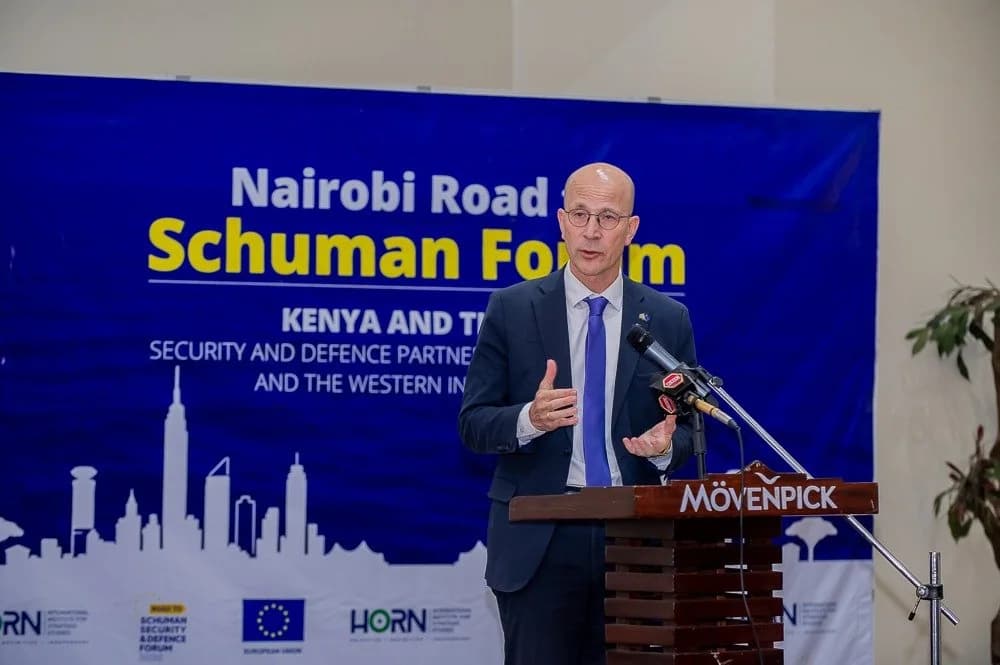
EU brings security roadshow to Nairobi, signals Western Indian Ocean as global frontline

The Nairobi edition is a critical stop and the first one in Africa, according to EU top diplomat Andreas Peschke.
The European Union is taking its security diplomacy on the road.
Ahead of the third edition of the Schuman Security and Defence Forum in Brussels this November, EU Delegations worldwide are hosting "Road to Schuman" events.
The Nairobi edition is a critical stop and the first one in Africa, according to EU top diplomat Andreas Peschke.
More To Read
- Win for farmers as counties get drone to boost data-driven planning, agricultural services
- EU appoints new envoy to Kenya as Somalia ambassador moves to senior Africa role in major diplomatic reshuffle
- Denmark achieves historic milestone in maternal health, first in EU to end mother-to-child HIV, Syphilis
It brought together government and military officials, high-level diplomats, and think tanks in Kenya to discuss maritime security in the Red Sea and Western Indian Ocean, Kenya's wider role, regional coordination, and partnership opportunities.
The closed-door event, held in Nairobi on Monday, was officially opened by Defence Cabinet Secretary Soipan Tuya.
She noted that the Western Indian Ocean is a "vital artery" for global trade, and that keeping the routes open is a major priority for Kenya.
Latest Stories
- Ex-Governor Waititu fined Sh21 million or 13 years in prison over Sh588 million Kiambu Road scandal
- Kisumu court jails family trio 10 years for Sh113 million money laundering, business fraud
- JSC begins interviews for Chief Kadhi position after year-long vacancy
- Matiang’i, Gachagua urged to resolve differences privately as opposition divisions deepen
"Lasting security cannot be achieved by any one nation alone," Tuya told attendees, including the Kenya Navy Commander, Maj. General Paul Otieno.
“It demands trust, shared responsibility and partnership grounded in mutual respect and common interests," she said, noting that shared vulnerabilities in the Red Sea have disrupted maritime routes.
She noted that the Port of Mombasa handled close to 50 million tons of cargo in 2025, with transit cargo up almost 20 per cent, underscoring why secure sea lanes matter.
The EU, which has signalled that it views the waters off East Africa as a frontline for global security, was represented by its ambassador in Nairobi.
Europe's economic lifelines
According to the European Union Institute for Security Studies, Europe's prosperity relies on maritime routes extending into the Western Indian Ocean.
Checkpoints such as the Strait of Hormuz and Bab el-Mandeb, along with key transit corridors like the Mozambique Channel, underpin Europe's economic lifelines and global connectivity.
Peschke told the room that the Schuman dialogue - named after Robert Schuman, one of the founding fathers of the European Union came at a time of global anxiety, when the world is becoming increasingly dangerous.
He described the interconnectedness of the world and reiterated the EU's commitment to supporting regional peace and security, including in Somalia.
He noted that the EU, a bloc of 27 member states, acts as a primary financial and structural backer for the wider security transitions taking place there.
He referenced the April approval of a €75 million funding package for the African Union Support and Stabilisation Mission in Somalia (AUSSOM) as proof of that commitment, confirming the EU as the largest supporter.
Europe engages with Africa multilaterally under the AU-EU partnership and promotes African stability under the EU Peace Facility.
Josephat Maikara, Director General at the State Department for Foreign Affairs, represented PS Korir Sing'oei.
He noted that Kenya brings its experience in the continent and the region in peacekeeping operations and mediation.
The China and India question
Given the geopolitical free-for-all currently playing out in the Indian Ocean and the Red Sea, this outlet asked the European diplomat whether there was an opportunity for collaboration with China, which has a military base in Djibouti, or India, which continues to position itself as a reliable security provider.
Peschke referenced the possibility of cooperation on freedom of navigation, noting, "it affects all of us."
In that context, the EU's anti-piracy operation off the coast of Somalia, Atalanta, has conducted several naval exercises with Japanese, Indian, and other partners—but none with China, which it views as a threat.
India has recently forged closer ties with Brussels and aligns with the EU's desire to find reliable, like-minded partners to patrol the region.
The Schuman Forum is fundamentally a European framework.
It is designed to uphold the "rules-based international order" a phrase that Brussels often uses to push back against Beijing's expanding global footprint.
However, the EU knows it cannot secure the Indian Ocean without acknowledging China's massive economic and military presence in the region, from the port of Djibouti to its heavy infrastructure investments in Kenya.
Since the full-scale invasion of Ukraine, the EU has severed almost all defence and security dialogue with Moscow.
The Schuman Forum is explicitly designed to address "today's most pressing security threats," and in Brussels' eyes, Russia is one of them.
Russia's naval presence in the Indian Ocean is minimal compared to the West, China, and India.
Moscow is currently focused on its naval base in the Red Sea (Sudan) and its African land operations.
The EU will not invite Russia to a forum designed to counter Russian aggression.
Kenya will attend the dialogue with CS Tuya representing the government, alongside some think tanks and scholars in the country.


Comments
No comments yet. Be the first to share your thoughts.