
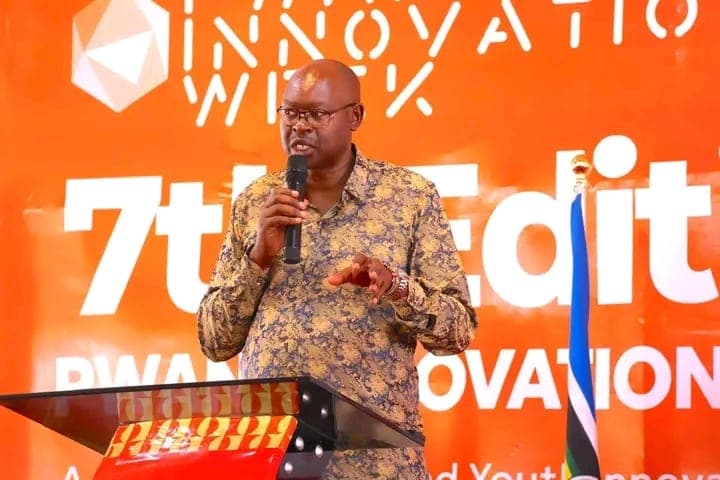
Young innovators in Kenya have been challenged to maintain proper finance, transform their ideas into profitable businesses and develop products capable of competing in global markets.
The innovators were urged to combine creativity with sound financial management, market research and strategic partnerships to build sustainable businesses capable of creating jobs, generating wealth and competing in international markets.
Speaking to young people during Pwani Innovation Week in Mombasa, Kenya National Chamber of Commerce and Industry (KNCCI) President Dr. Erick Rutto urged young entrepreneurs to prioritize commercial viability and long-term business growth, noting that innovation must translate into sustainable enterprises and wealth creation.
Dr. Rutto emphasised that generating income from a product or service is a critical step towards building wealth and establishing business networks across Kenya, Africa and the rest of the world.
“When you make money, you make wealthy young innovators, ensure your products generate profit rather than concentrating on ideas and innovation alone,” said Dr. Rutto.
He put Kenya’s economy at approximately Sh17 trillion to Sh18 trillion, describing it as relatively small compared with developed economies citing an average GDP figure of approximately US$50,000 for developed economies to illustrate the economic gap Kenya needs to bridge.
He noted that young people would play a central role in driving the country’s economic transformation and prosperity over the next quarter-century.
“Africa’s projected population growth to approximately 2.5 billion people in the coming decades would create significant opportunities for entrepreneurs capable of developing relevant products, technologies and services’’ said Dr. Rutto
He also highlighted the continent’s natural resources, agricultural potential and access to marine resources, as important foundations for economic transformation.
The KNCCI president outlined several initiatives by the chamber aimed at helping young people move beyond business ideas and establish commercially viable enterprises.
“We have JIINUE programme, in partnership with the Mastercard Foundation, which supports young people with entrepreneurial ambitions’’ said Dr. Rutto
According to Dr. Rutto, the programme has trained approximately 82,000 young people in developing business ideas, identifying opportunities and maintaining proper financial records and it also provides financial support to help participants establish or expand their enterprises.
He noted that having an idea is only the beginning of the entrepreneurial journey, adding that the real challenge lies in turning that idea into a profitable venture.
“Young people have ideas, but how they convert that idea into a profitable business is the question that they must answer and if they manage to answer that question, one become an entrepreneur and a successful businessperson,” he said.
Dr. Rutto also announced plans to expand support for young women, revealing that the next phase of the initiative targets 300,000 young women across the country.
He encouraged eligible young women to take advantage of the programme and participate in initiatives designed to strengthen their entrepreneurial skills and business capabilities.
He also highlighted the KNCCI Chamber Business Academy, describing it as a practical learning and networking platform rather than a conventional school.
The academy brings young people together to learn different approaches to marketing and taking products to market, enabling them to explore various strategies and select those best suited to their businesses.
“ The Academy has been able to train over 3,200 young people in practical skills, it is not a school; it is a place where young people meet, when you come, we show you how you can use different methods to market a product and choose the method that is most suitable for your business,” said Dr. Rutto.
Meanwhile, Absa Bank Kenya Head of Sustainability, Corporate Affairs and Foundation Charles Wokabi said the creative economy was increasingly contributing to the country’s economic growth, calling for greater investment and partnerships among stakeholders to support the sector.
Wokabi said financial institutions had a responsibility to help young people understand financing options and how to access and manage financial resources to grow their careers and businesses.
He encouraged young entrepreneurs to embrace emerging technologies, particularly artificial intelligence (AI), while developing strategies to grow their personal finances and businesses.
“Young people need to know how to grow their careers and businesses in this age of AI and the need to grow their money as individuals or as businesses,” said Wokabi.
He observed that access to capital was not necessarily the biggest challenge facing young entrepreneurs, arguing that developing a viable business idea and communicating its value clearly to customers were equally important.
“A viable idea is something that you can express clearly and have data behind it, always answering a customer problem, from the idea stage to commercialisation,” he said.
Wokabi further challenged young entrepreneurs to exercise financial discipline, warning against the temptation to increase personal spending immediately after making profits.
He noted that some entrepreneurs channel their initial earnings into expensive cars, phones and other lifestyle purchases instead of reinvesting in their businesses and securing their financial future.
“A lot of entrepreneurs will make money and immediately buy cars, start buying expensive phones and change their lifestyle. There is a need for discipline when it comes to finances,” he said.
by Mary Mtawa



Comments
No comments yet. Be the first to share your thoughts.