
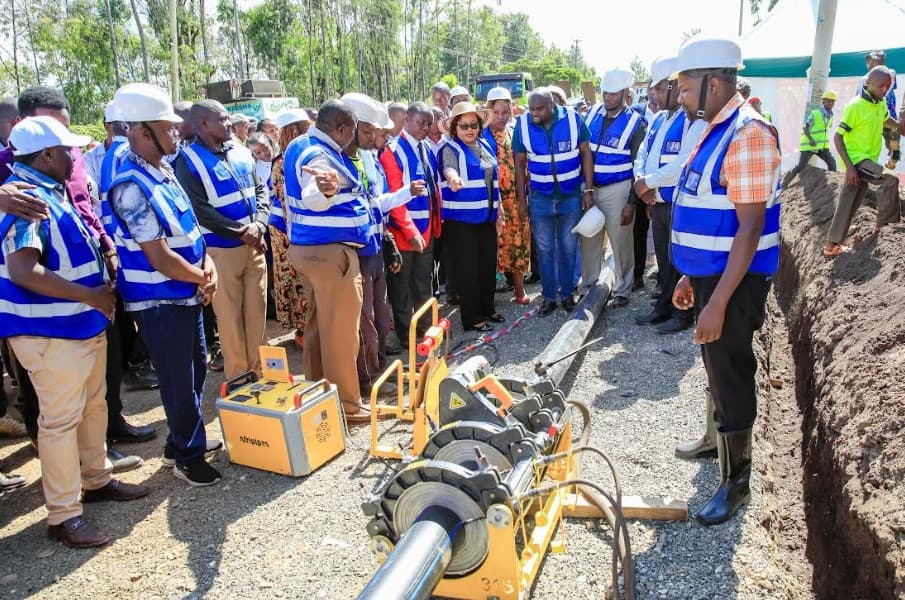
For years, thousands of residents in Mwea, Kirinyaga County, depended on irrigation canals to draw water for drinking, cooking, washing and other household needs, exposing families to contaminated water and water-borne diseases.
But the situation is changing following the implementation of the Mwea-Makima Water Project, with county health data showing a 63 per cent decline in diarrhea cases recorded in the area.
The project, implemented by the Kirinyaga county government, is providing clean and safe water to about 30,000 people in more than 7,500 households across Gathigiriri, Nyangati, Thiba, Mutiithi, Wamumu and Tebere wards.
The development marks a major shift for communities that previously relied on water from rice irrigation canals, where agricultural chemicals and other contaminants could expose residents to health risks.
Kirinyaga governor Ann Waiguru said access to adequate water for domestic and irrigation purposes remained a priority for her administration, with the county investing in water pipelines, storage tanks, boreholes and other infrastructure.
She said more than 200 water projects had been implemented across Kirinyaga during her tenure, improving access to clean water while supporting hygiene and sanitation in households and institutions.
The governor has also pledged to complete ongoing water projects worth Sh100 million in Mwea before the end of her final term.
Speaking on Thursday September 24,2026 during an impact assessment of the Mwea-Makima Water Project, County Executive Committee Member for Water Kinyua Mutugi said the project was addressing a longstanding challenge that had forced many families to depend on irrigation water for domestic use.
“Before implementation of this project, we had serious challenges in accessing clean water. Most people depended on water from rice canals, which exposed them to water-related diseases,” Mutugi said.
He said water flowing through the irrigation canals could contain chemicals and other contaminants associated with agricultural activities, increasing residents’ exposure to illnesses such as typhoid, dysentery and cholera.
The project has extended water services to areas including Rurii, Mutiithi Town, Maendeleo, Thiba North and South, Haraka, Ngurubani Town, Kimbimbi, Mbui Njeru and parts of Nyangati, as well as several villages in Gathigiriri.
Kirinyaga County Director of Public Health Peter Irungu said Mwea recorded 19,061 diarrhea cases during the 2018/19 financial year.
By the 2025/26 financial year, the number had dropped to 6,900 cases, representing a reduction of about 63 per cent.
“Since the residents started using clean water, there has been significant improvement in hygiene and sanitation standards in the area,” Irungu said.
Irungu said the reduction demonstrated the importance of investment in safe water, sanitation and hygiene, particularly in communities where residents had previously relied on unsafe water sources.
He warned that inadequate access to clean water and poor sanitation continued to expose communities to preventable diseases, including diarrhoea-related illnesses, cholera and dysentery, with children among those most vulnerable.
For residents, however, the change is not merely reflected in government statistics but in their daily lives.
Henry Mugo, a hotel operator in Tebere Ward, said access to clean water had made a significant difference to businesses and households in areas that previously experienced difficulties getting reliable supplies.
He said water was now reaching remote areas, including Githogondo, giving residents and businesses a more dependable source of clean water.
“The water is really clean and we are happy as we use it at our hotel, as we no longer have to worry about having stomach issues like before,” Mugo said.
For John Kaboco of Nyangati, the project has brought back memories of a time when residents had limited options and were forced to depend on irrigation canals or wait for rain.
“Children were unable to drink the water and we could not even clean clothes, especially white ones, because they would get dirtier,” he said.
Kaboco said some residents frequently sought treatment at Kangu Dispensary for conditions such as worms and amoeba, while diarrhoea sometimes forced children to miss school.
He said the arrival of piped clean water had eased the burden and allowed families to live in better and healthier conditions.
The county government says the gains in clean water provision are being complemented by investments in sanitation infrastructure.
Among the projects is the Kerugoya-Kutus Bulk Sewer Project, which has been constructed and operationalised to improve waste management and reduce health and environmental risks associated with the use of exhausters and other waste-disposal systems.
Mutugi said the sewer project was providing a more efficient way of managing waste in areas connected to the system.
Previously, he said, households and institutions relied heavily on exhausters and bio digesters, a situation that came with additional costs and potential environmental risks.
“The sewer system has benefited both public and private institutions, particularly in Kerugoya and Kutus”, he said.
by David Wandeto
Comments
No comments yet. Be the first to share your thoughts.