
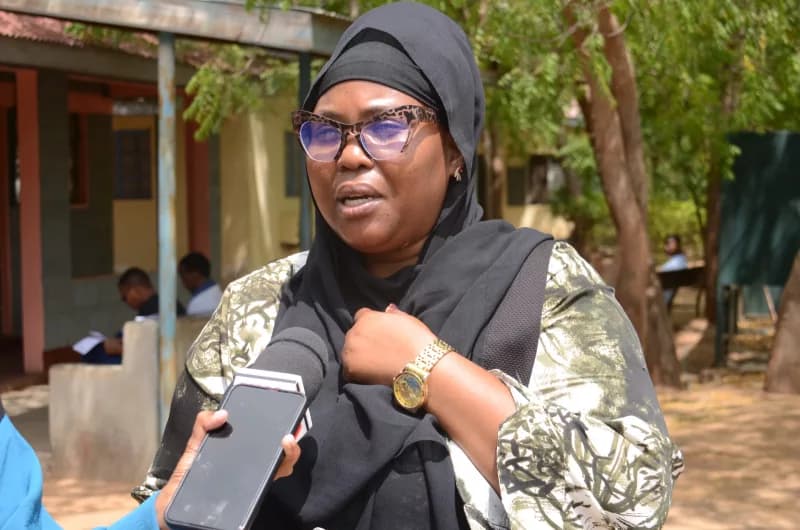
Search for Common Ground representative Rebecca Ghamaloku speaking to the press.

Peace actors and government agencies in Garissa have launched a youth-led initiative to strengthen early warning systems and curb online misinformation.
The Peace Pulse Project, spearheaded by peacebuilding organisation Search for Common Ground in partnership with the Kenya Community Support Centre (KECOSCE) and other stakeholders, seeks to identify emerging conflicts, counter misinformation and promote timely responses to threats that could undermine peace before, during and after the elections.
The initiative will monitor developments in online and offline spaces, with a focus on political tensions, community safety, public trust in institutions and the capacity of residents, particularly young people, to participate in peacebuilding efforts.
Search for Common Ground representative Rebecca Ghamaloku said the project would track key indicators of peace to help communities and relevant institutions identify emerging threats before they escalate. She spoke to journalists outside the Garissa county commissioner’s office after a meeting.
“Peace has a pulse that can be measured and monitored within communities,” Ghamaloku said, drawing a comparison between monitoring community peace and taking vital signs to assess a person's health.
She said the project would monitor indicators such as community safety, trust between communities, confidence in institutions and the willingness of residents to take action in promoting peace.
The 20-month initiative is funded by the German Federal Foreign Office and is being implemented in 11 counties, including Garissa, Tana River, Lamu, Nairobi, Homa Bay, Migori, Machakos, Meru, Kiambu and Kajiado.
Ghamaloku said the project would use conflict-monitoring information gathered from digital platforms and physical community engagements to inform discussions among stakeholders and develop a joint action plan for addressing emerging threats.
The approach is intended to strengthen collaboration between young people, government agencies, civil society organisations and other peace actors in identifying and responding to conflicts before they trigger violence.
Kenya Community Support Centre representative Maxwell Lumbasi said the initiative would work closely with young people, security agencies and election-related institutions to improve the country's preparedness for potential electoral tensions.
“Our main objective is to strengthen early warning and early response mechanisms so we are adequately prepared for the elections,” he said.
Lumbasi said young people were a key focus of the initiative, particularly because of the growing influence of social media in shaping public opinion and the potential for online misinformation to inflame political tensions.
Institutions expected to work with the initiative include the Office of the Registrar of Political Parties (ORPP), the National Cohesion and Integration Commission (NCIC) and the Independent Electoral and Boundaries Commission (IEBC).
“Peacebuilding cannot be achieved by one individual or institution acting alone,” he said, adding the timely sharing of information among partners would be critical to preventing conflicts from escalating into violence.
Sankuri deputy county commissioner Masaine Kishoiyan said the engagement brought together community leaders, women and representatives of different communities to strengthen preparedness and response to security threats.
He stressed that peace was fundamental to social and economic development, noting that insecurity disrupted livelihoods, education and the government's ability to address other challenges facing communities.
“We cannot grow our economy without peace, and students cannot sit their examinations in a peaceful learning environment if there is insecurity,” Kishoiyan said.
He said cooperation among government agencies, community leaders and peacebuilding organisations was essential in addressing insecurity, terrorism and environmental challenges.
Kishoiyan said peacebuilding should be treated as a continuous process extending beyond the election period, with stakeholders maintaining close collaboration to safeguard stability.
Human rights defender and peace actor Mohamed Khalif urged politicians and their supporters to avoid inflammatory rhetoric and resist attempts to mobilise young people to engage in electoral violence.
Khalif said political differences should not turn opponents into enemies, particularly in communities where candidates and their supporters share social and family ties.
“We must learn to put the interests of our country above personal and political interests,” he said.
He urged political actors and community members to embrace dialogue as a means of resolving disagreements, warning that the exploitation of young people for political purposes could expose them to violence and other risks.
Khalif also cautioned against the spread of misinformation, calling on residents to verify information and rely on credible sources instead of sharing content capable of heightening political tensions.
He said young people should be actively involved in peacebuilding initiatives rather than being treated merely as instruments of political mobilisation.
“By identifying potential sources of conflict and responding to them in good time, we can prepare adequately and help ensure that the country approaches the elections peacefully,” Khalif said.
The launch came a week after civil society organisations, electoral officials and religious leaders in Garissa established the Electoral Preparedness and Inclusive Governance Forum to promote peaceful, inclusive and credible elections in 2027.
Spearheaded by the Garissa County Civil Society Network, the forum seeks to bring together state and non-state actors to identify potential electoral challenges, improve public awareness of electoral laws and establish a coordinated mechanism for responding to issues that could undermine the credibility and peaceful conduct of the polls.
The forum brings together the IEBC, civil society organisations, religious leaders and human rights groups, with plans to incorporate additional institutions, including the National Gender and Equality Commission (NGEC), the NCIC and the ORPP.
The two initiatives reflect growing efforts by local stakeholders to strengthen electoral preparedness, promote accountability and address potential sources of conflict before the next General Election.
Through coordinated monitoring, community engagement and timely intervention, peace actors hope to build public confidence, protect young people from political exploitation and ensure that disagreements are resolved through dialogue rather than violence.
Peace actors at the meeting.


Sankuri Deputy County Commissioner Masaine Kishoiyan speaking to the press.

Human rights defender and peace actor Mohamed Khalif speaking to the press.

Comments
No comments yet. Be the first to share your thoughts.