
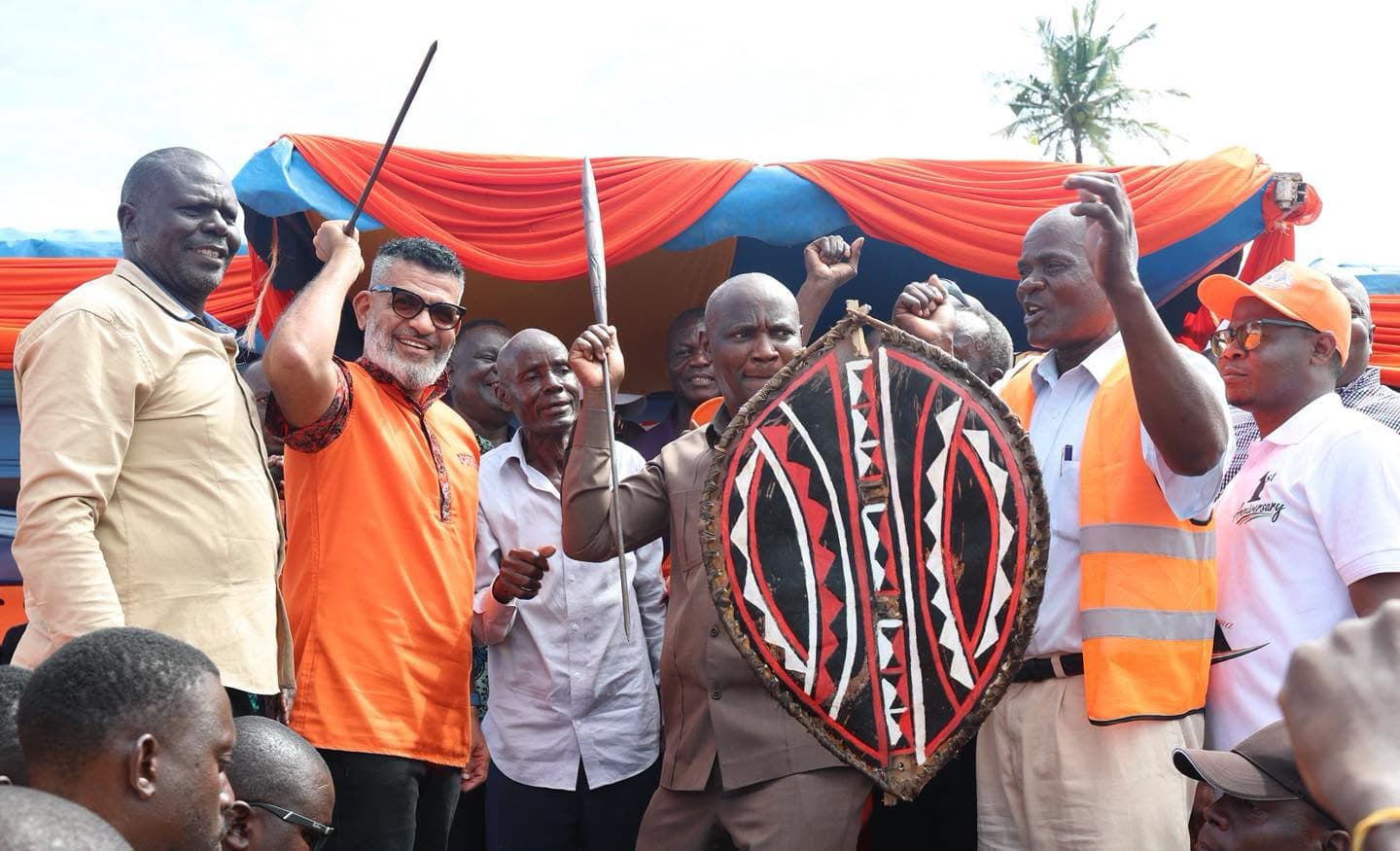
Mombasa governor Abdulswamad Nassir [L, with spear] and National Treasury CS John Mbadi [with spear and shield] in Likoni, Mombasa on Sunday / BRIAN OTIENO

National Treasury CS John Mbadi and Mombasa governor Abdulswamad Nassir in Likoni, Mombasa on Sunday / BRIAN OTIENO

Mombasa Governor Abdulswamad Nassir has vowed to turn the late Raila Odinga’s vision for Kenya into reality, pointing to county healthcare reforms as part of efforts to deliver what he described as the former Prime Minister’s Canaan dream.
Nassir said his loyalty to Raila and the Orange Democratic Movement (ODM) went beyond words, insisting that leaders who claim to honour the late opposition chief must demonstrate it through action.
“I want people to understand what we have done and what we are doing because they were in Baba Raila Amolo Odinga’s manifesto.
“When we say we loved Raila, and we love ODM, we don’t only talk, we act too,” Nassir said.
The governor cited healthcare reforms in Mombasa as an example of how his administration was pursuing Raila’s vision, with the long-term goal of making healthcare completely free for residents.
Children under five years are already receiving free treatment at county hospitals.
In October, marking the first anniversary of Raila’s death, Nassir directed that healthcare services be provided free of charge at all county hospitals throughout the month, a programme he branded “Mwezi wa Baba” or “BabaCare”.
He later extended the initiative to November 30, allowing Mombasa residents to access free treatment at county hospitals during the period.
Speaking at a fundraising event for Luo women in Likoni, Nassir said the best way to honour Raila was to follow his teachings and defend the ideals he championed.
He also criticised the United Opposition, accusing its members of seeking political popularity without presenting a clear agenda for Kenyans.
“For those who pretend they loved Baba, let them show with action that they truly loved him. Those who oppose us, if you ask them what their agenda or manifesto is, they do not have,” he said.
The ODM deputy party leader claimed the opposition’s political messaging revolved around slogans and hostility rather than policies.
“When you ask them what their agenda is, they will only tell you wantam, Kasongo, hatred, tribalism. They do not have any agenda, policy, or anything meaningful,” Nassir said.
He also warned politicians forming or joining rival parties that they would struggle to defeat ODM, citing the party’s more than two decades of political experience.
“ODM is the only party that, despite not being able to produce a president, because victory was stolen from us several times, it has remained strong.
“This is because it is a party that believes in ideals. It was not born just to win one election,” he said.
National Treasury Cabinet Secretary John Mbadi also defended ODM’s legacy, saying its history and evolution set it apart from other political parties.
Mbadi traced the party’s political roots through several formations, including Ford, Ford Kenya, the National Development Party (NDP), the Liberal Democratic Party (LDP) and Narc, before the emergence of ODM.
“This party was once called Ford, then we called it Ford Kenya, it then become NDP, before changing into LDP, then became Narc before being ODM.
“It is Baba’s party. He started it. And it is in his heart,” Mbadi said.
He urged those who respected Raila to remain in ODM and support its continued growth.
“For those who respect Baba, we must all remain firm in ODM, support it and push it forward. We command a lot of respect because of ODM,” he said.
Mbadi also defended Raila’s cooperation with President William Ruto, saying the former Prime Minister had worked with someone who was already part of ODM’s leadership rather than a political outsider.
He further argued that Ruto shared some of the party’s ideals, particularly the pursuit of equity and development across the country.
“It is ODM that was fighting for equity in Kenya. It is still doing so. And when you look at William Ruto you will realise he is also fighting for equity in the country and that is why he started this policy called Usawa in Sawa,” Mbadi said.
He accused previous administrations of concentrating development in their own regions.
“The others, when they were leading, when it came to development, they only took to their areas,” he said.
Likoni MP Mishi Mboko also backed Ruto’s re-election, saying the Coast and other historically marginalised regions had benefited from development projects under his administration.
Mboko said the best way to repay what she described as Ruto’s kindness was to support him for a second term.
She cited Nyanza, the Coast, North Eastern, Turkana and Pokot among the regions she said had received development attention.
At the Coast, she said, residents were beginning to receive title deeds and expressed hope that the longstanding problem of landlessness and squatter settlements would eventually be resolved.
Comments
No comments yet. Be the first to share your thoughts.