
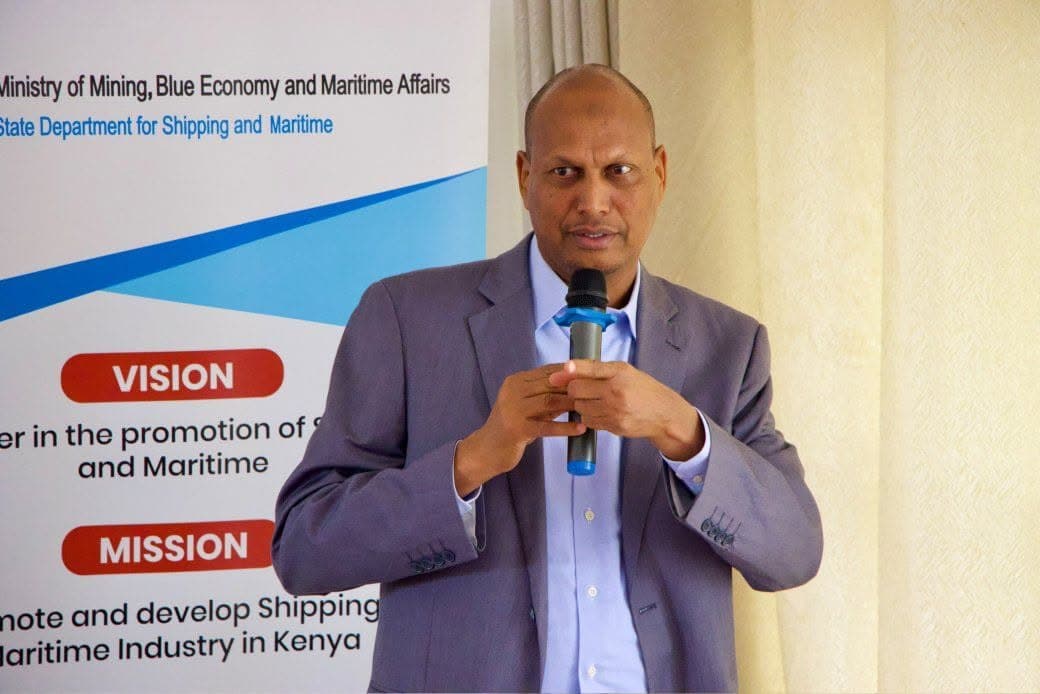
Shipping and Maritime Affairs PS Aden A. Millah, has called for comprehensive reforms to streamline the Directorate of Government Clearing Services (DGCS), emphasizing the need for enhanced staff competencies, operational efficiency, accountability and improved service delivery in the management of government-imported cargo.
Millah said there was an urgent need to strengthen the Directorate’s institutional capacity and operational systems to ensure seamless, transparent and dependable clearing services for government institutions and agencies.
Speaking during a Performance Improvement Programme (PIP) for the Directorate at a Machakos hotel, the PS challenged officers to move beyond theoretical knowledge and embrace practical competencies that would enable them to execute their mandate professionally and independently.
He observed that streamlining the Directorate required a deliberate approach anchored on structured capacity building, standardized operational procedures, effective supervision and a robust performance management framework.
The PS underscored the importance of equipping relevant officers with specialized knowledge and certification in the Integrated Customs Management System (ICMS), customs procedures, tariff classification, cargo valuation, clearance processes and regulatory compliance.
Millah directed that officers handling Integrated Customs Management System (ICMS) and related functions progressively undergo formal training and certification to strengthen their capacity to manage government consignments efficiently.
To bridge the gap between classroom instruction and operational realities, the PS announced plans to institutionalize practical on-the-job training, mentorship and staff shadowing programmes. These interventions will expose officers to different operational functions and provide opportunities to gain hands-on experience at customs stations, ports, airports and border points.
Millah further called for a performance-driven culture in which every officer is assigned clear responsibilities and measurable targets, supported by Key Performance Indicators (KPIs), regular supervision and continuous performance reviews.
He emphasized that performance management should not be treated merely as an annual appraisal exercise, but as a continuous process linked to professional development, operational efficiency and tangible improvements in service delivery.
On institutional coordination, the PS highlighted the need to strengthen collaboration between the Directorate, customs authorities and other relevant stakeholders, noting that effective communication, clear reporting channels and timely escalation of operational challenges were essential in eliminating bottlenecks.
He also called for greater utilization of digital systems and technology to enhance cargo tracking, transparency, accountability and efficiency in government clearing operations.
To ensure implementation, the PS directed management to develop a consolidated action matrix covering staff training, ICMS certification, mentorship, job shadowing and performance targets, with clearly designated responsibilities and timelines.
The framework will be supported by quarterly progress reports detailing achievements, operational challenges and corrective measures, alongside periodic reviews to assess competency development and institutional performance.
Millah challenged supervisors and those in management to take direct responsibility for staff development, performance monitoring and the implementation of agreed interventions, insisting that the programme must translate into measurable improvements rather than remain a policy commitment.
He noted that the ultimate objective was to establish a professional, competent, highly accountable and efficient Government Clearing Services function capable of delivering value for money in the management of government cargo.
The Performance Improvement Programme follows the successful completion of the Directorate’s first week of induction and is designed to consolidate institutional capacity, while strengthening the professional standards required for effective government clearing operations.
Millah expressed confidence that the interventions would position the Directorate to deliver more efficient, transparent and reliable services in support of government operations.
By Justus Anzaya



Comments
No comments yet. Be the first to share your thoughts.