
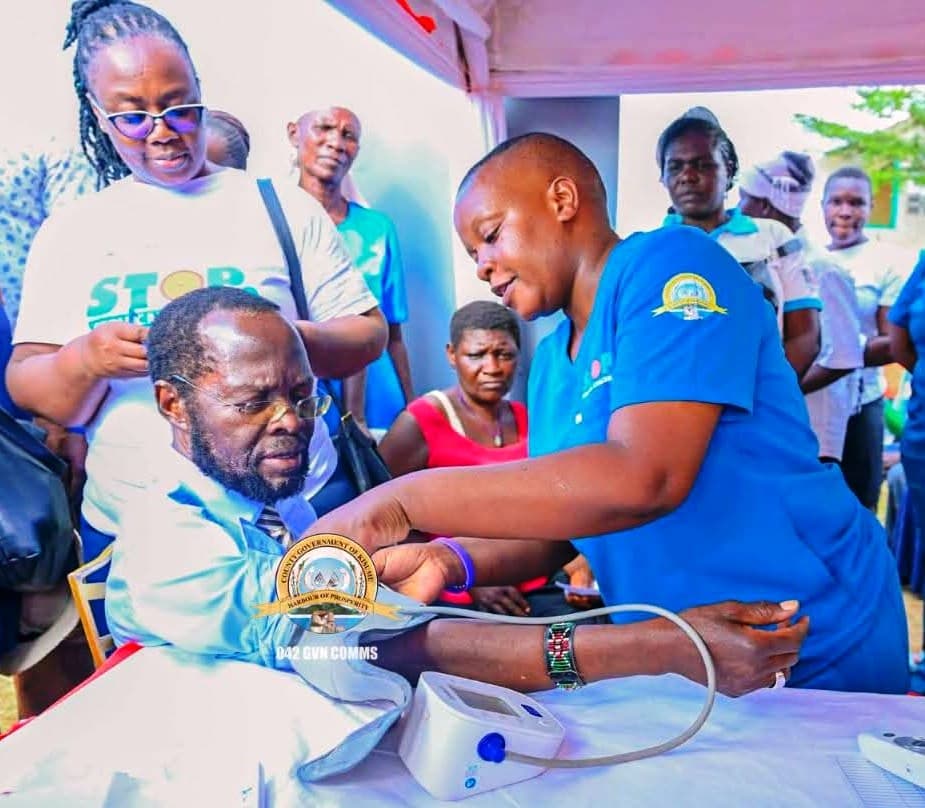
The grassroots health sector in Kisumu County has received a shot in the arm after the government of Prof. Peter Anyang’ Nyong’o injected Sh600 million into the sector in a bid to transform healthcare delivery by taking medical services directly to residents’ doorsteps.
The major investment will support 2,943 Community Health Promoters (CHPs) distributed across 291 Community Health Units.
To streamline operations, the county has fully digitised the workforce by equipping them with electronic gadgets powered by the electronic Community Health Information System (ECH) in order to help the CHPs. To this end, health workers have registered 330,678 people through this system, with 206,151 residents currently receiving consistent medical attention within their neighbourhoods.
Speaking in Kisumu on Tuesday when he distributed working equipment to the CHPs, Governor Nyong’o noted that the initiative represents a profound paradigm shift in governance, moving away from a reactive model to a proactive system that brings healthcare straight to the household.
“Our CHPs are registering families, identifying pregnant women and children at risk, providing basic services, promoting prevention, and making referrals when specialised care is required,” Governor Nyong’o stated.
He noted data spanning from 2021 to 2025 highlights a remarkable footprint by the community health workers, who logged 11.48 million household visits and facilitated the referral of 71,341 pregnant women to maternal and antenatal care centres.
This aggressive outreach has triggered 83 percent surge in the utilisation of antenatal care. Consequently, maternal mortality rates in the county plummeted from 495 to 343 deaths per 100,000 live births, while under-five child mortality dropped drastically from 67 to 37 deaths per 1,000 live births.
On disease control, the governor observed that the digital health workforce successfully managed 264,032 malaria cases among children under five years, alongside 242,514 cases in older patient brackets. Additionally, the promoters treated 90,530 instances of diarrhoea using zinc and oral rehydration salts (ORS).
The Governor further revealed that the success of this grassroots model heavily informed the creation of Kisumu’s indigenous Marwa Social Health Insurance scheme, where the local program covered more than 30,000 vulnerable residents, and its foundational structures and field experiences ultimately paved the way for its integration into the national Social Health Authority (SHA) framework.
Governor Nyong’o maintained that the ultimate success of any healthcare system is not measured by physical infrastructure but by its speed and efficiency in protecting families.
“The true measure of a health system is not only the number of hospitals we build, but how early we reach a mother, how quickly we identify a sick child, and how effectively we protect a family from an illness becoming a crisis,” the county Governor emphasized.
Kenya formally integrated community-based healthcare into the national health system in 2006 with the launch of the first Community Health Strategy, which recognised the community as the first level of healthcare delivery.
The strategy established a framework for taking basic preventive and promotive services closer to households through community health workers and linking communities with health facilities. The framework was later revised in 2013 following devolution, giving county governments a greater role in implementing community health programmes.
The current Community Health Promoters (CHPs) programme was rolled out nationally in 2023, when the government began deploying about 100,000 CHPs across the 47 counties as part of its Universal Health Coverage and primary healthcare agenda.
The CHPs provide health education, promote disease prevention, identify health risks, offer basic services and refer patients to health facilities, with digital platforms such as eCHIS supporting household registration and monitoring of services.
Community Health Promoters (CHPs) in Kenya are local, trained community members who act as the primary link between households and the formal health system to advance Universal Health Coverage (UHC).
Each Community Health Unit (CHU) typically covers a population of roughly 5,000 people and is assigned one Community Health Assistant (CHA) and about 10 CHPs.
They are equipped with basic medical kits, smartphones (for digital health reporting via eCHIS), and are linked to local health facilities (Level 2/3) through Primary Care Networks.
They educate households on handwashing, sanitation, nutrition, and safe breastfeeding and monitor pregnancies, track immunisations, spot danger signs early, and encourage antenatal and postnatal care visits.
CHPs also conduct basic home-level health checks, including screening for blood pressure, blood sugar (diabetes), malnutrition, and tuberculosis (TB) symptoms. They also identify sick individuals, issue referrals to formal health facilities, and follow up on patients discharged from hospitals or children who missed vaccinations.
by Mabel Keya-Shikuku and Chrispine Onyango Oduor (Trainee)


Comments
No comments yet. Be the first to share your thoughts.