
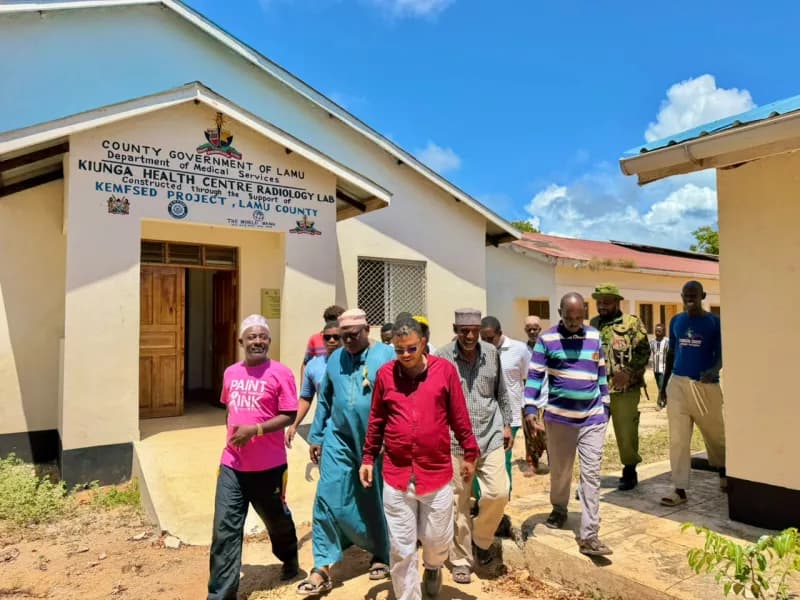
Lamu county director of peace-building and disaster risk management Shee Kupi and deputy governor Mbarak Mohamed Mbarak at the Kiunga Health Centre on Saturday / BRIAN OTIENO

The upcoming theatre and radiology unit at the Kiunga health center in Lamu / BRIAN OTIENO

When Aisha Msuo, a resident of Kiunga in Lamu East, discovered she was pregnant in mid-2025, she was excited about becoming a mother.
But her joy soon gave way to anxiety as she worried about what would happen if she developed complications during pregnancy or needed a caesarean section.
Where would she go for emergency care? Would she have to travel for hours by road and sea to reach King Fahad Hospital on Lamu Island?
“This stressed me, many times, I was afraid the stress would affect the pregnancy. Luckily, I gave birth normally early this year,” she said.
Msuo’s fears reflect the challenges facing pregnant women in Kiunga, a remote village near the Kenya-Somalia border. The local health centre is the main facility serving a population of slightly more than 5,000.
Patients requiring specialised treatment must travel to Lamu Island, a journey that takes between four and eight hours, depending on sea conditions and tides. Rough waters can make the trip risky, particularly during emergencies.
However, the situation could soon improve, as an operating theatre and radiology unit at Kiunga Health Centre nears completion.
Once equipped and operational, the facilities are expected to provide surgical and emergency obstetric services locally, reducing the need for patients to travel long distances for treatment.
“We have been losing unborn babies, new borns and sometimes the mothers due to complications, like excess bleeding, which are often not dealt with quickly enough,” Lamu Deputy Governor Mbarak Mohamed Mbarak said.
He added that the theatre would help reduce maternal and newborn deaths by improving access to timely treatment.
For Msuo, the prospect of having surgical services closer to home offers relief to expectant mothers who worry about reaching a hospital in time.
“The idea that we will soon have an operating theatre here means so much to us. It will be a game changer for pregnant mothers, especially those needing a C-section,” she said.
Mbarak, who also serves as the county’s health executive, said the theatre would support the treatment of conditions that have traditionally required referrals to larger hospitals in Lamu or other regional centres along the Coast.
Speaking during an inspection visit on Monday, he said the county government was committed to improving healthcare in remote and vulnerable border communities.
He said the county would ensure the facility had qualified staff, appropriate equipment and the necessary operational approvals.
The county hopes to upgrade Kiunga Health Centre to a Level 4 facility once the required infrastructure, equipment and staffing are in place.
Community leader Harun Bin Rashid said the improvements could benefit residents on both sides of the Kenya-Somalia border.
“Maybe this will help reduce hostilities between us and the Somalis just like the water project has done,” he said.
He was referring to the Kiunga Solar Desalination and Water-for-Peace Initiative, which uses solar energy to turn saline groundwater into clean drinking water. The initiative helps address water shortages and cross-border tensions.
County Director of Peace-building and Disaster Management Shee Kupi Shee said geographical isolation had long limited access to specialised healthcare in Kiunga.
He said the new facilities would serve people from different backgrounds, including host communities, refugees, internally displaced people from Boni Forest, security personnel and cross-border populations.
“In a border community such as Kiunga, access to essential public services is closely connected to peace, human dignity and social cohesion,” Kupi said.
He added that better access to public services could strengthen residents’ trust in government institutions and promote peaceful coexistence.
The operating theatre will use solar power, an approach Kupi said was suited to remote areas where maintaining a reliable electricity supply can be difficult.
He said renewable energy could help the facility maintain essential services during power disruptions and emergencies.
For Kiunga residents, the completion of the theatre and radiology unit represents an opportunity to access healthcare closer to home, reducing the difficult journeys families have long endured in search of specialised treatment.
Kiunga’s planned operating theatre could mark a turning point for families who endure hours of risky travel to access emergency and specialised healthcare. For pregnant women, the difference could be between timely intervention and a tragedy that could have been prevented.
However, this promise will only be realised if construction is followed by adequate equipment, qualified staff and reliable services. The county must ensure the facility becomes operational rather than allowing it to become another unfinished promise.


Comments
No comments yet. Be the first to share your thoughts.