
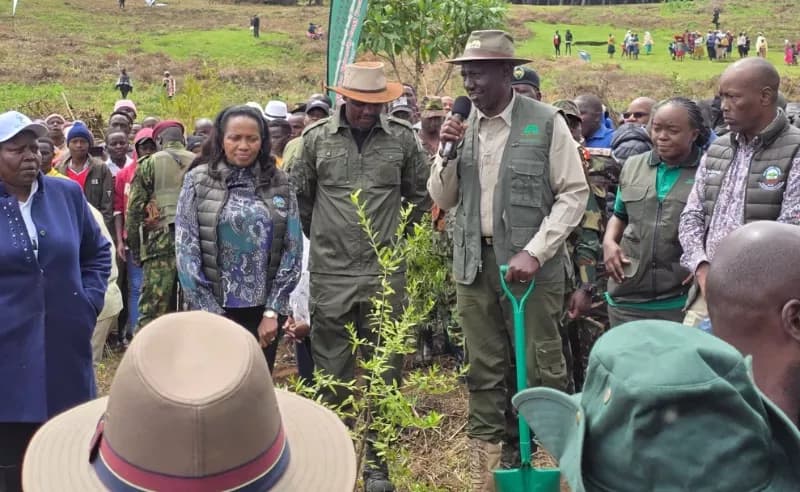
President William Ruto during a tree-planting session at the Mau Forest Complex in October 2025 /PCS

The success of the Sh21.5 billion Mau Forest restoration drive may ultimately depend on whether communities around the water tower can earn a living while helping to protect it.
For years, forest conservation has faced a difficult balancing act between protecting an ecologically critical resource and addressing the economic needs of people who depend on the surrounding land.
The Mau Forest Complex Integrated Conservation and Livelihood Improvement Programme (MFC-ICLIP) is attempting to bridge that divide by linking environmental restoration with agricultural production and market access.
The experience of Sirikwa Modern Potatoes Farmers’ Cooperative Society offers a glimpse of how the approach could work, although its long-term impact on household incomes and forest recovery remains to be established.
When the cooperative was formed in June 2025, it had only 26 members struggling with limited access to quality potato seed, fragmented production and unreliable markets.
Today, membership has grown to 280 farmers, with the cooperative receiving 155 bags of certified potato seed through the programme.
Chairman Edward Bett said the intervention had enabled farmers to combine food production and income generation with the nurturing of young trees in the Presidential Block under the Trees Establishment and Livelihood Improvement Scheme.
“The intervention introduced a different way of looking at the same piece of land: farmers could grow food and generate income while simultaneously nurturing young trees for the restoration of the Mau ecosystem,” he said.
The first production cycle yielded 1,014 bags of potatoes, comprising 814 bags of quality seed and 200 bags of ware potatoes. Ware potatoes are grown and sold specifically for human consumption, table use or industrial processing rather than for replanting as seed.
Beyond the harvest, the cooperative is seeking to multiply seed locally, reducing some of the difficulties farmers face in accessing quality planting material.
The programme is also supporting aggregation and links with buyers, including through engagements with the Kenya Private Sector Alliance (Kepsa) Foundation, to help farmers access training, exchange visits and local and export market opportunities.
The distinction matters. Increased production does not automatically translate into better incomes. Farmers also need dependable buyers, viable prices and the collective bargaining power to negotiate favourable terms.
For the cooperative, the challenge now is to turn its initial gains into a sustainable enterprise capable of supporting members beyond the programme’s direct interventions.
The conservation stakes are equally significant. Covering 403,000 hectares (995,835 acres) across 22 forest blocks, the Mau is East Africa’s largest Afro-montane forest and one of Kenya’s most important water towers.
It supports biodiversity, livelihoods and climate resilience, and is the source of 12 major rivers that feed vital lakes, including Lake Natron, a breeding site for lesser flamingos.
Yet illegal logging, charcoal burning, overgrazing, poor farming practices, riparian encroachment and climate change continue to threaten the ecosystem.
The economic argument for protecting the forest is substantial.
The complex is estimated to be worth Sh197 billion in ecosystem services and resources. However, translating that value into tangible benefits for communities remains a central test of the restoration initiative.
In Sirikwa, farmers are nurturing about 3,000 young trees in the Presidential Block while cultivating potatoes.
The model seeks to demonstrate that restoration need not exclude productive land use, provided agricultural activities support rather than undermine environmental recovery.
The 10-year MFC-ICLIP programme has broader ambitions. Its targets include restoring 33,138 hectares (81,886 acres) of degraded forest, rehabilitating 14 dams, protecting 40 springs, restoring 668 hectares (1,650 acres) of wetlands and rehabilitating 100 kilometres of riparian ecosystems.
It also plans to promote agroforestry across 143,000 hectares (353,360 acres), support 50 green value chains in milk, potatoes and avocados and create at least 10,000 green jobs.
These targets point to an integrated approach, but the scale of the ambition makes accountability essential.
Progress will need to be assessed not only by the number of hectares restored and trees planted, but also by tree survival rates, improvements in water sources, household earnings and the durability of the enterprises created.
For forest-adjacent communities, the measure of success will be whether conservation delivers reliable economic alternatives rather than temporary assistance.
For the government, it will be whether those benefits can be sustained while the ecosystem recovers.
Sirikwa’s growth from 26 farmers to 280 shows the potential of collective production, technical support and market linkages.
Whether that momentum can be sustained and replicated across the wider Mau landscape will determine how far the programme delivers on its promise.
The real test is not simply whether farmers can harvest potatoes alongside young trees, but whether better livelihoods can make protecting the Mau a lasting economic choice.


Comments
No comments yet. Be the first to share your thoughts.