
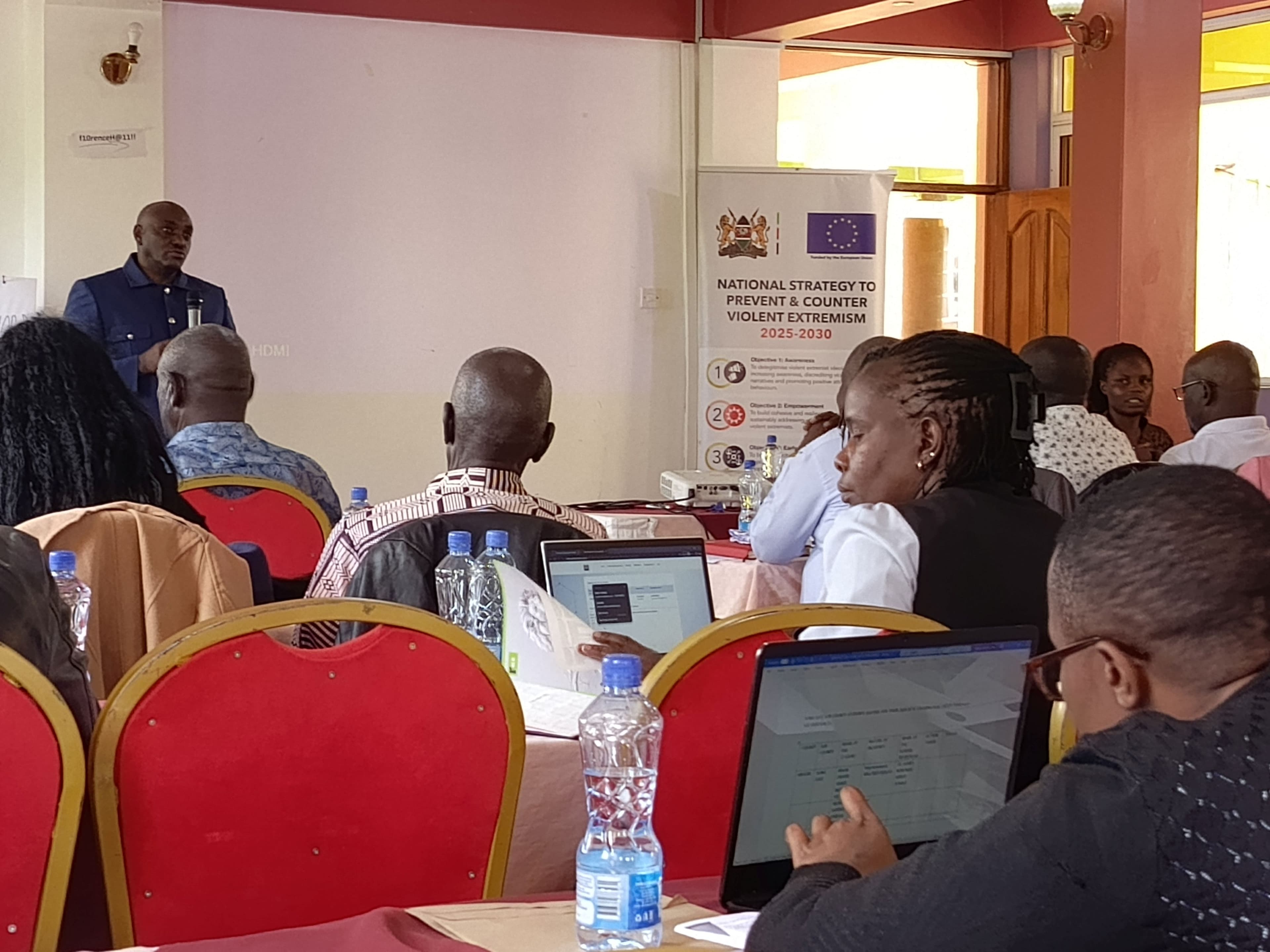
Migori County has begun developing local strategies to prevent and counter violent extremism through the implementation of the National Strategy to Prevent and Counter Violent Extremism (NSPCVE) 2025–2030.
The initiative seeks to translate the national policy into a practical County Action Plan (CAP) that addresses local security concerns, strengthens community resilience and promotes public participation in preventing radicalisation and terrorism.
The move was discussed during a three-day Migori County Engagement Forum (CEF) organised by the National Counter Terrorism Centre (NCTC), bringing together representatives from government departments, security agencies, civil society organisations, the county government, Bunge la Mwananchi and religious institutions.
Speaking during the forum, NCTC Head of Team Representatives Jennifer Chumba said the engagement was intended to equip stakeholders with the knowledge and capacity to localise the national strategy and develop interventions suited to the county’s circumstances.
She said the transition from the National Action Plan to a County Action Plan would enable stakeholders to identify local vulnerabilities and develop sustainable measures to prevent and counter violent extremism.
“We want to devolve the National Strategy to Prevent and Counter Violent Extremism from the National Action Plan to a County Action Plan to develop strategies that can be implemented to prevent and counter terrorism in Migori County,” Chumba said.
Although the county had not experienced major active terrorist threats, she said it was important to establish preventive mechanisms before extremist activities took root.
Chumba explained that the County Engagement Forum would provide a platform for stakeholders to identify emerging threats, develop early-warning systems and strengthen community awareness.
She added that localised interventions would help residents recognise signs of radicalisation and report suspicious activities to relevant authorities before they escalated into security incidents.
“The County Engagement Forum will help representatives create awareness within communities, detect early warning signs and develop responses to prevent violent extremism across the county,” she said.
Another NCTC official, Dan Mulunda, said combating terrorism should not be left solely to the police and intelligence agencies, stressing that communities had an equally important role to play.
He said involving residents in implementing the County Action Plan would strengthen public vigilance, protect vulnerable groups and help build safer communities.
Mulunda noted that the initiative would also examine factors that could make individuals, particularly young people, vulnerable to extremist recruitment.
These include unemployment, radical messaging and exposure to individuals or networks seeking to recruit young people into terrorist activities.
He said building trust between security agencies and communities would be central to the implementation of the national strategy, adding that cooperation would encourage residents to share information and participate in finding locally appropriate solutions.
Meanwhile, NCTC official Martin Kipchumba warned that terrorist organisations were increasingly exploiting digital platforms and decentralised networks to spread extremist ideologies and recruit supporters.
He observed that modern terrorism had evolved from the traditional model, in which charismatic leaders exercised direct control over organised groups, to networks that rely heavily on the movement of ideas, people and operational capabilities.
“Modern terrorism has become decentralised, engaging less in territorial capture but focusing more on ideas travelling, people travelling and capabilities travelling,” Kipchumba said.
He said the changing nature of terrorism required communities to remain alert to online radicalisation and the spread of extremist propaganda, particularly among young people.
Although Migori has not experienced widespread terrorist activity, several past incidents have demonstrated the need for sustained vigilance.
These include the reported prosecution in 2026 of an alleged Al-Shabaab recruiter from Kehancha in Kuria, an explosive incident in Kuria West in 2025, reported terrorist threats at Migori Teachers Training College in 2018 and the seizure of 305 explosives at Isebania in 2016.
Migori County Commissioner Kisilu Mutua, who officially opened the three-day forum, warned that localised political violence and organised criminal activities could create conditions that extremist groups might exploit.
He cautioned that goonism, if left unchecked, could evolve into more organised criminal and extremist networks, noting that some incidents in the county were linked to local political rivalries.
Mutua challenged religious leaders and community elders to avoid associating themselves with politicians who encourage violence and use criminal gangs to settle political scores.
He said community leaders had a responsibility to promote peace, tolerance and responsible political participation rather than legitimise violence.
The county commissioner also called on parents and guardians to provide proper guidance to children, saying positive upbringing and behavioural development were important in raising responsible citizens who could resist extremist influence.
He further urged residents to remain vigilant and report suspicious individuals and activities to the relevant security agencies.
Mutua said transforming the national strategy into a practical Migori County Action Plan would enable stakeholders to address specific security challenges through coordinated and sustainable interventions.
By Makokha Khaoya



Comments
No comments yet. Be the first to share your thoughts.