
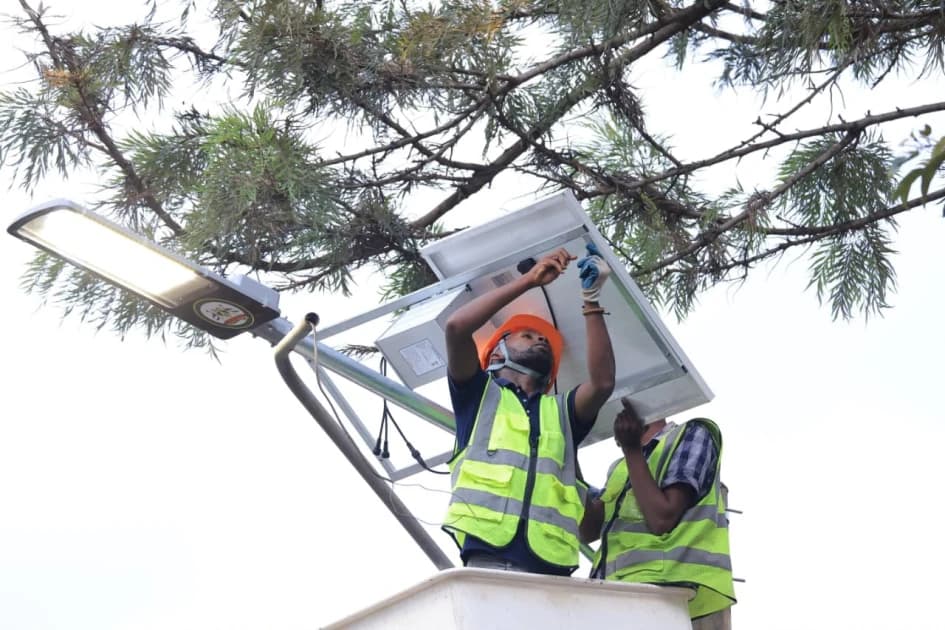
The ongoing rollout covers major highways, residential estates and informal settlements, with installation teams already working in Githogoro, along Gitanga Road towards Kawangware and Mbagathi Road, also known as Raila Odinga Highway.
Governor Johnson Sakaja said the programme would be extended to all 17 sub-counties, targeting poorly lit neighbourhoods to ensure residents across the city benefit from improved public lighting.
The initiative also includes the rehabilitation of approximately 50,000 faulty streetlights to restore lighting infrastructure in areas where existing installations are no longer functional.
Sakaja said the county was committed to creating a safer and more accessible Nairobi where residents could move around, access public transport and conduct business with greater confidence after dark.
The Governor further disclosed that the new solar-powered streetlights were being fitted with tracking devices to deter vandalism and protect public infrastructure.
“These lights are of no use to vandals. We have fitted them with trackers to help deter vandalism and protect this investment. I urge residents to take ownership of this programme and work with us in safeguarding the infrastructure. Keeping Nairobi lit is a shared responsibility,” Sakaja said.
He warned individuals involved in vandalising public lighting facilities that the tracking technology would make it easier to trace interference with the installations.
“The programme envisages the installation and rehabilitation of 100,000 lighting points across Nairobi. We want to light up the entire city, ensuring that residents in our estates, informal settlements and along major highways all benefit from reliable public lighting,” he said.
Sakaja added that improved street lighting would support security and transport while creating a more conducive environment for businesses operating at night.
“We want Nairobi to be a city where residents can walk, drive, work and do business with greater confidence, even after dark. Street lighting is not just about illumination; it is about security, mobility and creating an environment where economic activity can thrive,” he said.
The adoption of solar-powered lighting is also expected to reduce reliance on conventional electricity while extending public lighting to neighbourhoods where access to conventional power infrastructure has been challenging.
The county expects the expanded lighting network to benefit traders, transport operators, shops, restaurants and other businesses by improving visibility and creating safer conditions for operations after dark.
The rollout forms part of the county government's wider urban improvement agenda aimed at enhancing public safety, upgrading neighbourhood infrastructure and improving the accessibility of public spaces across Nairobi.



Comments
No comments yet. Be the first to share your thoughts.