
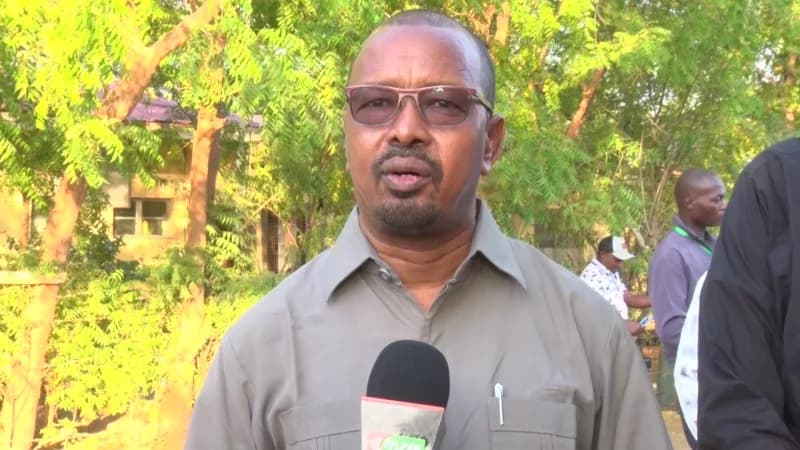
North Eastern Regional Director of Education Adhan Roble said adequate assessment materials had been distributed to schools across the region
North Eastern Regional Director of Education Adhan Roble speaking to the press./STEPHEN ASTARIKO

Education officials in the North Eastern region have assured learners, parents and other stakeholders that all preparations have been completed.
The officials said this will ensure the smooth administration of the Kenya Primary School Education Assessment (KPSEA) and the Kenya Junior School Education Assessment (KJSEA), despite security challenges in some parts of the region.
Speaking in Garissa Township during the opening of examination containers for the two assessments on Monday, Roble said the government had put in place logistical measures to ensure that all learners were able to undertake the assessments without disruptions.
“Everything has been put in place to ensure the smooth administration of the assessment. Adequate supplies have been distributed to schools, while government vehicles have been deployed to the counties and sub-counties to facilitate the transportation of assessment materials,” he said.
Roble noted that the government had also deployed helicopters to Mandera, Wajir and possibly Garissa to support the transportation of assessment materials to remote areas where insecurity and difficult terrain could pose logistical challenges.
He cited Mandera County as an example, saying all assessment materials had been successfully delivered to designated containers using helicopters because of the long distances involved.
“In Mandera, for instance, we have been informed that all the assessment materials were successfully delivered to the designated containers using helicopters because of the long distances involved,” he said.
The logistical arrangements are particularly important in parts of North Eastern Kenya that have previously experienced insecurity incidents, especially in areas bordering Somalia, where security concerns and the remoteness of some learning institutions can complicate the movement of essential supplies.
The deployment of additional transport resources is expected to help education officials overcome such challenges and ensure that learners in remote and border communities are not disadvantaged in accessing the assessments.
Director-General for Basic Education Elyas Abdi, who also spoke during the exercise, said teachers, supervisors and assessment managers had been adequately prepared to ensure compliance with the guidelines issued by the Kenya National Examinations Council (KNEC).
Abdi said field officers and KNEC personnel had briefed teams on the procedures governing the administration of the assessments, including the handling of mobile phones and the management of cases involving learners who might be absent.
“Our teams on the ground, including teachers, supervisors and managers, have been adequately briefed by our field officers and the Kenya National Examinations Council on the dos and don’ts of the assessment,” he said.
He explained that the briefings were intended to ensure that assessment personnel understood their responsibilities and followed the required procedures throughout the exercise.
Abdi added that guidelines had also been issued on how to handle assessment materials for learners who might fail to report for the exercise for various reasons, ensuring that such cases were managed in accordance with established procedures.
The Director-General called for a clear understanding of the changes introduced under the ongoing education reforms, noting that KPSEA and KJSEA were part of a competency-based system that places emphasis on assessing learners’ abilities and progress rather than relying solely on traditional examinations.
“This is an assessment, not an examination in the traditional sense, and it is not a high-stakes exercise. The education reforms have introduced significant adjustments to how assessments are conducted,” he said.
Abdi said the reforms were also designed to ensure that learners continued progressing through the education system, with measures in place to facilitate the transition of learners completing Grade 6 to Grade 7 and those completing Grade 9 to Grade 10.
He emphasised that the government had put in place arrangements to support a 100 per cent transition for learners completing the two levels, underscoring the commitment to ensuring that every learner continues with their education.
The assessments are being conducted as part of the implementation of the Competency-Based Education (CBE) system, which seeks to evaluate learners’ knowledge, skills and competencies at different stages of their education.
The successful administration of KPSEA and KJSEA in North Eastern will depend on the coordination of education officials, security agencies, school administrators and other stakeholders, particularly in areas where distance and insecurity have historically presented challenges.
Officials said the measures taken ahead of the exercise were aimed at ensuring that learners across the region, including those in hard-to-reach border areas, undertake their assessments under the established guidelines.
Director-General for Basic Education Elyas Abdi./STEPHEN ASTARIKO

Director-General for Basic Education Elyas Abdi hands over examination materials to a teacher./STEPHEN ASTARIKO



Comments
No comments yet. Be the first to share your thoughts.