
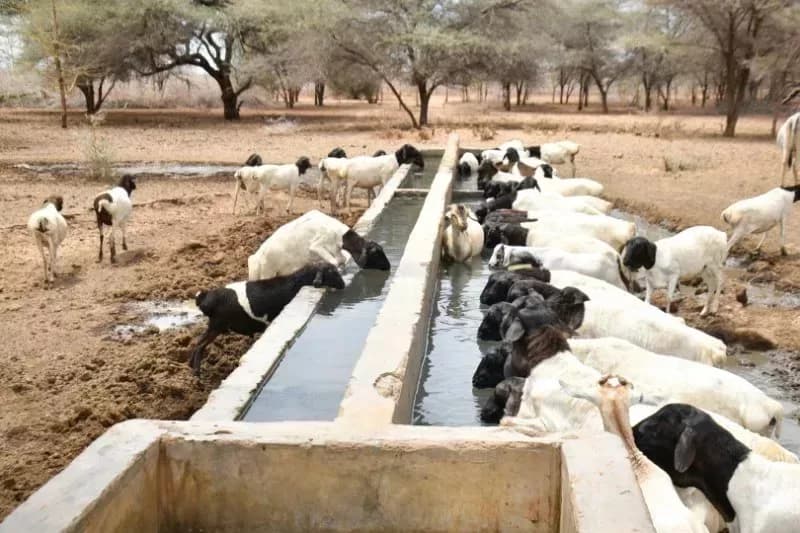
Goats and sheeps taken to a watering point in Afuene, Lagdera sub county.

Extreme heat threatened Sh70.84 billion in potential Kenyan earnings in 2025, while the annual monetary value of heat-related deaths among people over 65 rose 273 per cent, a new report shows.
The 10th indicator report of the Lancet Countdown on Health and Climate Change estimates that heat-related mortality among older Kenyans had an average annual monetised value of Sh62.13 billion between 2021 and 2025, compared with the 2000–2004 period.
The report, due to be launched on Wednesday, warns that rising temperatures are increasingly threatening the health, livelihoods and productivity of vulnerable populations.
It estimates that heat exposure caused an average loss of 1.3 billion potential labour hours annually in Kenya between 2016 and 2025, 229 per cent higher than the annual average in the 1990s.
Agriculture accounted for about 83 per cent of the lost labour hours, highlighting the exposure of workers who depend on outdoor activities for their livelihoods.
The report also estimates that reduced labour capacity caused by heat resulted in a potential earnings loss of Sh70.84 billion in 2025, equivalent to about 0.4 per cent of Kenya's gross domestic product.
Agriculture accounted for 64 per cent of the potential earnings losses.
The findings suggest that the impact of extreme heat extends beyond illness and premature deaths, affecting household incomes, food production and economic activity.
According to the report, 99.6 per cent of the heatwave days Kenyans experienced on average between 2021 and 2025 were directly attributable to climate change.
Children under one year and adults aged over 65 experienced an average of about five heatwave days annually during the period, approximately four more days a year than between 1986 and 2005.
The report warns that older people, young children, pregnant women and those with pre-existing health conditions face the greatest risks from high temperatures.
It also highlights the growing threat of extreme drought in Kenya, which threatens water availability, food security and livelihoods.
The findings form part of a wider assessment of how climate change is affecting health globally, including through heat-related deaths, reduced worker productivity, extreme weather events and pressure on essential services.
Globally, heat was linked to an estimated average of 540,800 deaths annually between 2016 and 2023. Of these, about 68 per cent, or 369,900 deaths a year, were attributed to human-caused climate change, up from 55 per cent in 2006–2015.
In 2023, heat was linked to an estimated 710,000 deaths worldwide, with about 71.5 per cent attributed to climate change.
The report also estimates that heat reduced workers' productive capacity globally in 2025, resulting in Sh139 trillion in potential income losses, equivalent to 0.91 per cent of global economic output.
Despite the worsening impacts, the report notes progress in the transition to cleaner energy. Global investment in clean energy reached a record Sh273 trillion in 2025, nearly twice the amount invested in fossil fuels.
The report estimates that declining air pollution from fossil fuels since 2016 has prevented about 323,000 deaths annually in at least 77 countries.
However, fossil fuels still account for more than 80 per cent of global energy supply, while production plans by the world's 100 largest oil and gas companies remain far above levels compatible with limiting global warming to 1.5 degrees Celsius.
The researchers are calling for climate change to be formally recognised and addressed as a global health emergency, with health considerations placed at the centre of climate policies and funding decisions.
“A decade after the Paris Agreement, our findings are unambiguous: the health harms of climate change are growing faster than the world's response to them, and in many cases even accelerating,” Prof Marina Romanello, executive director of the Lancet Countdown at University College London, said.
She said progress in clean energy, health system preparedness and health-protective regulation was delivering benefits, but remained insufficient to protect the most vulnerable.
World Health Organisation director-general Tedros Adhanom Ghebreyesus said climate change was already affecting health through worsening heat stress, extreme weather, food insecurity and disease.
He said placing health at the heart of climate policies could save lives and help build more resilient communities.



Comments
No comments yet. Be the first to share your thoughts.