
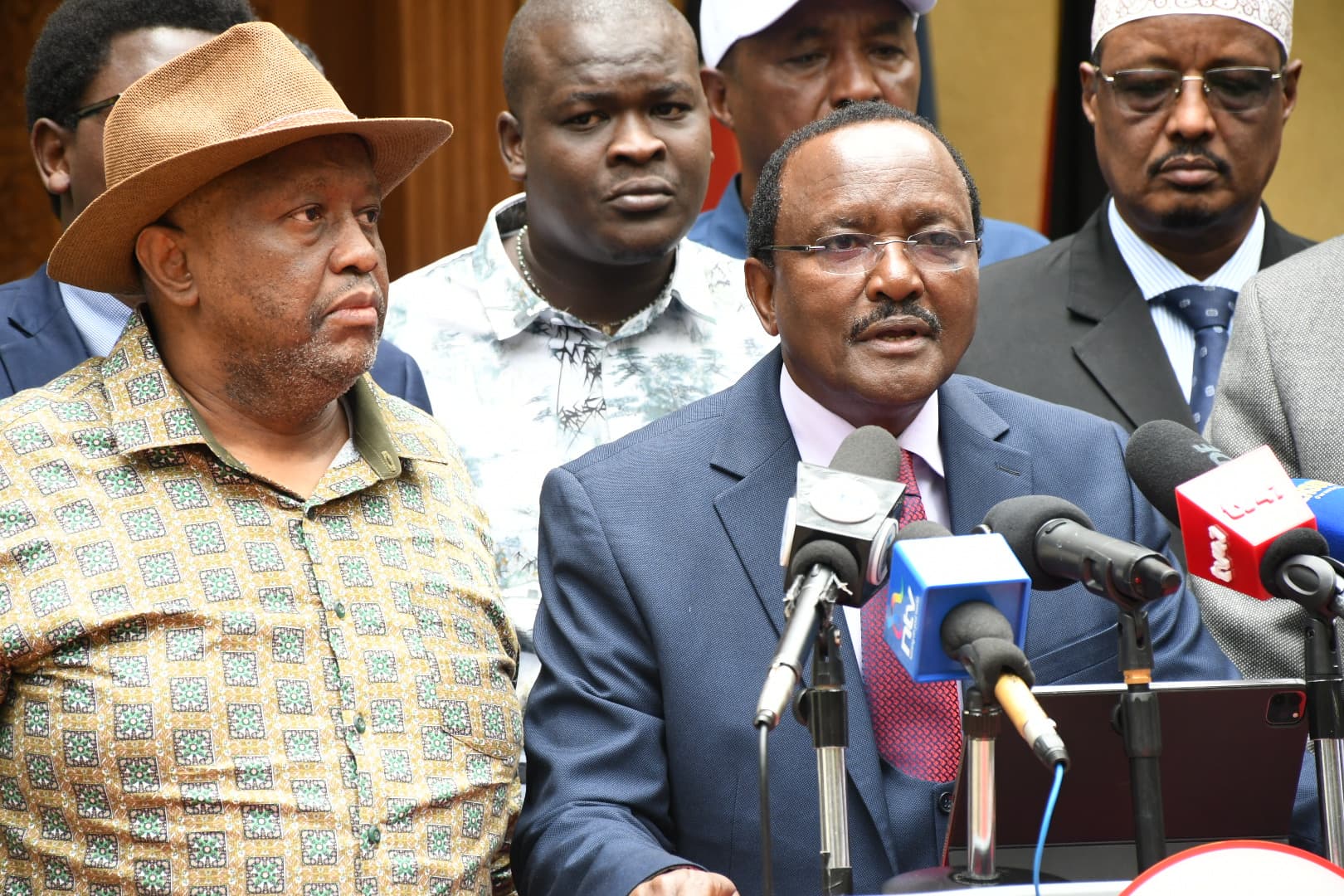
Opposition leaders have welcomed the High Court decision nullifying the sale of a 15 percent stake in Safaricom Plc, describing the ruling as a victory for Kenyans and a reaffirmation of constitutional safeguards in the management of public assets.
Speaking in Nairobi on Wednesday, Wiper Party leader Kalonzo Musyoka reported that the three-judge bench had declared the transaction unconstitutional, null and void, and ordered the shares to be restored to the government on behalf of the people of Kenya.
He said the court had quashed the transaction and related approvals, arguing that the process had failed to meet constitutional and legal requirements.
Musyoka alleged that there was inadequate public participation in the transaction, claiming that the government had selected the buyer, negotiated the agreement and determined the price before consulting Kenyans.
He further alleged that the buyer was changed during the process without adequate disclosure to the public, while key transaction documents were concealed.
According to Musyoka, the transaction also involved the improper procurement of transaction advisers, contrary to requirements under the Public Procurement and Asset Disposal Act.
He disclosed that the Government sold 6.01 billion Safaricom shares, representing 15 percent of the company, at Sh34 per share, translating to Sh204.3 billion.
Equally, Musyoka claimed the Treasury also received Sh40.2 billion as an advance against future dividends on the 20 percent stake retained by the Government, bringing the total amount involved to Sh244.5 billion.
He also questioned the valuation process used to determine the price of the shares, saying the government had not disclosed the methodology used to arrive at the figure.
Importantly, Musyoka described Safaricom as a strategic national asset because of its role in telecommunications, mobile money and the economy, noting that its services are used by millions of Kenyans.
In addition, he revealed that the court had also raised concerns over the absence of a national security impact assessment in relation to the transfer of control of a strategic asset to a foreign entity.
However, Musyoka cautioned against any attempt to transfer, encumber or exercise rights over the affected shares in defiance of the court decision, saying such action could attract legal consequences.
He ultimately thanked the petitioners, Civil Society Organisations and Kenyans who participated in the legal challenge, describing the outcome as a victory for present and future generations.
While backing the remarks, Democratic Party of Kenya (DP) leader Justin Muturi congratulated the petitioners and other groups involved in the case, reiterating that the outcome belonged to the people of Kenya and future generations.
Muturi stated that Kenyans needed to remain vigilant because, in his view, several institutions of governance were under strain.
He said the Judiciary remained an important constitutional safeguard and that the ruling demonstrated that Kenya continued to have functioning democratic institutions.
“We need vigilance. We remain vigilant, more particularly where it comes to matters of the economy of the country,” Muturi urged.
Muturi also raised concern over Government plans involving public corporations, alleging that the administration intended to dispose of a large number of parastatals.
He pointed out that some 68 government parastatals were targeted for sale, with 18 having already been subjected to valuation processes, and warned against similar transactions being undertaken without adequate constitutional and legal safeguards.
Nevertheless, Muturi affirmed that the opposition would remain steadfast in scrutinising such transactions, adding that opposition was not equivalent to rebellion.
Petitioner Tony Gachoka, who was among those who challenged the Safaricom transaction, described the High Court decision as an important victory in the protection of public assets.
Gachoka accused the government of attempting to dispose of national assets and said the ruling had demonstrated that such transactions could be subjected to judicial scrutiny.
He criticised President William Ruto’s administration over the Safaricom transaction and described it as a ‘heist’, while accusing the government of failing to protect the interests of Kenyans.
Gachoka also praised Musyoka’s role in the opposition’s campaign against the transaction, saying the Safaricom case had demonstrated the importance of challenging decisions involving public resources.
He vowed the opposition would continue to scrutinise government transactions and hold those responsible to account.
In a quick rejoinder, Musyoka reaffirmed that the opposition would continue scrutinising transactions involving strategic national assets, citing the ongoing court matter concerning the Kenya Pipeline Company.
He also linked the issue to the 2027 General Election, urging Kenyans to register as voters and remain vigilant.
“On 10 August 2027, we will answer at the ballot box,” Musyoka declared.
Meanwhile, the opposition leaders’ remarks came a day after the High Court declared the Safaricom share transaction invalid and ordered restoration of the 15 percent stake to the government on behalf of Kenyans.
The Government has indicated that it will appeal the decision, setting the stage for further legal proceedings over the transaction
By Aron Kinyamasyo

Comments
No comments yet. Be the first to share your thoughts.