
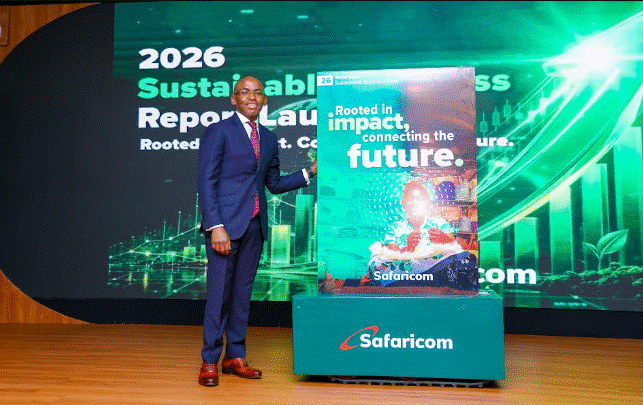
Safaricom has created Sh1.25 trillion in value for Kenyan society in the year to March 2026, up 10 percent from the previous year, according to the company’s 15th Sustainable Business Report.
The value reflects Safaricom’s wider contribution to the economy and society through its operations, digital and financial services, infrastructure investment, employment, and livelihoods supported across its ecosystem, as well as investment in communities.
For customers, this impact is reflected in the affordability and accessibility of services with non-chargeable M-PESA transactions accounting for over half of total transaction volumes during the year.
“Our impact is measured not only by what we earn, but by the value we create for society. More than half of M-PESA transaction volumes attracted no customer charge, helping millions of Kenyans transact affordably and participate in an increasingly digital economy,” Group Chief Executive Officer (CEO), Safaricom Peter Ndegwa emphasized.
Ndegwa noted that Safaricom’s ecosystem sustained more than 1.4 million jobs during the year, including livelihoods supported through its network of M-PESA agents, dealers, suppliers, and other partners.
He observed that M-PESA continued to expand access to financial services, enabling customers to transact, save, invest and access credit.
“The social value created by M-PESA was estimated at KES 478.1 billion in FY26,” announced the CEO, adding that beyond financial inclusion, Safaricom continued to invest in connectivity to bring more Kenyans into the digital economy including democratizing Fixed data business by launching more affordable customer propositions.
“As we grow into a technology company, we want every Kenyan to have the opportunity to participate in the digital economy. That means reliable connectivity, affordable access, and the skills to use technology to improve their lives,” stated Ndegwa.
Further, he reported that the company’s social impact also extended into communities, with 4.4 million lives impacted through Safaricom and M-PESA Foundation programmes in areas including health, education, economic empowerment, water, and environmental conservation.
On the environment, Ndegwa mentioned that Safaricom continued to reduce the environmental footprint of the network that keeps Kenyans connected.
“More than 2,000 network sites were running on solar power in FY26, compared with 1,432 in FY25, while its tree-growing programme reached 3 million trees,” revealed the CEO.
He equally pointed out that Safaricom also maintained its focus on building an inclusive workplace, with persons with disabilities accounting for 4 percent of its workforce, against a target of 5 percent.
For the first time according to the CEO, Safaricom has transitioned its sustainability disclosure framework to a double materiality approach.
This, he explained, assesses how the company’s activities affect people and the environment, and how sustainability issues such as climate change, fraud, and cybersecurity could affect the long-term value and resilience of the business.
Additionally, he disclosed that the company is preparing for mandatory sustainability reporting requirements in Kenya and aims to fully comply with the applicable IFRS sustainability disclosure requirements by FY28.
“Our commitment is to create lasting value for our customers, communities, investors and the planet. As technology becomes more central to people’s lives, we have a responsibility to ensure that growth and innovation create opportunity, strengthen trust, and leave society better off,” Ndegwa reaffirmed.
by Michael Omondi
Comments
No comments yet. Be the first to share your thoughts.