
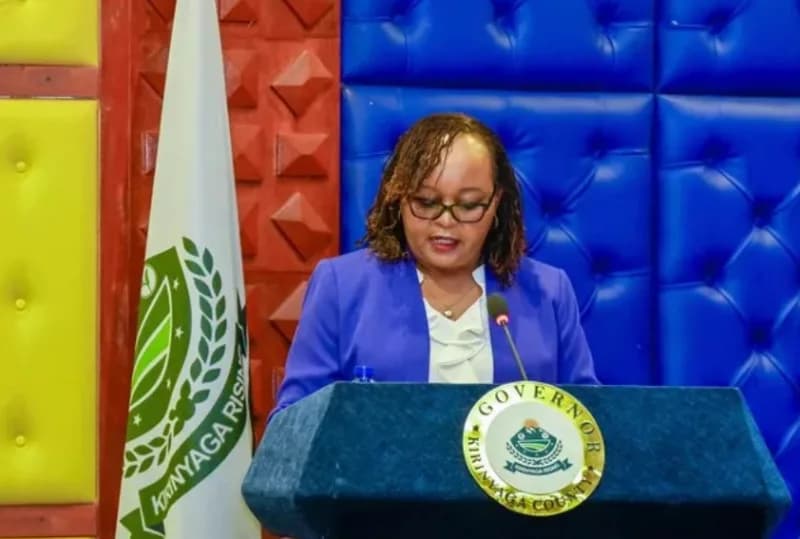
Kirinyaga Governor Anne Waiguru when she delivered my final State of the County Address on Tuesday

Kirinyaga Governor Anne Waiguru has defended her nine-year development record, citing improved healthcare outcomes, increased agricultural earnings, expanded infrastructure and declining poverty as she delivered her final State of the County Address.
Waiguru said the county's economy had grown from Sh114.9 billion in 2017 to Sh190.79 billion, recording real growth of 8.7 per cent in 2025, which she attributed to sustained investment, prudent resource management and disciplined implementation of development programmes.
Quoting the saying that excellence is not an act but a habit, the Governor said her administration had deliberately pursued long-term interventions rather than isolated projects.
"This principle has shaped our administration since 2017. We understood from the outset that meaningful and lasting transformation would not come through isolated interventions, but through sustained effort, prudent management of resources, strategic planning and disciplined implementation," she told the County Assembly.
Healthcare emerged as one of the key pillars of her administration's legacy, with maternal mortality declining from 88 deaths per 100,000 live births in 2017 to 49 in 2026, while neonatal mortality dropped by more than half, from 26 to 11 deaths per 1,000 live births.
The county has also achieved 92 per cent skilled birth attendance and maintained childhood immunisation coverage at 92 per cent, achievements Waiguru said had earned Kirinyaga national recognition.
The Governor attributed the improvements to investments in healthcare infrastructure, medical equipment, technology and human resources, including the recruitment of 230 healthcare workers over the last five years.
Her administration also recruited and deployed 1,222 community health promoters to strengthen preventive healthcare and bring essential services closer to households.
Kerugoya County Referral Hospital has expanded its capacity from 220 to 450 beds, with residents now accessing specialised services including renal dialysis, CT scans and digital X-rays within the county.
The county's healthcare network has grown to 72 facilities, while the completed Kimbimbi and Kenyatta medical complexes are expected to provide an additional 260 inpatient beds once operational.
Waiguru further reported that 99 per cent of people living with HIV in the county know their status, with more than 99 per cent of those identified receiving antiretroviral treatment.
She said the county had also strengthened its fight against tuberculosis, achieving a 91 per cent treatment success rate, while malaria transmission remained below one per cent.
Household registration under the Social Health Authority has reached approximately 76 per cent, placing Kirinyaga among the country's top four counties, according to the Governor.
Agriculture, which contributes approximately 42 per cent of Kirinyaga's Gross County Product and supports 87 per cent of its population, was another major highlight.
Waiguru said her administration had supported more than 100,000 farming households through organised farmer groups, value-chain development and access to affordable financing.
Rice production has more than tripled, rising from 65,000 metric tonnes in 2017 to 210,000 metric tonnes annually, generating approximately Sh16 billion for farmers.
Tomato production has also increased from 46,000 to 116,000 metric tonnes, generating an estimated Sh6.9 billion annually.
Coffee production rose from 28,000 metric tonnes to 49,100 metric tonnes in the 2025/26 financial year, generating Sh7.48 billion in sales.
The Governor said average farmer payments had increased from about Sh40 to Sh139 per kilogramme of coffee cherry, with some factories paying as much as Sh157.
In the dairy sector, milk production per cow has increased from an average of 2.5 litres to approximately eight litres daily, translating to an estimated 86 million litres annually, valued at Sh3.1 billion.
The county has additionally supported poultry farmers, distributed more than 120,000 avocado seedlings and expanded aquaculture, beekeeping and dairy goat farming.
To encourage youth participation in agriculture, the administration has developed the Wesesha Kirinyaga Youth Agribusiness Mentorship Programme, backed by a targeted investment of Sh61.4 million.
Beyond agriculture and healthcare, Waiguru reported that household access to water had increased from 48 to 74 per cent, reaching an additional 53,000 households.
Her administration has also graded 7,616.5 kilometres of roads and gravelled another 2,730.5 kilometres, while own-source revenue has grown from Sh344.4 million to Sh1.11 billion.
The county has constructed 18 markets and aggregation centres providing trading space for approximately 5,400 traders, with another 12 markets secured through partnerships with the national government.
Waiguru said the combined interventions had contributed to reducing poverty levels to 21 per cent, with an estimated 52,000 households lifted out of poverty.
As she approaches the end of her tenure, the Governor said the focus was on completing ongoing projects and consolidating the gains made over the past nine years.
"Every achievement raises new expectations and every milestone presents an opportunity to reach even greater heights," she said.


Comments
No comments yet. Be the first to share your thoughts.