
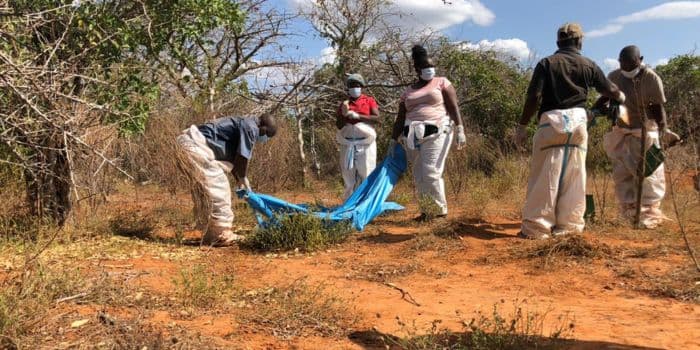
Shakahola exhumations valid despite absence of forensic archaeologist, judge rules

Justice Kavedza said the operation was a criminal investigation triggered by reports of suspected murders following the discovery of graves, rather than an archaeological exercise.
The absence of a forensic archaeologist from the team that exhumed bodies at Shakahola did not invalidate the exercise or compromise the reliability of the evidence, Justice Diana Kavedza has ruled, rejecting arguments that the investigation was defective because it lacked specialists trained in forensic archaeology.
In her judgement at the Mombasa High Court, Justice Kavedza said the operation was a criminal investigation triggered by reports of suspected murders following the discovery of graves, rather than an archaeological exercise intended to reconstruct the history of a site or study an ancient society.
“The absence of a forensic archaeologist from the multidisciplinary team did not, in the court’s view, skip, neglect, leave unfulfilled, or compromise any essential forensic function necessary to the integrity of the exercise,” the judge said.
She added that the team was qualified and sufficiently constituted to carry out the exercise, which involved the recovery and preservation of human remains, identification of bodies and determination of the causes of death.
The judge explained that archaeology involves the systematic examination and interpretation of material remains, including graves, structures, artefacts and other physical features, to reconstruct aspects of past human activity.
She said the mere fact that an operation involves the excavation of a grave does not mean that every aspect of the exercise falls exclusively within the province of an archaeologist.
Latest Stories
“The question that begs an answer is whether the absence of an archaeologist among the forensic analysts invalidates the entire process. In the court's view, it does not,” she said.
Justice Kavedza noted that the Shakahola operation was fundamentally different from archaeological work because its immediate objective was to establish the circumstances in which people had died, were dying and were being buried without the involvement of their families and government authorities.
The investigation began after PW1 was assaulted at Shakahola Forest while attempting to rescue his grandson. He was accompanied by police officers to the scene, where they encountered emaciated people and numerous graves.
The discovery prompted the expansion of the investigative team to include forensic experts.
According to the judge, the operation involved personnel with specialised skills, including pathologists, forensic imaging experts, scenes of crime officers, government analysts, survivors, nutritionists and investigators.
Justice Kavedza acknowledged that forensic archaeology can be used in criminal investigations involving buried human remains, particularly in locating, excavating and documenting graves. However, she said the central issue was whether the absence of an archaeologist made the Shakahola recovery exercise unreliable.
She said the court had to examine the nature of the investigations and the functions performed by individual analysts before determining whether the team had been properly constituted.
The judge acknowledged that a more extensive multidisciplinary team incorporating a forensic archaeologist would have been desirable and could have represented best practice in an ideal forensic investigation.
“That, however, is not the test,” she said.
“The question is whether the composition of the team was such that the reliability of the recovery, examination, and identification of the remains was materially compromised. I find that it was not.”
She said the evidence showed that the functions relevant to the exercise had been assigned to specialised personnel and that their work was documented and verified at different stages.
“In conclusion, it is the court’s finding that the absence of a forensic archaeologist or any other specialist identified by Dr did not, without more, render the exercise defective. Neither does the court find that the teams were improperly constituted,” Justice Kavedza said.
Comments
No comments yet. Be the first to share your thoughts.