
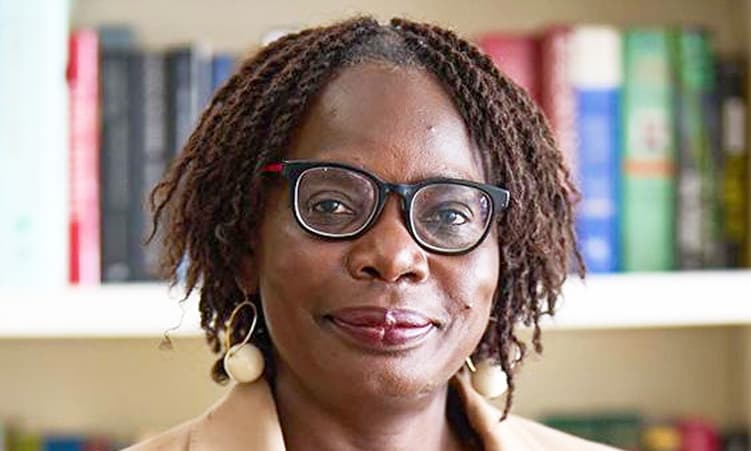
Kenya nominated her for election to the UN International Law Commission (ILC) in May 2021

Kenya has yet again made a significant step on the international stage after Prof Phoebe Okowa was elected to the International Court of Justice (ICJ) for a full nine-year term after securing the required majority votes in both the United Nations General Assembly and the Security Council o Tuesday.
Okowa was among nine candidates competing for five positions in elections held simultaneously by the two UN organs on Tuesday.
The other four judges elected alongside Okowa are Professor Dapo Akande of the United Kingdom, François Alabrune of France, Mahmoud Daifallah Hmoud of Jordan and Rena Lee of Singapore.
Akande is a professor of Public International Law at the University of Oxford and a member of the UN International Law Commission.
Alabrune is a French legal expert and diplomat, while Hmoud is an incumbent ICJ judge who was first elected in 2025 to fill a vacancy.
Lee is Singapore’s Ambassador for International Law and previously led negotiations that resulted in the UN agreement on the conservation and sustainable use of marine biodiversity in areas beyond national jurisdiction.
The five successful candidates will begin their terms on February 6, 2027, serving until 2036 on the 15-member court based in The Hague, Netherlands.
Her election secures Kenya’s continued representation on the world’s principal judicial organ, where she has been serving since November 2025 after winning a by-election to fill the vacancy left by Somali judge Abdulqawi Ahmed Yusuf, who resigned.
The earlier election gave her a temporary mandate running until February 5, 2027, prompting Kenya to mount a fresh diplomatic campaign to secure her a full term.
In a congratulatory message, Foreign Affairs Principal Secretary Korir Sing’oei said her election reflected the international community’s confidence in her ability to serve the court at a consequential time.
Sing’oei thanked members of the UN General Assembly and Security Council for supporting her candidature. He also acknowledged Sierra Leone, Korea and Ecuador for withdrawing their candidates after the third round of voting, saying the move helped avert a prolonged electoral process.
He congratulated the other judges elected from the United Kingdom, France, Singapore and Jordan, and thanked the teams that supported Okowa’s campaign.
President William Ruto has also congratulated Professor Okowa following her election. In a message, Ruto described her election as a moment of great pride for Kenya, saying it affirmed the country's contribution to international legal affairs.
"Your election is a moment of great pride for Kenya and a powerful affirmation of the depth of legal expertise, integrity and excellence that our country continues to contribute to the international community," he said.
Ruto wished Okowa success as she prepares to take up the responsibility, expressing confidence in her role in advancing the court's mandate.
He said he hoped she would discharge her duties with diligence while supporting the ICJ's mission of upholding international law and promoting the peaceful resolution of disputes among nations.
"Kenya is proud of you," Ruto said.
The Permanent Mission of Kenya informed Djibouti, as the coordinator of the Eastern African sub-region on candidatures, of the nomination in a letter dated February 27.
According to the letter, Okowa’s nomination was made by the Kenya National Group to the Permanent Court of Arbitration (PCA).
"Kenya is convinced that Okowa is competent and well qualified to contribute to the work of the ICJ," the letter reads in part.
Kenya then formally requested Djibouti to circulate the nomination to the African Group to ensure broad regional support.
Okowa’s nomination followed Kenya’s recent bid for the African Union Commission (AUC) chairperson's seat.
Former Prime Minister Raila Odinga lost the election to Djibouti's Mohamoud Youssuf.
WHO IS PROF PHOEBE OKOWA?
Prof Okowa is a lawyer, professor of Public International Law and Director of Graduate Studies at Queen Mary University of London.
In 2021, she was elected to the International Law Commission for a period of five years, starting January 1, 2023, becoming the first African woman to serve as a member of the Commission.
In 2016, she was appointed a member of the Permanent Court of Arbitration at The Hague by Kenya.
An advocate of the High Court of Kenya, she has acted as counsel and consultant to governments and non-governmental organisations on questions of international law before domestic and international courts, including the ICJ.
She was co-nominated by the United Kingdom and endorsed by the African Union.
Okowa received 162 votes in the United Nations General Assembly. The ILC is a body of experts responsible for helping develop and codify international law.
Under the ILC Statute, its members “shall be persons of recognised competence in international law.”
It is composed of 34 individuals who are elected by the United Nations General Assembly for a five-year term.
Okowa was born in Kericho on January 1, 1965.
She graduated at the top of her class with a Bachelor of Laws (LLB) degree with First Class Honours from the University of Nairobi in 1987.
Okowa was the first woman to be awarded a First Class Honours degree in the history of the Faculty of Law at the University of Nairobi.
She was called to the Kenyan Bar as an advocate in 1990.
Okowa then studied at Wadham College, Oxford, on a Foreign and Commonwealth Office Scholarship, obtaining a Bachelor of Civil Law (BCL) degree in 1990.
She completed her doctoral thesis (D.Phil.) at Oxford in 1994 under the supervision of Professor Sir Ian Brownlie, the Chichele Professor of International Law.
Comments
No comments yet. Be the first to share your thoughts.