
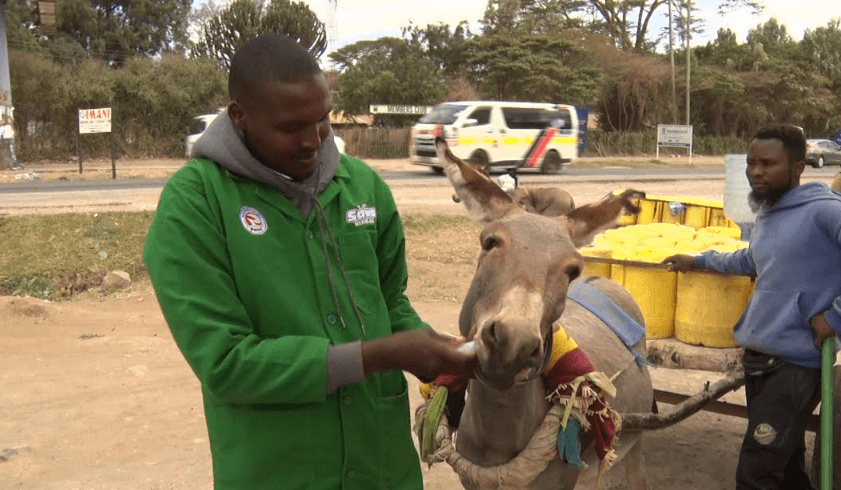
Sixty donkey owners from Nakuru, Naivasha, and Narok townships have undergone training on entrepreneurship and animal welfare aimed at maximizing the economic value of their animals while safeguarding them as sustainable sources of livelihood.
The initiative, supported by Farming Systems Kenya (FSK) in conjunction with Brooke East Africa, seeks to change perceptions of donkeys from mere beasts of burden to valuable economic assets that support rural and urban entrepreneurs.
According to FSK Project Officer, Community Development, Samuel Chege, the donkey owners were trained on humane handling, proper harnessing, feeding, hydration, and wound prevention.
Speaking during an event at the William Ole Ntimama Stadium in Narok town, which also featured a sports tournament for donkey owners from the three regions, Chege said simple improvements in the way donkeys are handled can prevent injuries, ease their workload, and improve their overall welfare.
“When donkeys experience welfare concerns such as carrying heavy loads over long distances, poor harnessing, wounds, parasites or lack of veterinary care, the families who rely on them feel the effects too. A weakened donkey can mean missed market days, lost income, reduced food security and greater hardship for households already living close to the margins,” said Chege.
He said the project combines peer-to-peer learning sessions on youth opportunities, entrepreneurship, livelihood development, sporting activities, and positive lifestyle skills with veterinary access, community support, and practical animal welfare interventions.
“Our project combines peer-to-peer exchange learning sessions on youth opportunities, entrepreneurship training, livelihood development, sporting activities and positive lifestyle skills, veterinary access, community support and practical improvements to create sustainable change,” he said.
“Together, these activities strengthen the link between family well-being and donkey welfare, helping animals and communities thrive side by side.”
Through the initiative, local animal health providers have also received specialist training in donkey medicine, mentorship, and links to veterinary suppliers. Organizers said the interventions are intended to ensure that donkey owners can access appropriate treatment and veterinary services sustainably within their communities.
Chege said supporting donkey owners to embrace entrepreneurship and increase their incomes would empower them to provide better care for their animals while addressing some of the underlying economic pressures that contribute to poor animal welfare.
“We also used the forum to raise awareness of welfare policies, the risks of the illegal skin trade, and the economic value of donkeys. This will help to shift attitudes, strengthen community voices, and influence local policies in favour of donkey protection,” he said.
He added that sporting activities provide an effective platform for sensitising communities, particularly young donkey owners, about the economic importance of donkeys and the need for compassionate care.
The owners were encouraged to provide proper shelter, seek veterinary attention when necessary, and avoid practices that expose the animals to cruelty, injuries, and unnecessary suffering.
The session brought together officials from the Narok County Department of Youth Affairs, the Youth Enterprise Development Fund, the Uwezo Fund, and other stakeholders, who shared information on enterprise opportunities, financial support, skills development, and youth empowerment.
Chege said young donkey owners who are equipped with knowledge, skills, and better livelihood opportunities are more likely to invest in responsible animal welfare.
Dr. John Nadokila, a veterinary surgeon attached to FSK, said the training is part of a broader strategy that prioritises strong partnerships, community-led change, improved training for animal health providers, and greater recognition of donkeys in policies and everyday life.
Nadokila said a well-fed, well-rested and stress-free donkey is more productive and can provide better returns to its owner.
He noted that donkey owners are also facing the serious threat of animal theft linked to the illegal international skin trade. To address the problem, the entrepreneurship training included technological approaches to animal identification and security.
Owners were introduced to tools such as microchips, artificial intelligence-based tracking systems, and digital registry mobile applications to help them identify and protect their animals.
“People should protect this resourceful animal; it is our hero. Donkeys help us a lot with water transport, which is key to rural livelihoods. Apart from water transport, the donkey has been crucial in transporting sand for construction, as well as transporting farm produce,” said Nadokila.
His sentiments were echoed by Cynthia Kioko, a Community Development Officer at FSK, who said donkeys play an important role in communities across cultural, economic, and social settings.
“People should understand that if we take away donkeys in our communities, we put the load on the women. That means that they will take more time to work and have less time to raise their own families,” said Kioko.
She said the contribution of donkeys extends beyond transport, noting their role in agricultural supply chains and household livelihoods.
“People should understand that the donkey is not just an animal but plays a key role in our communities,” she said.
Kioko noted that donkeys support the transportation of milk from farms to dairies, as well as vegetables such as potatoes and onions in hilly and difficult-to-access areas.
She also said donkeys have helped thousands of students access education by transporting water and other household necessities, although their contribution has often gone unrecognised.
“Despite earning thousands of students’ respect by enabling them to access education with ease, the donkey has been denied its rightful share of respect, let alone being embraced,” she said.
For Joseph Kabugi, a donkey owner from Naivasha, the animals have been central to his economic success and family well-being.
Kabugi said his donkey transport business enabled him to establish a small-scale enterprise that later became his main source of income. The earnings have helped him build rental houses and educate his children.
“My donkey transport business has helped me a lot. I’m where I am now because of the donkey. It has helped me open a medium enterprise, which remains my main source of income where my family makes a living as well as educates my children,” he said.
Kabugi said he opened his first shop using proceeds from the donkey transport business.
“I make at least Sh2,000 per day through the donkey business, with my workers taking home half the daily returns. Until now, all my children are in school,” he said.
According to a 2024 report by the Kenya Agricultural and Livestock Research Organization, each working donkey generates an average of Sh11,390 per month, highlighting the animal’s contribution to household incomes and livelihoods.
Kabugi said the donkey continues to play a significant role in Kenya’s agricultural and economic activities and called on county governments to strengthen measures aimed at protecting donkey owners and their animals.
“Despite the ban on donkey slaughterhouses, donkey farmers in rural areas are still losing their tool of trade,” he said.
He said the continued theft of donkeys and the commercial demand for their skins remain a major concern for communities that depend on the animals for their livelihoods.
FSK said donkeys in many parts of Africa face challenges including low fertility, inadequate management, poor nutrition, limited access to veterinary services, and inbreeding.
The organisation said commercial slaughter of donkeys for skin and meat has also increased pressure on populations, raising concerns about their long-term sustainability.
Karanja Ng’eno, a donkey owner from Njoro Sub-County in Nakuru, said the training had improved his understanding of caring for pregnant donkeys.
“We have been sensitized on how to care for a pregnant donkey to ensure that they have good nutrition and good rest, which requires that they work fewer hours and that we also care for their emotional status,” said Ng’eno.
He said proper care during pregnancy improves the chances of a healthy foal and helps maintain the health of the mother.
“By doing these things, then you are helping the donkey throughout its gestation period; hence, this will guarantee a good foal being born,” he said.
However, Ng’eno said donkey breeding is a long-term undertaking and does not produce offspring annually.
“Donkey breeding takes years. I have been a donkey farmer for the last 15 years, and all my three donkeys have given birth thrice because that’s how they are wired. The idea of donkey breeding on a large scale is a big lie,” he said.
He said the decline in donkey populations is a concern for communities that rely on the animals for transport, agriculture, and income generation.
Ng’eno said the contribution of donkeys to household livelihoods is often overlooked despite their role in reducing the burden of domestic work, particularly for women.
“In Kenya, this underrated animal has restored the woman’s position in the community by propelling the financial independence of women’s Saccos, helping women make ends meet without over-dependence on their husbands, as well as helping widows raise their families,” he said.
He added that donkeys have helped reduce the amount of physical labour required from women by carrying water and other heavy loads, giving them more time for household responsibilities and economic activities.
According to the participants, the animal also contributes to education by helping families complete household chores more efficiently and enabling children to have more time to study.
By Emily Kadzo
Comments
No comments yet. Be the first to share your thoughts.