
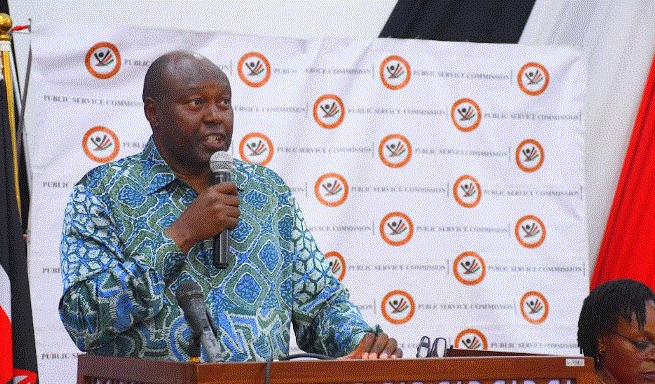
Public Service Commission (PSC) Chairperson Francis Meja has asked Chief Executive Officers of State Corporations and Vice-Chancellors of public universities to declare vacancies and meaningfully engage interns, as the government plans to expand the Public Service Internship Programme (PSIP) from 8,000 to 50,000 interns in January 2027.
State corporations were urged to mentor the interns; the PSC Chairperson disclosed that previous intakes saw unfortunate incidences in which some interns were reduced to office messengers.
“The purpose of this programme is to prepare these young people for the job market. They are professionals in their own right, and reducing them to messengers is really missing the bigger point. Kindly help us address that; we have noted it as a major challenge,” said Meja.
He added that the Commission will officially communicate to all state agencies and ministries to furnish them with reports on vacancies and staffing needs to accommodate more interns from next year.
The PSC Chairperson was speaking in Mombasa when he officially opened a Two-Day capacity-building forum for state corporations and public universities, on human resource matters arising from disciplinary appeals at the Kenya School of Government (KSG), Mombasa Campus.
The Chairperson said they want to see a reduction in the number of appeals that come to the Commission that sometimes lead to litigation in law courts.
“We have had instances where, in one particular case, because of a simple process that was not followed, an institution is penalised to the tune of Sh10 million. I believe these are avoidable things, and that is why we are here, so that we can build that capacity to reduce the number of these cases,” said Meja.
Articles 234(2)(c) and 232 of the Constitution give the Commission the function to ensure that all public agencies uphold the values and principles of the public service. Article 234 also gives the Commission the general function of managing human resources in the public service, including the power to exercise disciplinary control.
The Commission guides all state agencies on a wide range of human resource functions. It also hears and determines appeals from State Corporations, Government Owned Enterprises and Public Universities.
“Over time, the Commission has noted several challenges in how some of these state agencies handle human resource matters. The main challenge is failure to comply with the Constitution, the law, existing human resource policies, procedures manuals and guidelines, and the Commission’s directives and resolutions,” said the PSC Chairperson.
He added, “This problem is not limited to disciplinary matters. It cuts across many human resource functions in the public service. Of great concern is the failure by some state agencies to implement the Commission’s directives on disciplinary matters.”
The PSC cited refusal to reinstate officers even after the Commission directed reinstatement at the end of a disciplinary appeal.
Others have refused to pay non-practice allowance to the lawyers they employ, despite a clear directive the Commission issued following a Court of Appeal decision.
“Such refusal to comply with the Constitution, the law and the Commission’s directives has led to huge and avoidable financial costs. In some cases, the officers who failed to comply have been held personally liable,” stated Meja.
The two-day sessions will use standard presentations and real case studies and will cover other relevant topics on managing human resources in state agencies.
“This forum is our deliberate and structured response. It aims to build capacity where all human resources and disciplinary matters begin, that is, within your agencies,” said Meja.
He further noted that human resource management and disciplinary control do not operate in isolation but sit within wider policy and legal frameworks and within the codes that govern state corporations, Public Universities and Government Owned Enterprises.
The PSC Chairperson affirmed that the Mwongozo Code for State Corporations, is more than a set of guidelines but a living and critical tool that promotes ethical leadership, board effectiveness, transparency, accountability, risk management and good corporate governance.
The Chairperson contended that when officers and Boards or Councils exercise due diligence on disciplinary matters, fewer appeals and court cases follow. “That is the outcome the Commission seeks,” he said.
The PSC Chairperson explained that the sessions are designed to be practical, interactive and focused on solutions.
The participants were urged to ensure they leave the forum with clearer processes for managing human resources, stronger internal mechanisms, and a renewed appreciation of the policy and legal frameworks that guide every decision in the agencies.
The capacity building, he noted, is part of the move to enhance institutional capacity, ethical culture and performance management.
“Unfair or poorly handled disciplinary processes erode trust, demotivate staff and lower the quality of services delivered to Kenyans. On the other hand, fair, timely and lawful processes build confidence, strengthen accountability and free institutions to focus on their core mandates.”
He emphasised that the Commission does not intend to second-guess day-to-day management of human resources but seeks partnership.
“We want a public service where human resource management and disciplinary control are exercised with professionalism, consistency and humanity. In this way, fewer officers will need to appeal, fewer cases will reach the courts, and more energy will go into delivering
quality services to the people of Kenya,” he stated.
By Sadik Hassan


Comments
No comments yet. Be the first to share your thoughts.