
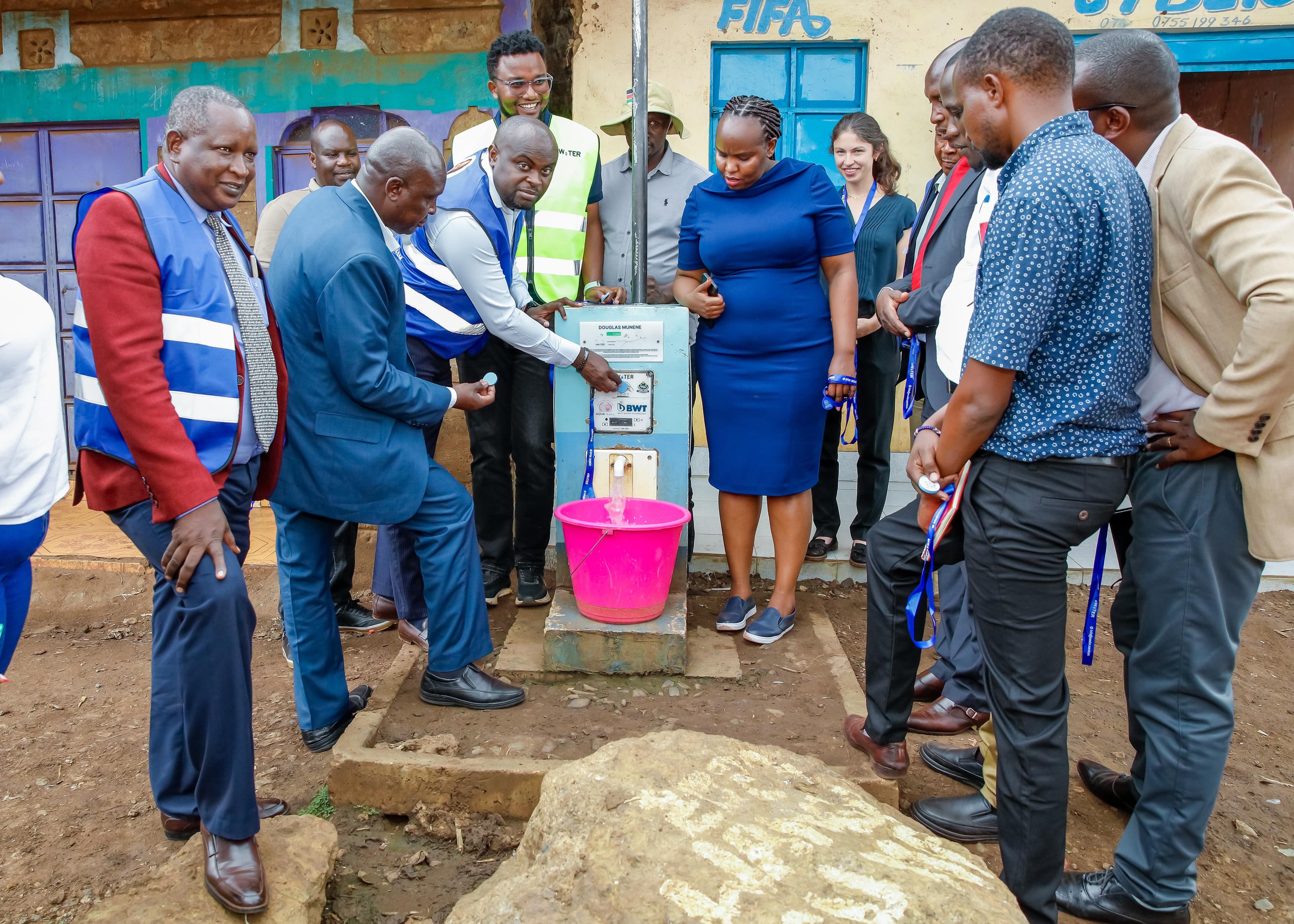
Kirinyaga County’s e-water model is gaining traction, as other counties seek to replicate the project in the provision of reliable and affordable clean water to underserved communities.
A delegation from Kajiado County is the latest to visit the project to learn from its digital system that ensures users access and only pay for the water they use.
Barely a month ago, another delegation from Mozambique and the World Bank visited the county to benchmark on the project.
The project domiciled in Gathigiriri Ward, a semi-arid area of Mwea Constituency, currently serves over 17,000 residents across villages of Gathigiriri, ensuring access to clean, treated domestic water.
Under the eWATER model, residents use mobile money to top up their eWATER tags and pay only for the amount of water they consume.
The approach enables the operator to provide reliable water services while keeping the cost affordable for rural households.
Speaking at Kiriko Village during the visit, County Executive Committee Member (CEC) for Environment Kinyua Mutugi said that by providing quality water services, health challenges, especially waterborne diseases, in the area have significantly reduced.
He said the success of the project had demonstrated the importance of partnerships in addressing water challenges and improving the well-being of communities.
The eWATER project has delivered 124 community smart taps, 84 household connections and six institutional connections in Gathigiriri Ward, with the whole network serving approximately 17,000 people across seven villages.
“The model had helped bring treated water closer to households while making it possible for residents to pay for only what they consume,” Mutugi said.
Kajiado Water Executive Judy Peree said the delegation was keen to learn from Kirinyaga’s experience and explore the possibility of adopting the model in areas facing water shortages in Kajiado.
“We are here to explore a partnership that might happen between eWATER and Kajiado County. It has been good to see how impactful it has been in Kirinyaga County and how it has touched many lives,” Peree said.
She said Kajiado had areas where residents continued to struggle with inadequate access to clean water and that the delegation would assess how the model could be adapted to meet the needs of those communities.
“It is a venture we would like to partake in and see how it fits the Kajiado community,” she added.
For residents of Gathigiriri, the project has replaced unsafe canal water with treated water available closer to their homes, while reducing the burden and costs associated with waterborne illnesses.
Douglas Munene, a resident of Kiriko Village, said access to safe water had reduced the amount of money families spent seeking treatment for illnesses associated with contaminated water.
He said the affordability of the eWater service had also made it accessible to households, noting that residents pay Sh5 for a 20-litre jerry can and sometimes receive promotional offers at as little as Sh2.
Another resident, Julius Ndung’u, said the project had eased the burden of fetching water, particularly for women who previously had to travel to rivers and canals.
“We thought it was a joke when it was starting. We went for public participation, but now it has come to make things easier for us, especially our women,” Ndung’u said.
The County Government has continued to prioritize access to clean water across Kirinyaga, with Governor Anne Waiguru noting that Sh200 million had been allocated in the last and current financial years for the implementation of water projects, alongside additional investments through various partnerships.
By Mutai Kipng’etich
Comments
No comments yet. Be the first to share your thoughts.