
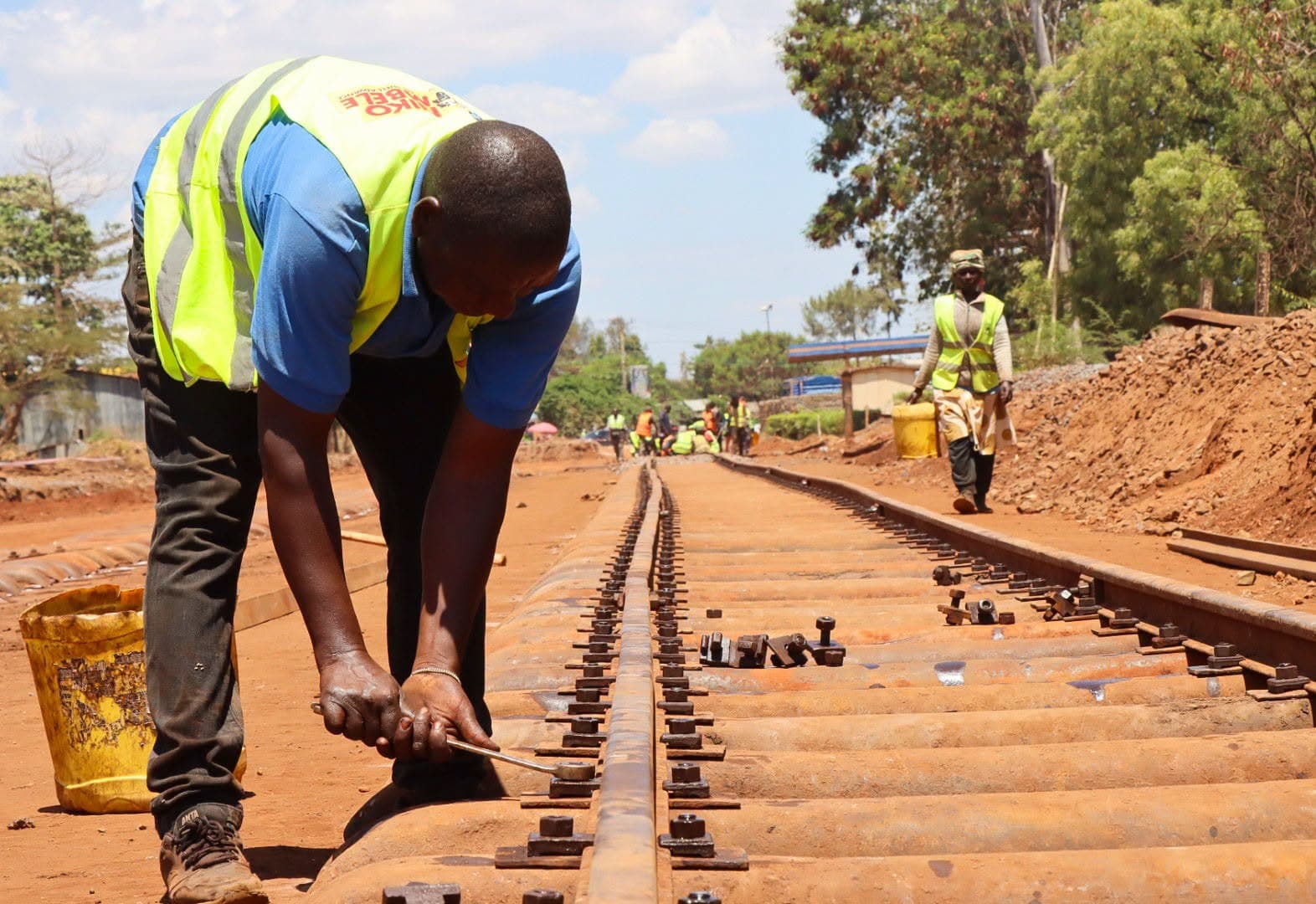
A major upgrade is underway for the fifty-seven-kilometre Nairobi Central–Thika commuter corridor, as Kenya Railways Corporation (KRC) targets fifteen stations for modern development through a World Bank-funded transport programme.
The modernised rail route will directly connect downtown Nairobi with key population and business hubs in Nairobi and Kiambu counties, providing faster commutes for residents in areas that include Dandora, Githurai, Ruiru, and Thika.
According to an Environmental and Social Impact Report under the Kenya Urban Mobility Improvement Project (KUMIP), the rail line spans fifteen stations beginning at Nairobi Central, with the initial line running through Kaloleni, Makadara, Mutindwa, Kariobangi South and Dandora.
Moving northward, the line will connect KPCU, Maili Saba, Mwiki, Githurai, Kahawa West, Kenyatta University, Ruiru, and Juja’s Kalimoni area before ending at the Thika terminal.
Currently, eight stations along the corridor are active, i.e., Nairobi Central, Makadara, Dandora, Mwiki, Githurai, Kahawa West, Ruiru, and Thika.
Four additional existing stations, Kaloleni, Mutindwa, Kariobangi South, and Kenyatta University, are currently non-operational but have been earmarked for revitalisation.
The project will introduce three new stations along the route at KPCU, Maili Saba, and Kalimoni (Juja), bringing the total station count to fifteen.
Key infrastructure works will include track repairs, modernised station designs, and major safety and accessibility enhancements for daily commuters.
Non-motorised transport forms a core part of the upgrade, with plans to build access roads, footpaths, bike lanes, and street lighting within one kilometre of every station. This infrastructure is designed to give nearby residents safer car-free access to rail services.
Kenya Railways is also building a major maintenance hub at Makadara Railway Station near the Kenya Pipeline Company Headquarters.
The facility will serve as a central depot to repair, service, and overhaul locomotives, passenger cars, and freight wagons.
The project comes after the World Bank committed USD five hundred million (Sh 65 billion) earlier this year to transform the 58-kilometre Nairobi–Thika commuter rail corridor into a modern transit system.
Once complete, the Nairobi–Thika commuter rail upgrade promises to dramatically reduce travel times, ease severe traffic congestion along the busy Thika Superhighway and unlock new economic potential across Nairobi and Kiambu counties.
By replacing bumper to bumper commutes with a reliable modern rail alternative, the project marks a pivotal milestone in transforming Kenya’s urban transit landscape.
By Hellen Lunalo

Comments
No comments yet. Be the first to share your thoughts.