


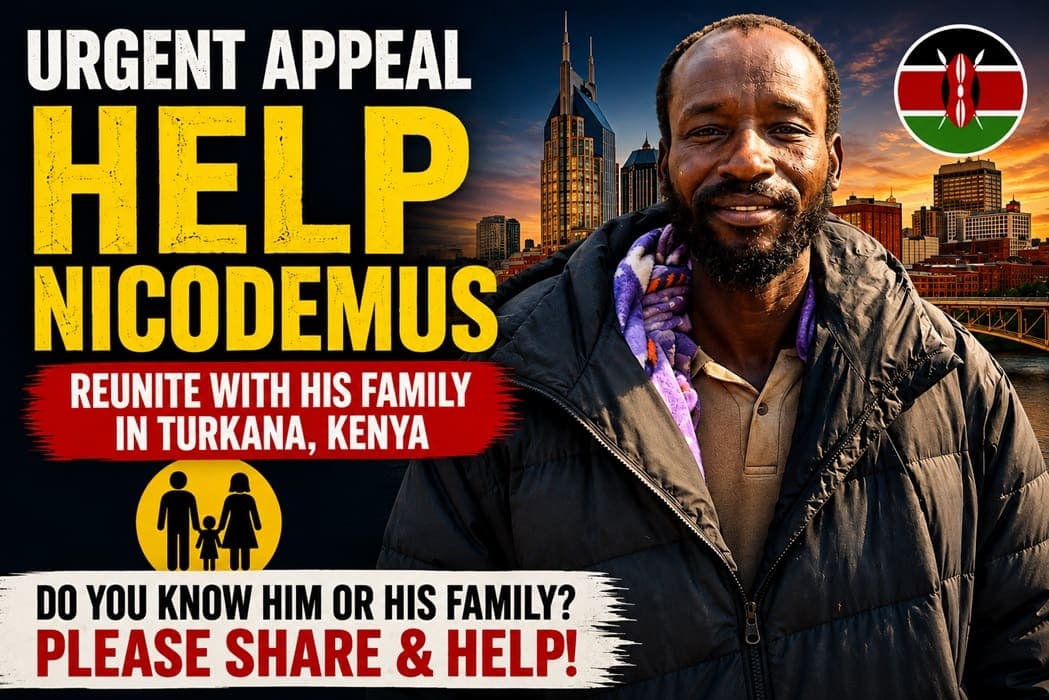
The story of Njoroge, a Kenyan man reportedly homeless and living in his car in Atlanta, Georgia, is drawing attention within the Kenyan diaspora community and raising difficult questions about immigration, disability, employment, family breakdown and the realities of starting over in America.
For many immigrants, moving to the United States represents an opportunity for a fresh beginning. Families arrive carrying academic qualifications, professional experience and dreams of building a better future. But sometimes, the journey takes an unexpected turn.
According to information shared about his circumstances and Njoroge’s own account, his life today is dramatically different from the future he may once have imagined.
He reportedly came to America with his wife and two children. The family was educated, ambitious and seemingly positioned for success.
Today, however, Njoroge is reportedly sleeping in his vehicle in the Atlanta area, while members of the Kenyan community are trying to rally support around him.
An Educated Family With a Promising Future
Before moving to the United States, Njoroge reportedly studied finance at the University of Leeds in the United Kingdom.
His wife was reportedly a lawyer in Kenya.
Together, they had two children and appeared to have the educational foundation and professional experience necessary to build a successful future.
But qualifications alone do not always guarantee a smooth transition into the American workforce.
Before the family’s relocation to America, Njoroge was reportedly involved in a serious motorcycle accident that left him with a disability.
Although he eventually recovered sufficiently to travel, the effects of the accident reportedly continued to influence his ability to work and rebuild his career.
The family eventually relocated to Atlanta, Georgia, where they bought a home and began establishing themselves.
His Wife Rebuilt Her Legal Career in America
According to the account being shared, Njoroge’s wife returned to school after arriving in the United States and completed the necessary educational and professional requirements to pursue her legal career.
She eventually succeeded and established herself as a lawyer in America.
Njoroge’s journey was reportedly very different.
Despite having studied finance in the United Kingdom, he struggled to translate his education and experience into comparable employment opportunities in the United States.
His experience highlights a challenge familiar to many immigrants.
When Foreign Qualifications Don’t Open American Doors
Many highly educated immigrants arrive in the United States only to discover that their degrees, professional licenses or previous work experience do not immediately translate into equivalent employment.
Doctors may find themselves driving taxis while preparing for licensing examinations. Lawyers may have to return to school. Engineers and accountants sometimes accept entry-level positions while trying to understand American certification requirements and build local professional networks.
For many immigrants, physically demanding jobs become the temporary bridge between arrival and professional stability.
Warehouses, caregiving, transportation, delivery services, restaurants, retail stores and other jobs can provide much-needed income during the transition.
But what happens when someone has a disability that makes those jobs difficult?
That appears to have been one of the major challenges facing Njoroge.
Even work such as food delivery can become difficult when a driver must repeatedly walk long distances, climb stairs or carry orders into apartment buildings.
His story therefore speaks to a broader issue affecting some members of the Kenyan diaspora in America: education and determination are important, but physical limitations and structural barriers can make rebuilding a career extremely difficult.
Family Problems Changed Everything
According to Njoroge’s account, serious domestic problems eventually developed within the family.
Police became involved, and he was arrested and served time. After his release, he reportedly could not simply return to the family home.
The details surrounding domestic and legal disputes can be complicated, and accounts shared publicly may not capture every perspective. For that reason, the circumstances should be approached with care and without rushing to conclusions about the people involved.
What is clear from the appeal now circulating is that Njoroge is reportedly facing a serious housing crisis.
A man who once moved to America with his family and lived in a home is now said to be sleeping in his car in Atlanta.
A Difficult Side of the American Dream
Njoroge’s situation is also a reminder that homelessness does not always fit the stereotypes many people have about who becomes homeless.
A person can be educated and still become homeless.
A person can once have had a professional career and still fall into financial hardship.
A person can own a home with a family and later find themselves sleeping inside a vehicle.
Disability, unemployment, divorce or separation, legal problems, unexpected expenses and the loss of a support system can quickly change someone’s circumstances.
For immigrants, these challenges can be intensified by being thousands of miles away from extended family and long-established community networks.
That is why diaspora communities often become an important source of support during moments of crisis.
Kenyan Community in Atlanta Asked to Help
Members of the Kenyan community are now being encouraged to consider how Njoroge can be assisted as he works toward stability.
While immediate financial assistance may help with urgent needs, long-term support could potentially involve helping him identify suitable housing, disability-friendly employment opportunities, social services, legal resources and other programs for which he may qualify.
The objective should not simply be helping someone survive another night in a vehicle. Where possible, community support can help create a pathway toward independence, dignity and long-term stability.
At the same time, anyone wishing to contribute financially should independently confirm the details and intended use of contributions before sending money.
A Lesson for the Kenyan Diaspora
Njoroge’s story should encourage a larger conversation among Kenyans living abroad.
Diaspora success stories deserve to be celebrated, but communities should also create room to talk about those who are struggling.
Behind the photographs of new homes, graduations, businesses and professional achievements are immigrants facing unemployment, loneliness, family breakdown, disability and financial hardship.
Sometimes the person who needs help is someone who once appeared to have everything going for them.
The measure of a strong diaspora community is not only how loudly it celebrates success, but also how compassionately it responds when one of its members falls on difficult times.
For Njoroge, the hope is that this difficult chapter will not become the final chapter of his American journey.
Community Contact Information
For more information about the reported community effort or how to assist, contact:
Karanja Dan KD: 770-895-1176
Njoroge can also reportedly be reached directly:
John Njoroge Ndungu: 678-367-9261

Comments
No comments yet. Be the first to share your thoughts.