
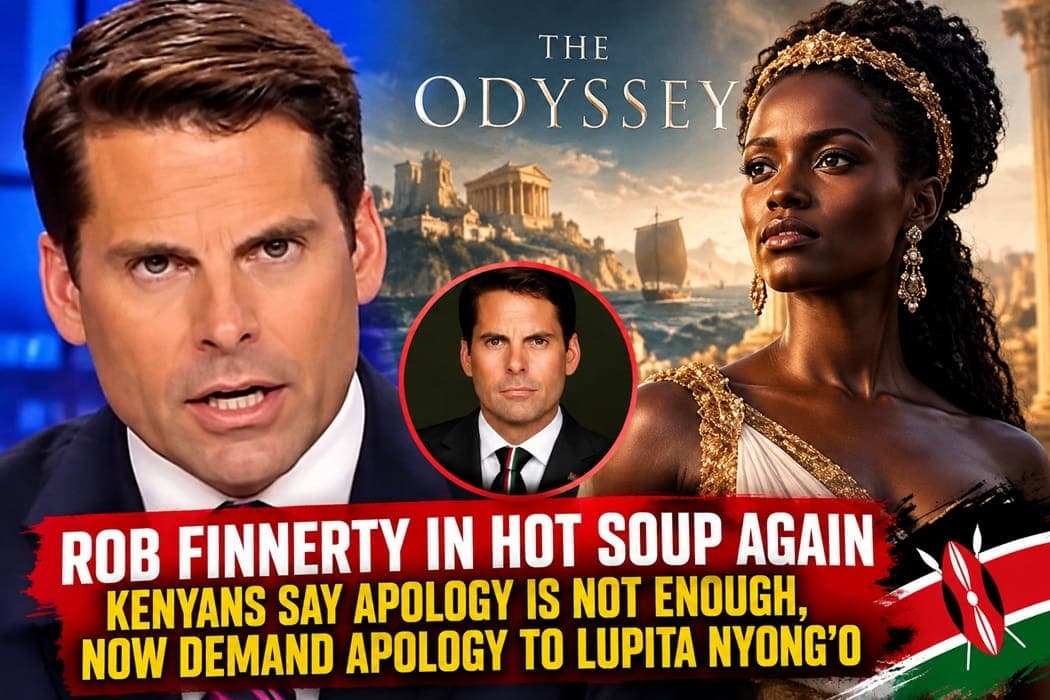

Rob Finnerty in Hot Soup Again as Kenyans Demand Apology to Lupita Nyong’o Over The Odyssey Remarks
American journalist Rob Finnerty is facing a fresh wave of criticism from Kenyans after an old video resurfaced showing him questioning the casting of Kenyan-born Hollywood actress Lupita Nyong’o in Christopher Nolan’s blockbuster film The Odyssey. The renewed controversy comes shortly after Finnerty apologised for his remarks comparing Nairobi to American cities affected by immigration.
Rob Finnerty Faces Fresh Backlash From Kenyans
Just when American television journalist Rob Finnerty appeared to be moving past his controversial remarks about Nairobi, another video has emerged, reigniting criticism among Kenyans both at home and in the diaspora.
This time, the controversy involves Oscar-winning actress Lupita Nyong’o, one of Kenya’s most internationally recognised entertainment personalities.
In the resurfaced recording, the Newsmax television host questions casting decisions in Christopher Nolan’s film The Odyssey, particularly those involving Nyong’o and actor Elliot Page.
Finnerty describes the casting as ridiculous, arguing that the film’s interpretation of characters from ancient Greek mythology conflicts with his expectations of historical authenticity.
His remarks have attracted renewed attention on Kenyan social media, where some users are demanding an additional apology, this time directed specifically at Lupita Nyong’o.
The latest development has transformed what began as a controversy over Nairobi into a broader discussion about African representation, Hollywood casting and how international media personalities speak about people and cultures outside the United States.
What Did Rob Finnerty Say About Lupita Nyong’o?
In the resurfaced video, Finnerty criticises Nolan’s decision to cast Nyong’o as Helen of Troy, a legendary figure associated with Greek mythology and the Trojan War.
“The movie is not magnificent; the casting was ridiculous,” Finnerty declares in the recording.
His criticism focuses on the decision to portray traditionally depicted Greek characters using actors whose identities differ from those representations.
Finnerty also questions Elliot Page’s casting, discussing the interpretation of male warrior characters in the production.
However, Page’s confirmed role is Sinon, rather than Achilles, a distinction that became important in subsequent discussions of the film.
Nyong’o portrays Helen of Troy and Clytemnestra in Nolan’s adaptation.
The controversy raises a central question: Should filmmakers be restricted to traditional depictions of mythological characters, or should creative interpretation allow actors from different backgrounds to portray them?
For some viewers, Finnerty’s criticism represents a legitimate debate about artistic authenticity. Others see the objections to Nyong’o’s casting as an example of the unequal scrutiny faced by Black actors in major Hollywood productions.
Nairobi Controversy: Why Rob Finnerty Previously Apologised to Kenyans
The resurfaced video comes just days after Finnerty faced widespread criticism over comments about immigration and American cities.
During a television discussion, Finnerty suggested that immigration was making some American cities resemble Nairobi rather than New York.
His comparison triggered a backlash among Kenyans, who interpreted the remarks as an unfair portrayal of their capital city.
Social media users responded by sharing photographs and videos showcasing Nairobi’s skyline, modern infrastructure, business districts and urban development.
Many argued that the journalist had relied on outdated stereotypes about African cities.
Following the criticism, Finnerty publicly apologised to Kenyans, acknowledging that his comparison was inappropriate.
He described Nairobi as a thriving city and expressed regret for offending Kenyans.
His apology was welcomed by some social media users, while others continued questioning his original remarks.
Now, with the emergence of the Lupita Nyong’o video, the journalist finds himself confronting another controversy involving Kenya.
Why Lupita Nyong’o’s Casting in The Odyssey Became Controversial
Christopher Nolan’s The Odyssey, released in July 2026, is a cinematic adaptation of Homer’s ancient Greek epic.
The film features an internationally recognised cast, including Matt Damon, Tom Holland, Anne Hathaway, Robert Pattinson, Zendaya, Charlize Theron and Lupita Nyong’o.
Nyong’o’s casting as Helen of Troy generated debate well before the film’s release.
Some critics argued that the character should reflect conventional artistic representations of ancient Greek figures.
Others defended the decision, pointing out that Helen of Troy belongs to mythology rather than a documented historical biography.
Supporters of inclusive casting also argued that film adaptations frequently reinterpret literary characters to suit a director’s artistic vision.
The debate became part of a wider Hollywood conversation about race, representation, creative freedom and the boundaries of historical interpretation.
Lupita Nyong’o Responded to Earlier Casting Criticism
Lupita Nyong’o previously addressed criticism surrounding her participation in The Odyssey during a May 2026 interview.
Rather than engaging in a prolonged public argument over her suitability for the role, the actress defended the diversity of the film’s cast.
“Our cast is a representation of the world,” Nyong’o said.
She also made clear that she did not intend to spend her time defending her right to portray a mythological character.
Her response attracted attention from entertainment publications and supporters who viewed her position as an affirmation of artistic freedom.
There is no confirmed public statement from Nyong’o specifically responding to the latest resurfacing of Finnerty’s remarks.
Why the Controversy Matters to Kenyans in the Diaspora
For millions of Kenyans living in the United States, United Kingdom, Canada, Australia, Germany and other countries, Lupita Nyong’o represents an internationally recognised example of Kenyan talent succeeding on the global stage.
Her Hollywood career has made her a prominent figure in conversations about African excellence, cultural identity and representation.
Nyong’o won the Academy Award for Best Supporting Actress for her performance in 12 Years a Slave, establishing herself among Hollywood’s leading performers.
Her subsequent work in major international productions has continued to inspire audiences, including young Africans pursuing careers in film, theatre and entertainment.
For Kenyan diaspora communities, the discussion surrounding her casting extends beyond a single Hollywood movie.
It raises questions about the opportunities available to African performers in international entertainment and the standards used to evaluate their participation in productions traditionally associated with Western cultures.
At the same time, the controversy illustrates how social media has empowered diaspora communities to participate directly in international conversations.
A television statement made in the United States can now generate immediate responses from Nairobi, London, Toronto, Washington, DC, and other cities with significant Kenyan communities.
Kenyans Online Demand Another Apology
Following the circulation of the video, some Kenyans have called on Finnerty to apologise to Nyong’o.
Others have questioned whether his comments should be interpreted as artistic criticism or as part of a broader pattern of controversial statements involving African people and places.
The discussion has also produced differing opinions about public accountability.
While critics argue that influential broadcasters should exercise greater care when discussing race and cultural representation, others maintain that journalists and commentators should be free to criticise casting decisions without automatically being accused of prejudice.
These competing perspectives have kept the conversation active across social media.
There is currently no verified indication that Finnerty has issued a separate public apology to Lupita Nyong’o over the resurfaced video.
From Nairobi to Hollywood: A Growing Conversation About Representation
The two controversies involving Rob Finnerty have drawn attention to different but related questions about how Africa and Africans are portrayed internationally.
The Nairobi remarks prompted discussions about perceptions of African cities, while the Lupita Nyong’o controversy has focused on opportunities for Black performers in major film productions.
Both incidents demonstrate the growing influence of Kenyan online communities in challenging international narratives.
However, they also highlight the importance of distinguishing between legitimate criticism, personal opinion, inaccurate characterisations and discriminatory commentary.
For journalists, filmmakers and audiences alike, the debate offers an opportunity to examine how cultural assumptions influence public conversations.
Will Rob Finnerty Apologise to Lupita Nyong’o?
Whether Finnerty will respond to the renewed criticism remains unclear.
His earlier apology over Nairobi showed that public reaction from Kenyan audiences can attract the attention of an international television personality.
The resurfaced video has now placed his comments about Lupita Nyong’o under renewed scrutiny.
For many Kenyan social media users, the immediate question is whether his apology to Nairobi should be followed by another apology to the Oscar-winning actress.
For others, the bigger issue is whether artistic criticism of a Hollywood production necessarily requires an apology.
As the debate continues, one thing is evident: Kenyan voices, both at home and across the diaspora, are increasingly participating in global conversations about cultural representation, media accountability and African achievement.
What do you think? Should Rob Finnerty apologise to Lupita Nyong’o, or was he simply expressing an opinion about Hollywood casting? Share your views in the comments.
Diaspora Messenger will continue following developments involving Rob Finnerty, Lupita Nyong’o and other stories of interest to Kenyan communities worldwide.



Comments
No comments yet. Be the first to share your thoughts.