
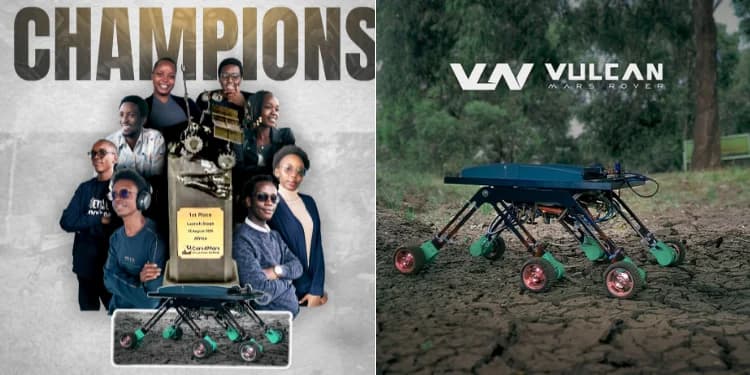
Eight engineering students from the Jomo Kenyatta University of Agriculture and Technology (JKUAT) have emerged at the top of the Cars4Mars African Rover Challenge 2026 Launch Stage Final after their Mars rover project, Team Vulcan, beat 39 other teams that qualified for the stage.
The results, announced after the August 15 competition, placed the Kenyan team first with 370 points, ahead of South Africa’s Wall-E with 341 points and Zimbabwe’s Cyberstorm with 329 points.
According to JKUAT, more than 100 teams entered this year’s competition, but only 39 qualified to present at the Launch Stage Final, while 22 progressed to the next stage.
Team Vulcan’s eight students spent months designing and building a wireless-controlled Mars rover prototype with an independent power source.
The team will now compete in the Mars Stage Final scheduled for September 19, 2026, at SANSA Space Operations in Hartebeeshoek, South Africa, where the rover will be tested on a 40-ton red-sand Mars Yard.
JKUAT Students Top Africa’s Mars Rover Challenge After Year of Engineering Work
The team brought together students from mechatronics, telecommunications, aerospace, mechanical and electrical engineering.
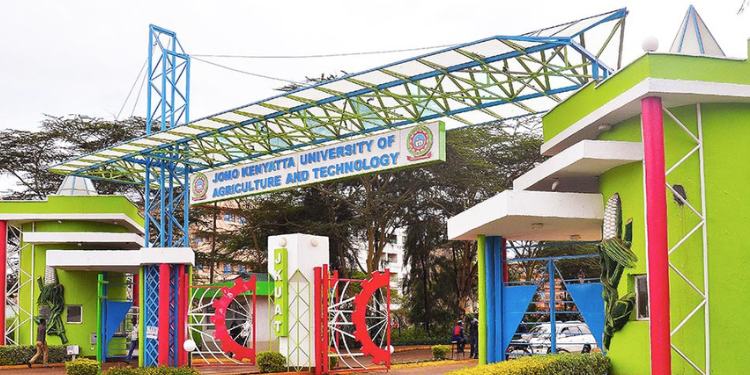
JKUAT said Team Vulcan grew out of Team Jabari, a previous university rover project led by mechanical engineering graduate student Japheth Libese.
For team members, the project offered a chance to move beyond classroom theory and work on a complex engineering system.
“Actual learning takes place while doing,” said Collins Kiprop, one of the students involved in the project.
Team lead Victoria Rotich said the project was also driven by a desire to see more African students involved in robotics and space technology.
“When you look online for Mars rovers and space robotics, you almost exclusively see content from Europe or Asia,” she said. “Taking on this project was our way to change that narrative.”
How Team Vulcan Built its Rover
The students designed the rover with separate systems to improve reliability during operation.
The rover uses two independent battery packs: one powers the drivetrain, and the other supports the onboard computer. This arrangement is intended to prevent heavy power demands from the motors from affecting the computer system.
The team also developed a wireless communication system designed to prioritise steering commands and other critical functions over video transmission.
According to JKUAT, the rover exceeded the competition’s 80-metre range requirement and can operate without depending on an external internet connection.
Technical lead Brian Fundi said the team focused on ensuring the different systems worked together reliably.
The rover combines hardware, software and autonomous systems, with students taking responsibility for different parts of its development.
Team Vulcan Tops the Leaderboard
Team Vulcan scored 50 points in the Project Strategy Report, 46 points in the Final Report, and 182 points for its video presentation, for a total of 370 points.
South Africa’s Wall-E finished second with 341 points, followed by Zimbabwe’s Cyberstorm with 329. Kenya’s Probity002 came fourth with 310 points, while Nigeria’s Blazers completed the top five with 308 points.
The result means Team Vulcan will represent JKUAT at the next phase of the challenge, where the rover will face physical tests in an environment designed to simulate Martian terrain.
The Mars Stage Final will include a Traversal Mission and an Autonomous Mission, testing the rover’s ability to move and operate in challenging terrain.
What’s Next for the JKUAT Team?
Beyond the competition, Team Vulcan is looking at ways to develop the technology for use outside the Mars rover challenge.
The team is exploring improvements in autonomous navigation and camera-based perception to reduce reliance on active sensors such as LiDAR.
JKUAT said the technology developed through the project could potentially be adapted for use in areas such as security, mining surveys, warehouse logistics, agriculture and automated delivery.
The students also hope to build on the project by mentoring future teams and creating a lasting culture of participation in robotics competitions at the university.
“Our major goal is to build a lasting culture at JKUAT where students consistently enter and excel in the Cars4Mars competition year after year,” Rotich said.
With the Launch Stage title secured, Team Vulcan will now turn its attention to South Africa, where its locally built rover will face its biggest test yet.
Follow our and X Account for real-time news updates.

Comments
No comments yet. Be the first to share your thoughts.