
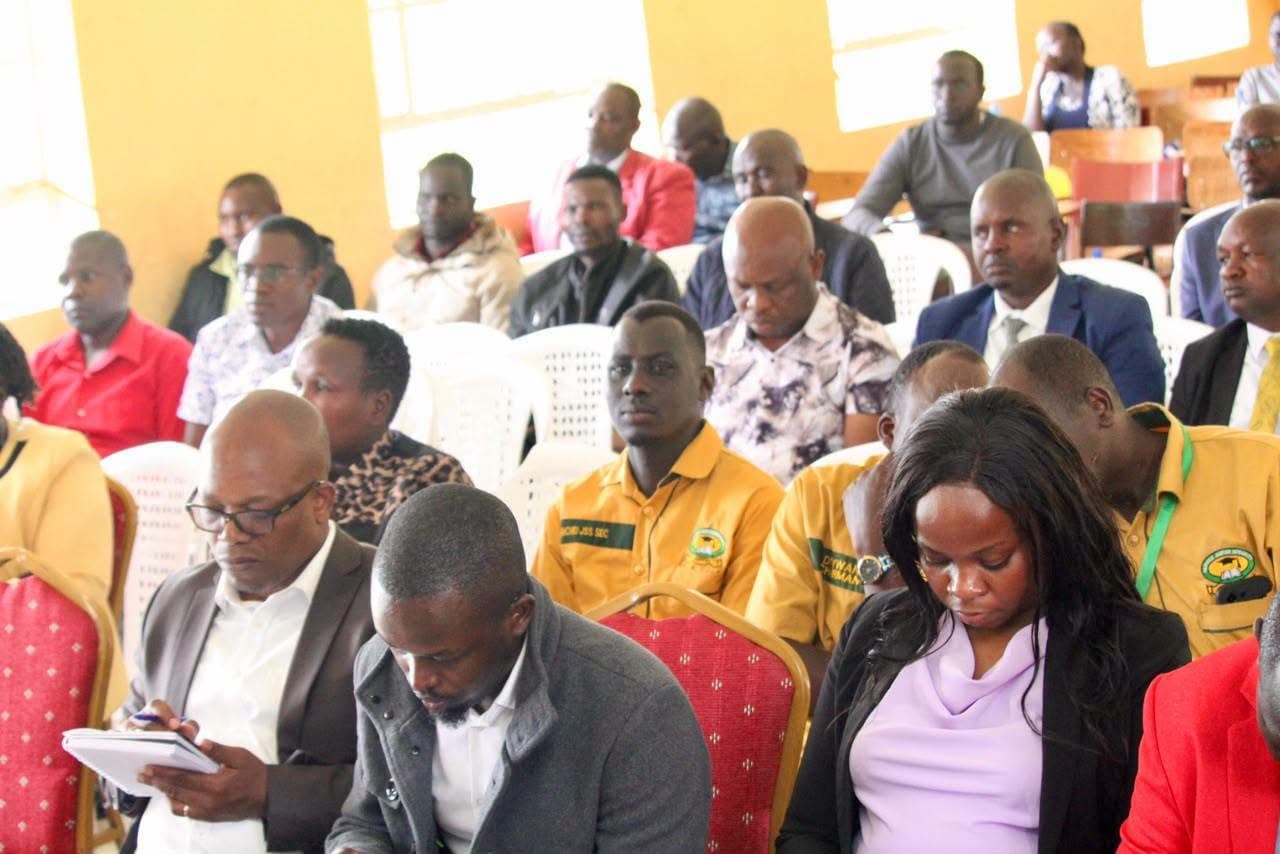
The Kenya Union of Post Primary Education Teachers (KUPPET) and the Kenya National Union of Teachers (KNUT) in West Pokot County have differed over the proposed management and autonomy of Junior Schools (JS).
The disagreement emerged during a public participation exercise by the National Assembly Departmental Committee on Education on proposed education Bills.
KUPPET officials called for Junior Schools to operate autonomously within primary school compounds and be headed by teachers trained to teach at the post-primary level.
Speaking during the exercise, KUPPET Executive Secretary in West Pokot Alfred Kamuto argued that teachers supervising Junior Schools should have the qualifications and expertise required to manage and mentor teachers handling learners at that level.
According to Kamuto, holders of a P1 certificate, diploma in primary education or ECDE qualifications may not have the required training to supervise, appraise or mentor teachers with degrees specialising in secondary education.
“The manager of JS must therefore be a degree holder with secondary option, not just a degree holder. It is therefore our humble request that JS be domiciled within the primary school compound but shall be autonomous and that it be led by a post-primary teacher,” Kamuto said.
KUPPET maintained that the leadership structure of Junior Schools should reflect the qualifications and teaching requirements of the level.
However, KNUT officials opposed the proposal, supporting the recommendation of the Presidential Working Party on Education Reform to retain Junior Schools within comprehensive school structures.
KNUT Executive Secretary in West Pokot Dorcus Lotimen said separating Junior Schools from primary schools could affect the smooth transition of learners between the different levels of education.
“These schools should not be separated so that learners can have a smooth transition from one level to another and so that our teachers can share knowledge they have with those in JS and Primary school to curb the knowledge gaps,” Lotimen said.
The public participation exercise was also attended by other education stakeholders, who presented proposals on various aspects of the proposed legislation.
Baringo North MP Joseph Makilap, in his opening remarks, urged stakeholders to make specific proposals on the Bills, including suggestions for amendments where necessary.
“These laws will affect education right from pre-primary to university level. I urge you to make your proposals to amend or oppose with a solution and cure,” Makilap said.
The Committee also received views on tertiary education and student financing.
Officials from the Kenya Medical Training College (KMTC) Kapenguria Campus proposed changes to the Tertiary Education, Placement and Funding Bill, 2026, saying the legislation should provide equitable access to financing for KMTC students while recognising the distinctive costs and practical requirements of health-professional training.
The students also proposed changes to the proposed Higher Education Loans Board (HELB) loan repayment provisions.
They argued that graduates should not automatically be required to begin repaying their loans one year after completing their education if they have not secured employment.
KMTC Kapenguria President Andrew Pkemoi said loan repayment should begin when a beneficiary secures either formal or informal employment.
“It is not a guarantee that after one year of graduating one gets employed. So, repayment would be subject to when one gets formal or informal employment. We also proposed a clear percentage of four per cent of basic salary be deducted to repay the loan and not the current proposal stating that the authority shall deduct not more than 25 per cent of the employee’s emoluments,” Pkemoi said.
The National Assembly Committee is in the third week of public participation on six education Bills.
They include the Tertiary Education, Placement and Funding Bill, 2026; Pre-Service Education and In-Service Training Bill, 2026; Basic Education (Amendment) Bill, 2026; Kenya Institute of Curriculum Development (Amendment) Bill, 2026; Kenya National Educational Assessments Council Bill, 2026; and Kenya National Qualifications Framework (Amendment) Bill, 2026.


Comments
No comments yet. Be the first to share your thoughts.