
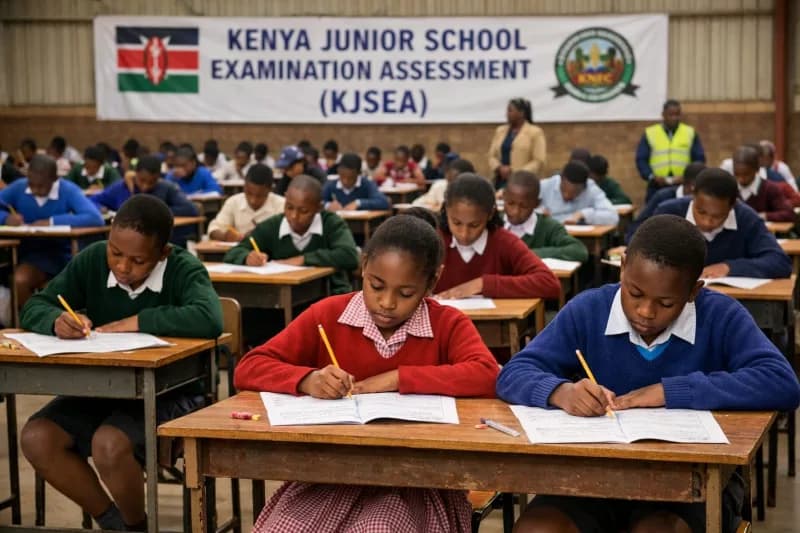
Students in an exam room /AI generated

Throughout my academic journey, I have tussled with continuous assessment tests, examinations, seminar papers and presentations, and that experience continues to this day.
Last Saturday, however, I found myself on the other side of the experience, seated among parents, students, teachers and members of the church, praying for the 2026 candidates who will be sitting their national examinations.
As I engaged my daughter, one of this year’s candidates, on her level of preparedness, I noticed she was a bit on edge.
She was not alone. Her friends also exhibited some level of tension, unlike during my previous visits to the school.
Like many of us who have been in this exact situation before, I found it quite normal, given the high stakes associated with passing a national examination.
Admittedly, the most uplifting moment of the day came when the preacher took the microphone and offered words of hope.
His message was clear and powerful: “Do not be afraid but trust in God. In case you feel pressured, worried, or not ready, just turn off your power and turn on God’s. Be sure that God will be there with you in the examination room.”
As the preacher spoke a word of blessing over the candidates, I saw happiness and hope return to their faces.
As the day went by, I found myself slipping into a pensive mood, contemplating the place of examinations in our lives.
I asked myself why we spend so many days with our children at home and in school, teaching them, observing their progress and getting to know their abilities, only to set questions for them one day and rank them based on their performance, as though we did not already know their capabilities, skills and interests?
In the process, I consoled myself that perhaps this is the gap the competency-based education seeks to remedy.
Another question then popped up in my mind: What, ultimately, is the point of passing examinations?
As I synthesised my thoughts in search of an answer, I ended up drawing on lessons from my monitoring and evaluation classes.
I couldn’t help but view the education system through the lens of a monitoring and evaluation framework.
Clearly, the framework showed me that before candidates can pass examinations, several inputs must be injected into education.
I thought of policies, government funding, teachers employed, the fees parents pay, and investments in classrooms, books and laboratories.
For these contributions, the government, development partners and parents deserve credit, where they have fulfilled their responsibilities.
Secondly, I considered the processes candidates undergo and the efforts teachers invest in lessons and other learning activities.
In my daughter’s school, there is a shared philosophy in term three of ‘finishing power’. During this period, both teachers and students are on overdrive. Teaching, for sure, remains a noble profession and a calling.
After considering the inputs and the demanding processes, I turned my attention to the candidates in the examination room.
At this stage, I realised that passing an examination could only be classified as an output measure. I asked myself why this was so, and what the end game was.
The answer was simple: education extends beyond examinations. Its ultimate outcomes include the acquisition of skills and the development of character and values.
For sure, the world continues to face skills shortages in Science, Technology, Engineering and Mathematics.
Moreover, the many social problems we face today require well-equipped social scientists.
On the other hand, creative arts and sports offer increasingly visible economic opportunities, with talented individuals finding avenues to earn a living through their work.
As our candidates sit for their examinations, we expect them to be honest, take responsibility for their time and schedules, demonstrate discipline, respect their teachers, supervisors and fellow candidates, remain resilient in the face of sometimes harsh conditions, uphold integrity, maintain a positive attitude and cooperate throughout the process.
In today's workplaces, no one has the time to hold your hand or monitor your every move.
Your character will always guide you towards doing the right thing at the right time, even when no one is watching.
Indeed, many people now work remotely with minimal supervision, making self-discipline and personal accountability more important than ever.
It is the right values and character that matter in the world of work. On the few occasions I have served on interview panels, my argument has been simple.
Grades and skill are important, but attitude is the tie-breaker. Skill can be learnt by anyone, anytime, but attitude determines how the skill will be used to achieve organisational goals.
With the right skill, positive character, and attitude, we can then create impact in our lives and at the community level.
Special success wishes through the Star to all our 2026 national examination candidates.

Comments
No comments yet. Be the first to share your thoughts.