

Technical and Vocational Education and Training (TVET) enrolment has risen from about 350,000 learners in 2022 to 1,201,320 as of May 2026 under President William Ruto’s administration.
The growth has been linked to increased uptake of practical skills training, with more young Kenyans pursuing courses connected to employment and entrepreneurship.
More than 26,000 students who scored C+ and above have voluntarily enrolled in TVET courses, pointing to growing interest in technical education.
President William Ruto, on March 26, 2024, during the centenary celebrations of TVET in Kenya at Nyeri National Polytechnic, said Kenya needed to equip millions of young Kenyans with the education, training and skills necessary to enhance their productivity in a dynamic, globalized and competitive labor market.
“As we implement policies, programs and projects which create jobs for the youth, we must simultaneously equip millions of young Kenyans with the education, training and skills necessary to enhance their productivity in a dynamic, globalized and competitive labor market,” he said.
Kenya now has about 260 TVET institutions, including 33 national polytechnics. A further 17 institutions are under construction as the government pursues its plan to establish a TVET institution in each of the country’s 290 constituencies.
The government is also working towards increasing TVET enrolment to two million learners.
New training models and student funding
Practical training has been expanded through Competency-Based Education and Training, modular courses, digital skilling, Recognition of Prior Learning and the Dual Training Model, which combines classroom learning with industry experience.
Some modular programs enable learners to acquire employable skills within six months, while shorter courses offer specific skills within one month.
The administration has also sought to make technical training more affordable, reducing annual TVET fees from Sh105,000 to Sh67,000 while expanding efforts to modernize institutions and increase enrolment.
Since the 2023/24 financial year, 169,629 TVET trainees have received scholarships, with Sh6.9 billion disbursed.
Under the new student funding model, the most financially vulnerable learners can receive up to 90 percent government support, comprising a 50 percent scholarship and a 40 percent loan.
Ruto has also announced plans to provide State funding to students placed in public universities, colleges and TVET institutions.
“There is a law in Parliament called the HELB (Amendment) Bill, 2026 that will enable us to ensure that every Kenyan student who has been placed in a TVET or a university gets state funding,” he said.
The number of university and TVET students receiving financial support increased from 339,347 in the 2022/23 financial year to 823,691 in 2025/26, an increase of 484,344 students or 143 percent.
Government funding for students has also increased from Sh44.24 billion in the three years before the Kenya Kwanza administration to Sh113.66 billion since 2023.
TVET graduates’ access to local and overseas opportunities
TVET training has been positioned as part of the Bottom-Up Economic Transformation Agenda, equipping young people with skills for sectors including affordable housing, manufacturing, agriculture, ICT, hospitality, transport and logistics, the digital economy and the green transition.
Education Cabinet Secretary Julius Migos Ogamba has described TVET as a key pillar in the government’s efforts to achieve Vision 2030 as Kenya seeks to develop a workforce capable of supporting industrialization and economic transformation.
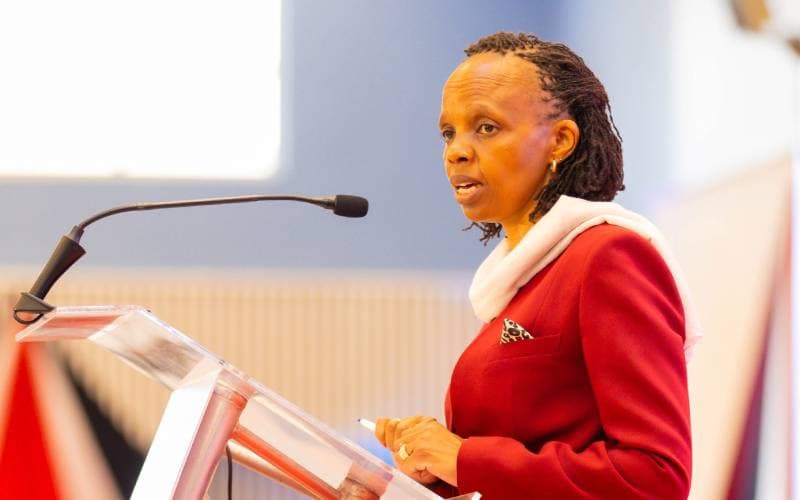
TVET Principal Secretary Esther Muoria has also called on training institutions to ensure their programs keep pace with technological changes.
Speaking during the closing ceremony of the 8th Annual International Multi-Disciplinary Conference and 6th National Skills Competition (CARI 2026) at Kisumu National Polytechnic, Muoria said artificial intelligence, automation and climate change were rapidly transforming industries.
She challenged institutions to move beyond displaying innovations at exhibitions and instead commercialize technologies that address real-world problems.
“The technicians of the future must not only understand how systems operate but also how to make them safer, cleaner and more efficient,” she said.
More than 3,000 TVET graduates have secured seasonal agricultural jobs in the United Kingdom through the Mkulima Majuu program.
A further 12,465 young people have been mobilized through Kazi Majuu, with 6,206 qualifying for overseas opportunities.
Government partnerships have also secured 1,100 training and employment opportunities in the textile and apparel sector, 127 jobs through Sainath Education Center and EPZ industries, and 49 hospitality jobs in Jordan, Mauritius, and Seychelles.
The programs aim to help young Kenyans use practical, certified skills to access employment, start businesses, and build sustainable livelihoods.
Follow our WhatsApp Channel and X Account for real-time news updates.



Comments
No comments yet. Be the first to share your thoughts.