
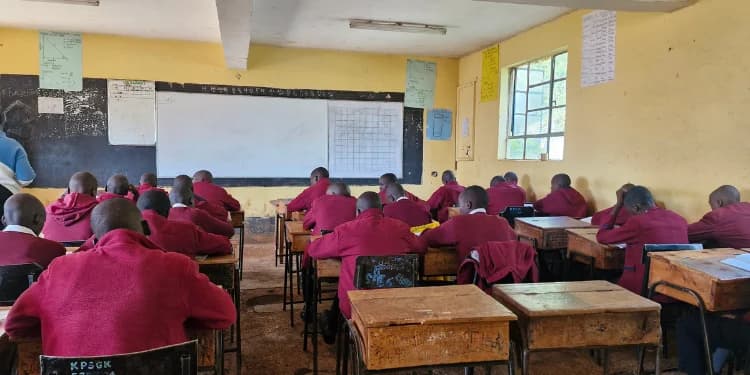
Learners in Kenya’s better-resourced senior schools are more than eight times as likely to attain a mean grade of C+ or above as those in Cluster 4 schools, highlighting wide disparities in learning conditions across the country.
Findings from Usawa Agenda‘s 3rd senior school survey report show a sharp difference in academic outcomes between schools depending on their category and level of resources.
“A child who attends a Cluster One senior school is more than eight times as likely to score a mean grade of C+ and above as one in a Cluster Four senior school,” the report read.
The findings highlight the impact of differences in staffing, learning infrastructure, technology, and other resources available to learners across senior school categories.
Usawa Agenda Report Shows Cluster 1 Schools Better Resourced
The report found that Cluster 1 schools are generally better equipped than other school categories, with greater access to science laboratories, libraries, computers and other learning resources.
Cluster 4 and special schools, on the other hand, remain among the most under-staffed and under-equipped.
“Kenya’s Senior School system is unequal. Cluster One schools are better resourced, while Cluster Four and special schools remain heavily under-staffed and under-equipped with critical learning infrastructure—science labs, computer labs, libraries, and sports facilities,” the report added.
The disparities extend to digital learning.
Nearly nine in 10 Cluster 1 schools offer computer lessons, compared with only one in five Cluster 4 schools.
Nationally, only about three in 10 senior schools offer computer lessons, the findings show.
Cluster 1 schools also recorded the highest ownership of key ICT resources, including LCD projectors, tablets, teacher digital devices and operational computer laboratories.
Huge Difference in Class Sizes
The report also found a significant gap in the number of learners per class across school categories.
A typical Cluster 1 school has 560 learners per class in Form 2, falling to 403 in Form 3 and 365 in Form 4, according to the figures presented by Usawa Agenda.
Cluster 2 schools followed, with 246 learners per class in Form 2 and about 200 learners in Forms 3 and 4.
The report said the gap narrowed slightly by Form 4 but remained substantial across the categories.
Private schools recorded the smallest class sizes, with about 30 to 32 learners per class in each form.
Teacher absenteeism also varies across school categories.
Cluster 1 schools recorded the lowest share of unattended lessons at 2 per cent, while special schools had the highest at 17.5 per cent.
Across the categories, an average of 11.2 per cent of lessons were unattended by teachers.
Laboratories and Libraries
The gap in learning resources is also evident in access to science laboratories and libraries.
Cluster 1 schools have greater access to laboratories for key subjects such as chemistry, physics, and biology than Cluster 4 schools, further widening the difference in learning opportunities between the two categories.
Cluster 1 schools are more likely to have operational libraries and related learning resources, while learners in Cluster 4 schools face greater limitations in accessing these facilities.
Safety Gaps Remain
The report also raised concerns about school safety measures, particularly in Cluster 4 institutions.
Nationally, 81.7 per cent of schools are gated and fenced, while 73.1 per cent have functional firefighting equipment.
However, only 57.9 per cent of schools have designated fire assembly points, while 43.7 per cent have conducted fire drills.
Cluster 4 schools lagged behind other categories in several of the safety measures assessed, with less than half having conducted fire drills or having designated fire assembly points.
Fees Affecting School Attendance
Financial pressure on families is also affecting learners’ school attendance.
Usawa Agenda identified non-payment of school fees as the leading cause of learner absenteeism.
The findings further show that school uniform costs remain a burden for parents and guardians, with four in 10 senior schools reporting that a complete uniform set costs more than KSh5,000.
Follow our and X Account for real-time news updates.


Comments
No comments yet. Be the first to share your thoughts.