
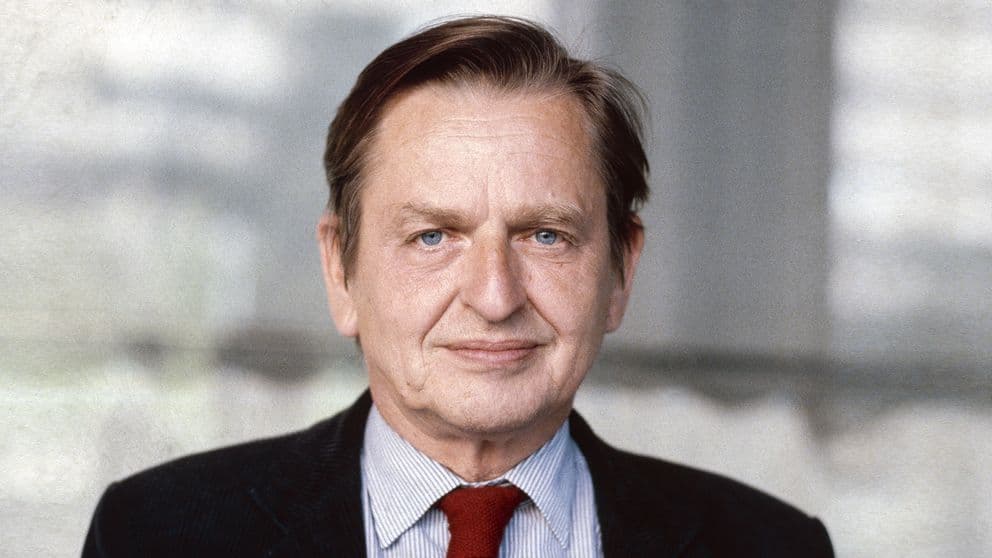
Sven Olof Joachim Palme was a Swedish statesman and one of the most prominent political figures of the Cold War era.
Born on 30 January 1927 in the affluent Östermalm district of Stockholm into an upper-class family, he rose to become leader of the Swedish Social Democratic Party and served two terms as Prime Minister of Sweden, first from 1969 to 1976 and again from 1982 until his assassination on 28 February 1986.
Known for his sharp intellect, passionate oratory, and outspoken internationalism, Palme advocated social democracy, nuclear disarmament, solidarity with developing nations, and criticism of superpower interventions.
Table of Contents
ToggleSiblings
Olof was the youngest of three full siblings born to Gunnar Palme, managing director of the insurance company Thule, and Elisabeth Sophie von Knieriem, who had arrived in Sweden as a Baltic German refugee.
His older brother was Johan Claës Woldemar Palme, known as Claës Palme, born in 1917 and died in 2006.
Claës became a respected lawyer specializing in maritime law, ran his own practice, served as a reserve officer, and represented clients including the Soviet state in a notable case against the Swedish government.
He was active in the Moderate Party and later lived periodically on the French Riviera.
His older sister was Catharina Elisabeth Palme, later Catharina Palme Nilzén, born in 1920 and died in 2002.
She married the physician and allergy researcher Åke Nilzén, a professor at the Karolinska Institute.
In addition, Olof had a half-brother, Sture Gunnarsson, born in 1911 and died in 2005, from his father’s earlier relationship.
Career
Palme’s path to power began with elite education and early political engagement.
After schooling at Beskowska skolan and Sigtuna Humanistiska Läroverk, he studied at Kenyon College in the United States, earning a Bachelor of Arts in 1948, and completed a law degree at Stockholm University in 1951.
He joined the Social Democratic Party in the late 1940s and quickly became personal secretary and speechwriter to Prime Minister Tage Erlander in 1953.
Elected to the Riksdag in 1958, he entered government as a minister without portfolio in 1963, later serving as Minister of Communications and then Minister of Education.
In 1969 he succeeded Erlander as party leader and Prime Minister.
During his first term he advanced progressive domestic reforms while taking strong international positions, including vocal opposition to the Vietnam War that strained relations with the United States.
After electoral defeat in 1976 he remained active in opposition, chaired the Independent Commission on Disarmament and Security Issues, served as president of the Nordic Council, and acted as a United Nations special representative mediating in the Iran-Iraq War.
Returning to office in 1982, he continued to promote social democratic policies and global dialogue until his murder on a Stockholm street while walking home with his wife after a cinema visit.
Accolades
Although formal personal awards during his lifetime were secondary to his political role, Olof Palme earned widespread international recognition for his commitment to peace, human rights, and international solidarity.
He was widely regarded as one of Europe’s leading Social Democratic voices and a moral authority on questions of disarmament and North-South relations.
After his death the Olof Palme Memorial Fund was established by his family and the Social Democratic Party; it has awarded the annual Olof Palme Prize since 1987 for outstanding achievements in the spirit of his ideals of international understanding and common security.
The prize, consisting of a diploma and a substantial monetary award, has gone to figures and organizations including Václav Havel, Amnesty International, Aung San Suu Kyi, Kofi Annan, Denis Mukwege, and many others working for democracy, human rights, and peace.


Comments
No comments yet. Be the first to share your thoughts.