
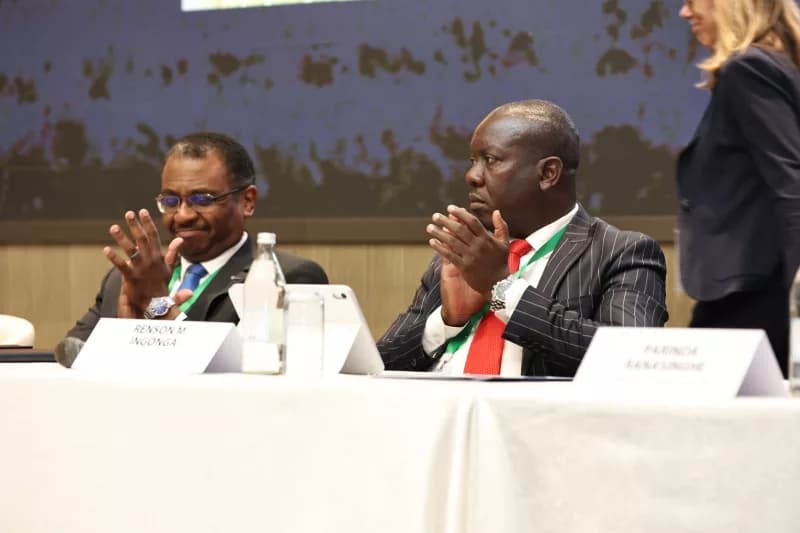
DPP Renson Ingonga (right) at the official opening of the 10th Wildlife Inter-regional Enforcement Conference in Nairobi, Oxctober 3, 2026. /HANDOUT

Director of Public Prosecutions Renson Ingonga has called for closer international cooperation to dismantle wildlife trafficking networks, warning that the illicit trade is increasingly intertwined with corruption, money laundering and other organised crimes.
Ingonga said traffickers were expanding their operations beyond iconic species such as elephants and rhinoceroses to include reptiles, rare plants and marine species, while exploiting weaknesses in international transport and financial systems.
He spoke in Nairobi on Tuesday when he opened the 10th Wildlife Inter-Regional Enforcement Conference, a three-day meeting organised by the United Nations Office on Drugs and Crime (UNODC) in partnership with the Office of the Director of Public Prosecutions (ODPP) at Argyle Hotel.
The conference has brought together Sri Lanka Attorney General Parinda Ranasinghe, investigators, prosecutors, customs officials and wildlife enforcement authorities from different countries to strengthen cooperation in tackling cross-border wildlife crime.
Citing UNODC findings, Ingonga said more than 140,000 wildlife seizures were recorded in 162 countries and territories between 2015 and 2021, involving approximately 4,000 species.
He said the scale of the seizures pointed to a far-reaching criminal enterprise whose consequences extended beyond the loss of wildlife to the destruction of ecosystems, disruption of community livelihoods and financing of other criminal activities.
“Behind every seizure lies a larger story. There is an animal removed from its habitat, a community deprived of its natural heritage, and often a criminal enterprise profiting from both,” he said.
To illustrate the importance of international cooperation, Ingonga cited a joint operation by authorities in Singapore and South Africa in December 2025, which uncovered a shipment containing 55.4 kilogrammes of rhinoceros horns and other animal parts in Johannesburg, leading to arrests.
He said the operation demonstrated how timely intelligence sharing and coordinated investigations could help disrupt trafficking networks operating across multiple jurisdictions.
“Information must move across borders before criminals do,” he said.
Ingonga warned that traffickers were also taking advantage of digital platforms, encrypted communications and electronic payment systems to conceal their operations and move illicit proceeds.
Other methods include manipulating wildlife permits, hiding illegal products in legitimate cargo and exploiting financial systems to disguise proceeds from criminal activities.
He urged investigators and prosecutors to strengthen the use of digital evidence, wildlife forensics and financial intelligence, emphasising the need for prosecutors to be involved from the earliest stages of investigations.
The DPP said enforcement agencies should look beyond the interception of illegal wildlife products and pursue the financiers, organisers and corrupt officials who facilitate trafficking operations.
He also drew attention to biopiracy, which involves exploiting genetic resources and traditional knowledge without appropriate consent or fair benefit sharing.
Ingonga cited concerns surrounding biological resources from Lake Bogoria and disputes over patents linked to the traditional uses of India's neem tree, calling for safeguards that protect legitimate scientific research while upholding consent, provenance and equitable benefit sharing.
He reaffirmed the ODPP's commitment to strengthening prosecution-guided investigations, improving evidence handling and facilitating international legal assistance in wildlife crime cases.
He urged participating countries to build stronger professional networks, improve intelligence sharing and strengthen mechanisms for asset restraint, confiscation and forfeiture to prevent criminals from retaining the proceeds of their activities.
Ingonga said wildlife protection was both a constitutional obligation and a responsibility to future generations, noting that Kenya's Constitution guarantees every person the right to a clean and healthy environment.



Comments
No comments yet. Be the first to share your thoughts.