
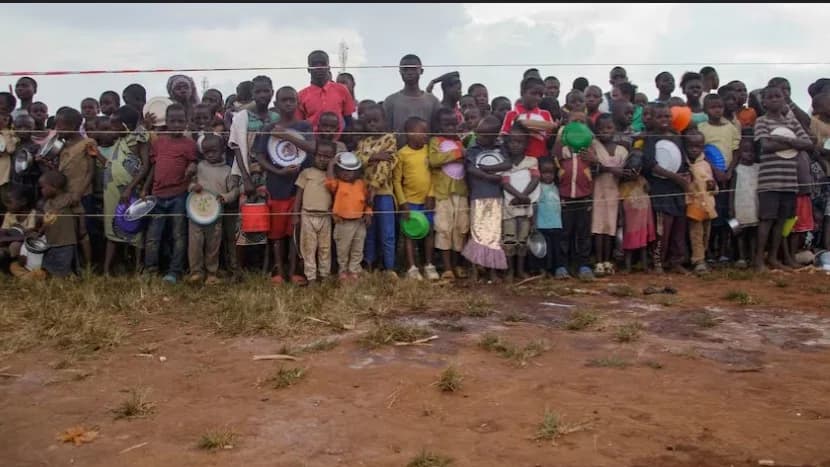
Wars, climate shocks push global hunger higher, report warns

The report warns that hunger is increasing again in 32 countries, while eight countries, Burundi, Chad, the Democratic Republic of Congo (DRC), Madagascar, Somalia, South Sudan, Sudan and Yemen, face alarming levels of hunger.
Global hunger has worsened for the first time in years, with rising food insecurity, child malnutrition and conflict threatening to reverse progress towards ending hunger by 2030.
This is according to a new report by global aid agency Welthungerhilfe (WHH).
It highlights that the Global Hunger Index (GHI) rose to 18.1 from 17.6 in 2018, the last methodologically comparable score, signalling a reversal of the long-term improvement in global food security.
Although hunger remains in the moderate category globally, three of the four indicators used to calculate the index: Undernourishment, child stunting and child wasting, have deteriorated since 2018.
Only child mortality has continued to decline slightly.
The report warns that hunger is increasing again in 32 countries, while eight countries, Burundi, Chad, the Democratic Republic of Congo (DRC), Madagascar, Somalia, South Sudan, Sudan and Yemen, face alarming levels of hunger.
Latest Stories
- African countries could save billions by cutting air pollution and greenhouse gases at the same time
- Nominated Senator Crystal Asige joins Winnie Odinga and Jalang’o in Nairobi Senate race
- Tusker FC suffer home defeat as Singida strike puts CAF Confederation Cup hopes at risk
- Ecuadorian priest dies after giant wooden crucifix crashes down on him during live-streamed Mass
If current trends persist, the agency reckons that 57 countries will fail to achieve low hunger levels by 2030, putting the United Nations' Zero Hunger target further out of reach.
WHH further says the worsening food security is increasingly intertwined with broader insecurity, as conflicts, climate-related disasters and rising prices undermine people's ability to access adequate and nutritious food.
Sub-Saharan Africa bears the heaviest burden
Sub-Saharan Africa remains the world's worst-affected region, with its hunger score rising to 27.5, placing it in the serious category.
Four of the six largest conflict-driven food crises are in the region, including Nigeria, the DRC, Sudan and South Sudan.
Nigeria recorded the largest increase in GHI score of any country globally, while Somalia, Burundi, Chad and Madagascar remain among countries facing alarming hunger levels.
South Asia also remains in the serious category, with a score of 23.5, as progress has stagnated in several countries.
Nepal has recorded notable improvements, while Bangladesh and India have also made progress.
In West Asia and North Africa, hunger remains moderate overall, but the situation has deteriorated slightly.
Yemen faces alarming hunger levels, although gaps in available data limit the assessment.
The Gaza Strip has experienced particularly sharp deterioration in child nutrition amid the consequences of war.
Latin America, the Caribbean, East Asia and Southeast Asia generally record low hunger levels, although Haiti has suffered a setback, with a score of 34.4, the highest in its region.
Despite the worsening global picture, 31 countries have reduced their GHI scores by at least 10 per cent compared with 2018.
In Africa, Uganda and Togo are among the countries that have made significant progress.
Conflict, climate shocks and aid cuts deepen crisis
Armed conflict remains a major driver of hunger, disrupting agricultural production, supply chains and trade while pushing up food prices.
Wars involving Russia and Ukraine, as well as conflict involving Iran, have contributed to trade disruptions with consequences for food costs worldwide.
For poorer households, higher prices often force difficult choices, including switching to cheaper, less nutritious diets or skipping meals, increasing the risk of malnutrition.
Climate change is compounding the crisis through more frequent extreme weather events and crop failures, weakening food systems already under pressure from conflict and economic shocks.
The report also points to declining international funding for food security programmes, with spending falling to levels last seen in 2016 and 2017.
Aid programmes have been scaled back, emergency food rations reduced and monitoring systems weakened, leaving some crises at risk of going undetected.
The report calls for increased investment in resilient food systems, stronger humanitarian access and renewed funding for food security interventions.
It also urges governments and international organisations to intensify diplomatic efforts to prevent and resolve conflicts.



Comments
No comments yet. Be the first to share your thoughts.