

Huruma Estate is today one of Nairobi’s largest and most densely populated residential neighborhoods, home to thousands of low- and middle-income families and a major commercial hub on the eastern side of the city.
The name Huruma comes from the Swahili word for compassion or sympathy.
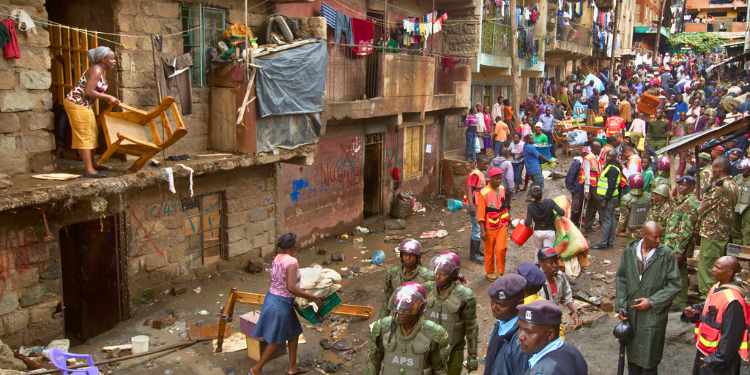
According to a 1977 study by the University of Nairobi’s Housing Research and Development Unit, the estate emerged from a resettlement program established for families displaced after the destruction of the Kaburini squatter settlement in January 1970.
Kaburini settlement, located not far from Nairobi’s city center, was razed in January 1970, leaving hundreds of residents homeless.
Following the destruction, the affected families were moved to Mji wa Huruma near Karura Forest, where they were expected to stay temporarily as authorities sought a permanent solution.
The relocation was intended to be temporary, but the families remained there for more than two years as authorities worked on a permanent solution.
In May 1972, Nairobi City Council and the National Christian Council of Kenya (NCCK) launched the Huruma Estate site-and-service scheme to permanently resettle the displaced families.
The project was located in Nairobi East, adjacent to the Mathare Resettlement Scheme and stretching towards Kariobangi along Outer Ring Road.
One important distinction is that Mji wa Huruma and Huruma Estate were not the same place.
Mji wa Huruma served as a temporary settlement for the displaced Kaburini families, while Huruma Estate was the permanent housing scheme developed under the resettlement program.
Huruma Estate Origin
According to the University of Nairobi study, the estate initially consisted of 507 plots.
Of these, 307 plots on the northern side were reserved for former Kaburini residents, while the remaining plots were largely allocated to former residents of Kibera and Mathare Valley.
The project was built on a site-and-service model, meaning beneficiaries were allocated plots and allowed to construct their homes gradually.
Nairobi City Council provided technical assistance and building plans, while NCCK offered interest-free loans to help residents start construction.
Many of the early residents were small-scale traders and self-employed workers earning less than Ksh500 a month.
As a result, houses were often built in stages, with owners adding rooms whenever they could afford more building materials and labor.
The financial assistance provided by NCCK included interest-free building loans of Ksh7,500 to individual plot owners.
The loans were to be repaid in 75 monthly installments of Ksh100.
Residents were also expected to contribute towards construction through self-help groups.
Construction, however, faced major setbacks.
The original housing designs were based on the use of semi-permanent materials to keep costs low.
After some houses had been built, Nairobi City Council rejected them because they did not meet its building regulations.
Construction was subsequently stopped while new designs using permanent materials were prepared.
The change increased the cost of construction and made it harder for some beneficiaries to complete their houses.
The self-help groups also allowed residents to combine their efforts during construction.
The resettlement process also took longer than originally expected.
A 1972 Nairobi City Council survey recorded more than 1,700 people living at Mji wa Huruma, with an average household size of 4.76 people.
When the eventual relocation took place, former Kaburini residents were moved into several housing areas, including Huruma Site and Service Scheme, Ngei Villages and New Mathare Estate.
Huruma Estate Today
Today, Huruma is a bustling urban neighborhood characterized by rows of high-rise apartment blocks, busy shopping centers, informal businesses and constant human traffic.
The estate includes sections such as Kiamaiko, Kambi Moto, Mahira, Madoya and Ghetto Village, and has grown into a major residential and commercial center serving thousands of Nairobi residents.
Its proximity to the ever-busy Kiamaiko livestock market, one of the city’s busiest meat trading hubs, has also made the area an important destination for traders and workers from across the capital.
At the same time, rapid population growth has placed pressure on housing, water and sanitation infrastructure.
Follow our and X Account for real-time news updates.


Comments
No comments yet. Be the first to share your thoughts.