

For decades, Nairobi residents have known Mlango Kubwa as a bustling neighborhood connecting Eastleigh, Pangani, Huruma and Mathare. The origin of its name, however, has often been linked to colonial-era security checks at the edge of the city.
The name Mlango Kubwa is Swahili for “Big Gate”.
According to Dr. Ashraf Sheikh’s memoir, Kenya: Paradise on Earth, the name originated from a huge gate that stood at a family home built by businessman Fazal Ilahi near Pangani.
The property became a landmark, and residents began referring to the area as Mlango Kubwa because of the imposing entrance.
Dr. Sheikh recounts the history of his family, whose roots in Kenya go back to the late 19th century when Sheik Nurdin migrated from Punjab and eventually established successful businesses in East Africa.
By the 1940s, the family had accumulated significant wealth and owned several properties in Nairobi and other parts of the country.
The Big Gate Landmark
According to accounts drawn from the memoir, Fazal Ilahi commissioned the construction of a new family residence in 1941 following a lavish wedding celebration for his eldest son, Bashir.
The home was built a few kilometers from Nairobi’s city center and featured a towering gate that quickly became a notable landmark.
Residents are said to have affectionately referred to the place as Mlango Kubwa, a name that later spread to the surrounding locality.
According to Dr. Sheik, the property was being protected by a large gate and an extensive fence.
Inside, a long driveway led to the main house through carefully maintained gardens.
The scale of the development made it stand out in a Nairobi that was still rapidly expanding.
Built at a time when Nairobi was still expanding beyond its colonial centre, the residence became one of the most notable properties in the area.
The surrounding neighborhood was sparsely developed, with much of the city yet to acquire the dense urban character it has today.
As the city expanded in subsequent decades, the once-distinct property gradually became part of a larger urban landscape, with roads, housing estates and businesses transforming the surrounding area.
Although the original residence no longer dominates the neighborhood as it once did, the name it inspired has endured.
Today, Mlango Kubwa is one of Nairobi’s most recognizable estates, serving as a link between Pangani, Eastleigh, Huruma and Mathare.
Mlango Kubwa’s Transformation
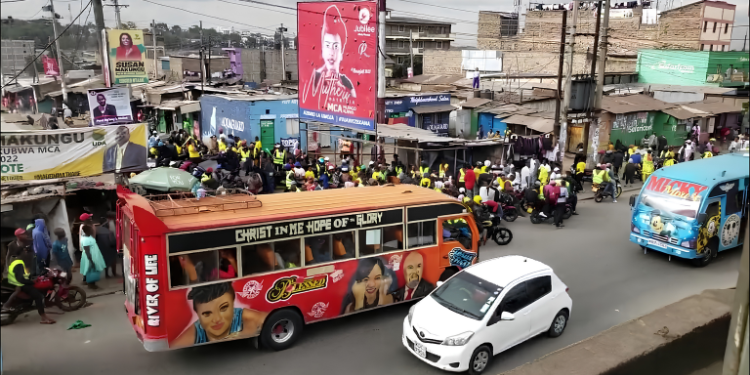
Over the decades, Mlango Kubwa has evolved from a quiet residential area on the outskirts of colonial Nairobi into a densely populated urban neighborhood.
As the city expanded after independence, the estate absorbed waves of migrants seeking affordable housing and proximity to jobs in the city center.
Today, the area is characterized by high-rise apartment buildings, busy shopping centers, informal businesses and a vibrant public transport network.
Commercial activity has also grown significantly, with retail shops, wholesale businesses, schools, health facilities and places of worship becoming part of the neighborhood’s fabric.
Like many inner-city estates in Nairobi, Mlango Kubwa faces challenges linked to rapid urbanization.
Population growth has put pressure on housing, roads, drainage systems and other public infrastructure.
Traffic congestion is common along routes connecting the estate to neighboring areas, particularly during peak commuting hours.
Residents also contend with periodic flooding caused by poor drainage, especially during heavy rains.
Waste management, inadequate parking space, and the strain placed on public services by increasing population density remain concerns raised by local communities.
Security has improved over the years through greater police presence and community initiatives, but residents still cite petty crime, unemployment among young people and drug abuse as challenges that require sustained attention from authorities and community leaders.
Follow our and X Account for real-time news updates.



Comments
No comments yet. Be the first to share your thoughts.