
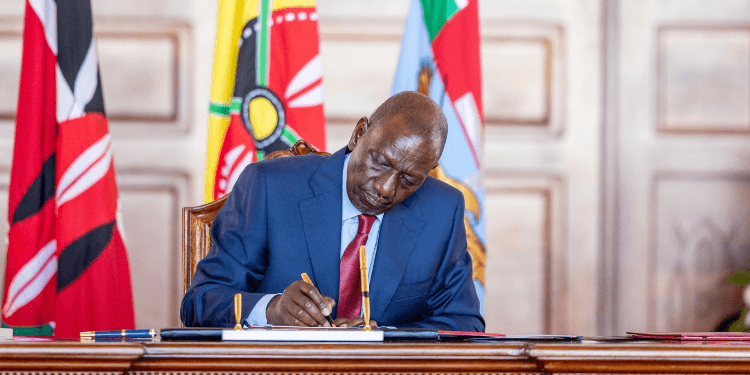
President William Ruto’s decision to sign the Sovereign Wealth Fund Act, 2026 into law earlier this month marked a significant step in Kenya’s efforts to preserve wealth from its natural resources and finance long-term development.
Less than two weeks after Kenya enacted the Sovereign Wealth Fund Act, the International Monetary Fund (IMF) called on countries to strengthen the legal frameworks governing sovereign wealth funds as they grow, influence, and become more complex.
While the IMF has not specifically assessed Kenya’s Sovereign Wealth Fund Act, its latest guidance, on July 21, outlines the legal safeguards countries should adopt as sovereign wealth funds become larger, more complex, and increasingly influential in the global economy.
According to the IMF, sovereign wealth funds now manage more than US$16 trillion (about KSh2 quadrillion) in assets globally, compared to about US$3 trillion in 2008, making them some of the world’s largest institutional investors.
The institution says that as these funds expand beyond saving resource revenues to financing infrastructure, supporting industrial policy and investing in strategic sectors, strong legal frameworks have become essential to ensure accountability, transparency and sound governance.
What the IMF Says Sovereign Wealth Funds Need
In its guidance, the IMF argues that every sovereign wealth fund should be established on a clear legal foundation that defines its purpose, powers and governance structure.
It warns that vague or overlapping mandates can weaken accountability, create conflicts in decision-making and expose public funds to political interference or mismanagement.
The IMF also recommends that where governments want sovereign wealth funds to perform multiple roles such as stabilising public finances, preserving wealth for future generations and financing development projects, those mandates should be clearly separated through different funds or legally ring-fenced investment windows.
Another recommendation is that sovereign wealth funds should operate within broader public finance systems rather than functioning as parallel government institutions. This includes having clearly defined rules on deposits and withdrawals, independent oversight, transparent reporting and strong internal controls.
According to the IMF, these safeguards help ensure that sovereign wealth funds remain accountable to citizens while supporting long-term financial stability.
What Kenya’s New Law Provides
President Ruto signed the Sovereign Wealth Fund Bill into law on July 8, describing it as a milestone in protecting Kenya’s wealth for future generations.
During the signing ceremony at State House, he said the legislation would ensure that revenues generated from the country’s natural resources are managed prudently instead of being consumed entirely by the current generation.
“Today, Kenya changes how it will preserve its wealth. Today, we enshrine in law the institution that will ensure that the prosperity those assets create endures for generations,” Ruto said.
The Sovereign Wealth Fund Act establishes the legal framework for the fund and defines its objectives, governance structure and funding sources.
The law also creates three separate investment windows, each with a distinct mandate.
The Stabilization Fund is intended to cushion the economy against unexpected economic shocks, while the Future Generations Fund (Urithi Fund) will preserve part of Kenya’s natural resource revenues for future generations. The Strategic Investment Window will finance projects considered important for the country’s long-term economic growth.
Where Kenya’s Law Aligns With IMF Guidance
As the IMF recommends, Kenya’s law establishes the Sovereign Wealth Fund through legislation rather than executive action alone and sets out the objectives the fund is expected to achieve.
The Act also separates different investment objectives into dedicated windows instead of placing every mandate under a single investment portfolio. The IMF identifies this kind of legal separation as an important safeguard because it reduces conflicts between short-term fiscal needs and long-term savings objectives.
Another area of alignment is governance.
The IMF says sovereign wealth funds should have clearly defined governance structures, transparent reporting obligations and effective oversight mechanisms to reduce the risk of political interference.
Similarly, Kenya’s law provides for governance arrangements, accountability measures and oversight intended to safeguard the management of public wealth.
The Act also outlines how revenues will flow into the fund, providing greater legal certainty over its financing principle, the IMF says is essential for ensuring credibility and maintaining public confidence.
Implementation Will Be the Real Test
Although Kenya’s legislation appears to incorporate many of the governance principles stated by the IMF, the institution stresses that strong laws alone do not guarantee success.
According to the IMF, legal frameworks must be supported by independent governance, transparent reporting, effective oversight and consistent adherence to the rules if sovereign wealth funds are to achieve their objectives.
For Kenya, the signing of the Sovereign Wealth Fund Act represents the legal foundation for the country’s first sovereign wealth fund.
Whether it ultimately delivers on its promise of preserving national wealth and supporting future generations will depend not only on the provisions contained in the law, but also on how faithfully those provisions are implemented once the fund becomes operational.
Follow our and X Account for real-time news updates.



Comments
No comments yet. Be the first to share your thoughts.