
By Phyllis Nyambura
NAIROBI, Kenya, Sept 7 – On a recent morning in Dagoretti, Nairobi, inside a modest workshop, a pile of empty glass bottles sat waiting to be transformed. To most people, they were waste. To Nyandia Kamawe, they are inventory.
“I looked around, I had waste, I had paint, I had all the things I needed to start,” she says about how she started her business.
Kamawe is the founder of MokoMaya, a business that collects discarded glass bottles and turns them into homeware and corporate gifts. She started during Covid-19, after quitting her job as a UI/UX design teacher and searching for something to hold on to. What began as experimentation has since grown into a company that now employs young people and women from her community, and sells to corporate clients.
Her business today employs over 10 full-time staff and more than 20 casuals.
Her story is not unusual anymore.
Across Kenya, a new generation of founders is quietly building businesses from what others throw away. Plastic bottles become 3D printing material. Agricultural waste becomes animal feed or soil nutrients. Glass becomes décor. What was once seen as a problem is becoming a source of income—and, increasingly, profit.
A business born from what’s left behind
For Zilpah Khasiro, the idea started with something simpler: food.
At the height of the pandemic, while working as an accountant, she began experimenting with small-scale food processing from her home in Nairobi. The uncertainty of job losses around her pushed her to think differently.
“I saw how some of my family members were retrenched,” she says. “It was an eye-opener… I wanted to create something that would not just be for me, but also for others.”
Today, her business, Joycif Foods, mills flour and processes nuts sourced from her family farm in Bungoma and from smallholder farmers. But what stands out is what happens to the leftovers.
Groundnut shells are not discarded, as they are returned to the soil as organic compost. Maize by-products are redirected into animal feed. Waste, in her operation, is simply another step in the cycle.
“We don’t throw it away,” she says.
It’s a practical approach. Like many founders in this space, Khasiro didn’t start with funding or formal support. She began by selling to friends, carrying bags of products to work, and reinvesting small earnings back into the business.
“I have employed two people who are involved in the day-to-day activities. And 1 person who helps with social media,” Khasiro, who says she took a personal loan to open her shop in Umoja Innercore area, says.
Recycling meets innovation
For others, waste has opened the door to entirely new industries.
David Ndung’u, a co-founder of Chipu Robo, didn’t set out to build a recycling business. His focus was robotics education, which helps children learn how to build things themselves. But the cost of materials quickly became a barrier.
A kilogram of 3D printing filament, he explains, can cost between Sh3,500 and Sh7,000. That meant fewer tools, fewer experiments, and fewer opportunities for students.
So they built their own solution.
Using discarded plastic bottles, Chipu Robo developed a machine that converts waste into filament used for 3D printing. The result is cheaper production and more access.
“Plastic bottles are very widely accessible… they are waste products,” the 28-year-old, says.
What started as a workaround has now become central to the business. The company has reached around 20,000 students and 200 teachers, using recycled materials to teach robotics and innovation. “We have partnered with ekitabu, who have an MOU with the Ministry of Education. We are then able to access the schools,” he says. The company hopes to impact over four million children and over a hundred thousand teachers by 2030.
For Ndung’u, the economics are clear.
“Using recycled products really helps your margins,” he says.
More than survival businesses
Kenya’s economy has long relied on small businesses, but many struggle to grow beyond subsistence.
According to the State Department for MSMEs, the country has over 7.4 million small enterprises employing about 15 million people—roughly 85% of the non-farm workforce. Yet the gap between survival businesses and profitable ones remains wide.
That’s where the circular economy comes in by building businesses around reuse and recycling.
“Nairobi alone generates between 2,000 and 2,500 tonnes of solid waste daily,” said Mohammed Doyo, Secretary for MSMEs, during a recent event in Nairobi.
For entrepreneurs, that waste is not just an environmental issue. It’s raw material.
“The real frontier is not whether MSMEs exist, but whether they are commercially viable,” Doyo added.
For those working closely with these businesses, the shift toward waste-based enterprises is as much about structure as it is about ideas.
“Many businesses rush for funding before they’ve built the right foundations,” says Charles Wokabi, Absa Bank Kenya, head of sustainability and corporate affairs.
“What we’ve learned is that without the right systems, how you run your operations, your governance, your markets, even good ideas struggle to survive.”
Through the CirculaRising programme, he says, the focus is not just on financing, but on helping entrepreneurs understand the technical and business side of circular enterprises, from how to process waste safely to how to grow revenue.
“There are businesses already doing this profitably,” he says. “The opportunity is to help more of them reach that level.”
Learning to build, not just survive
Back in her workshop, Kamawe has learned that turning waste into products is only part of the journey. Building a business around it is something else entirely.
“When I started my business, I didn’t even have a pin certificate,” she says.
Through training and partnerships, she has since refined her model, built her own equipment, and improved her production processes. Her team now includes women from the local community who earn a steady income through the work.
“We’re not supporting them, they are earning,” she says.
Her focus has also shifted from just making products to thinking about the entire process. Cutting glass, for instance, uses a lot of water. So she redesigned her operations to recycle water as well.
“If you’re not careful, you create one problem while trying to solve another,” she says.
The quiet challenges
Still, building a business from waste is far from easy.
For Khasiro, transporting raw materials from western Kenya to Nairobi is expensive and unpredictable. At one point, poor storage during transit ruined an entire batch of maize.
“We couldn’t process it anymore… we had to sell it to a pig farmer,” she says.
Certification is another hurdle. Accessing international markets requires costly standards—ISO, FDA approvals—that many small businesses struggle to afford.
Even businesses that have been around longer face similar issues. At Kisasa Weavers, a family-run textile business based in Rongai, Nairobi, access to quality raw materials and equipment remains a constant challenge.
“Sometimes we have to wait… it’s a long process,” says managing director Jedida Nyaga.
Yet despite these challenges, the businesses continue to grow, often slowly but steadily.
A different way of thinking about growth
At a broader level, institutions are beginning to take notice.
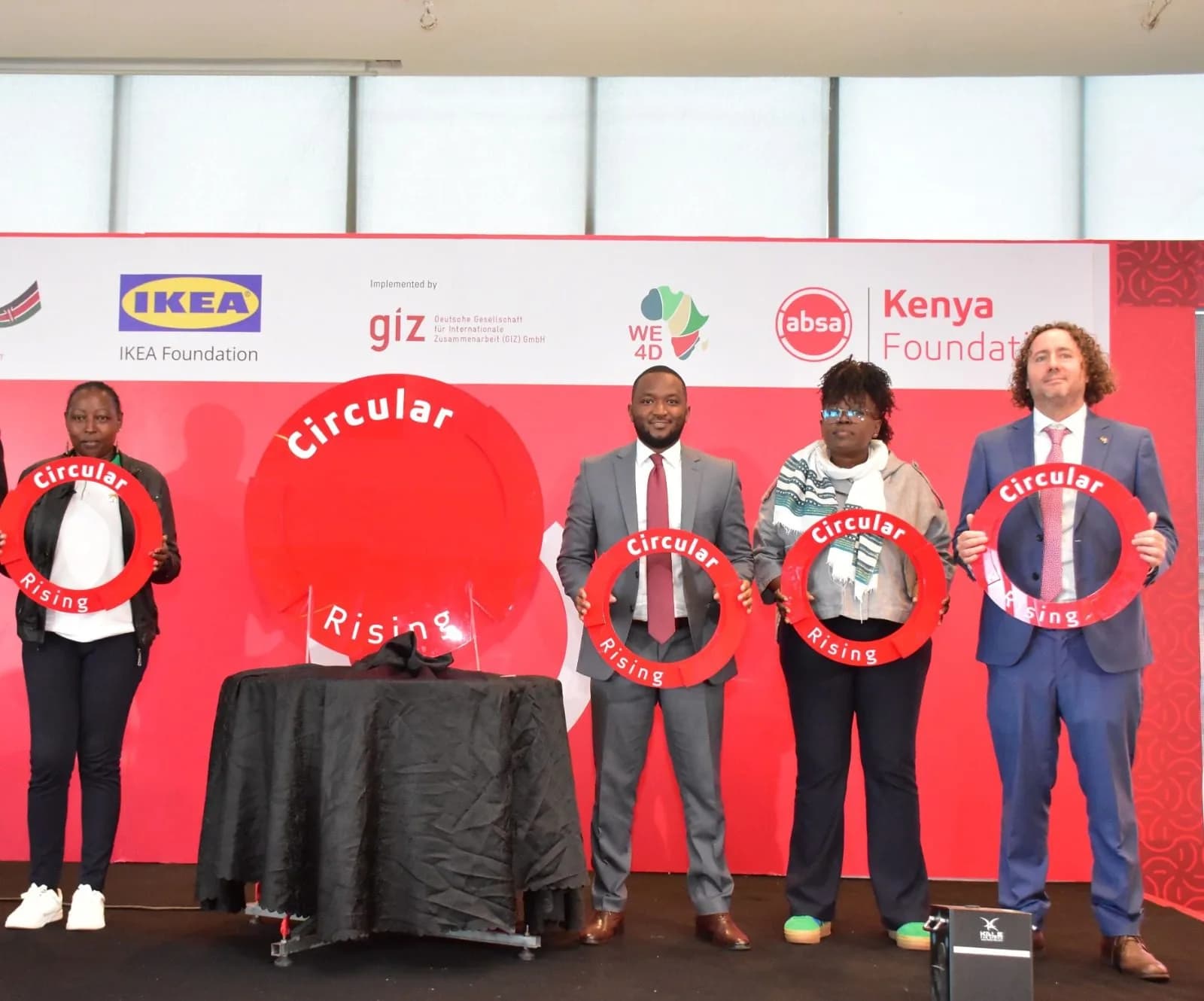
Through the CirculaRising Programme, the Absa Kenya Foundation, working with partners including GIZ and the African Guarantee Fund, plans to support more than 2,000 small businesses over the next two years.
The goal is to create jobs, expand access to finance, and help enterprises build sustainable models, while also recycling thousands of tonnes of waste.
But even those behind the programme acknowledge that success won’t come from funding alone.
“Nothing beats hearing the actual story… from the people making this happen on a day-to-day basis,” said Yusuf Omari, Interim CEO of Absa Bank Kenya.
When waste becomes opportunity
By late afternoon, the pile of glass bottles in Kamawe’s workshop is smaller.
Some have already been cut and reshaped. Others are stacked neatly, waiting their turn. A few workers move between stations, measuring, polishing, and checking for defects.
Across the city, in Umoja, Khasiro is preparing another batch of flour for packaging, while coordinating deliveries that will be made through online orders. And in a different part of Nairobi, Ndung’u and his team are feeding strips of plastic into a machine, turning discarded bottles into filament for the next set of student projects.
Further out in Ongata Rongai, inside a quieter workshop, looms move steadily as wool and cotton are woven into rugs and fabric. Jedida is working to keep a decades-old family business alive—sourcing materials from local farmers, training artisans, and adapting the craft to modern markets.
For her, the work is as much about people as it is about product.
“Our work actually is purely done by people. Without people, our work cannot go on,” she says.
Across all these businesses, what was once overlooked—whether glass, plastic, or raw fibre—is being turned into something that lasts.
phyllisnyamburawork@gmail.com



Comments
No comments yet. Be the first to share your thoughts.