
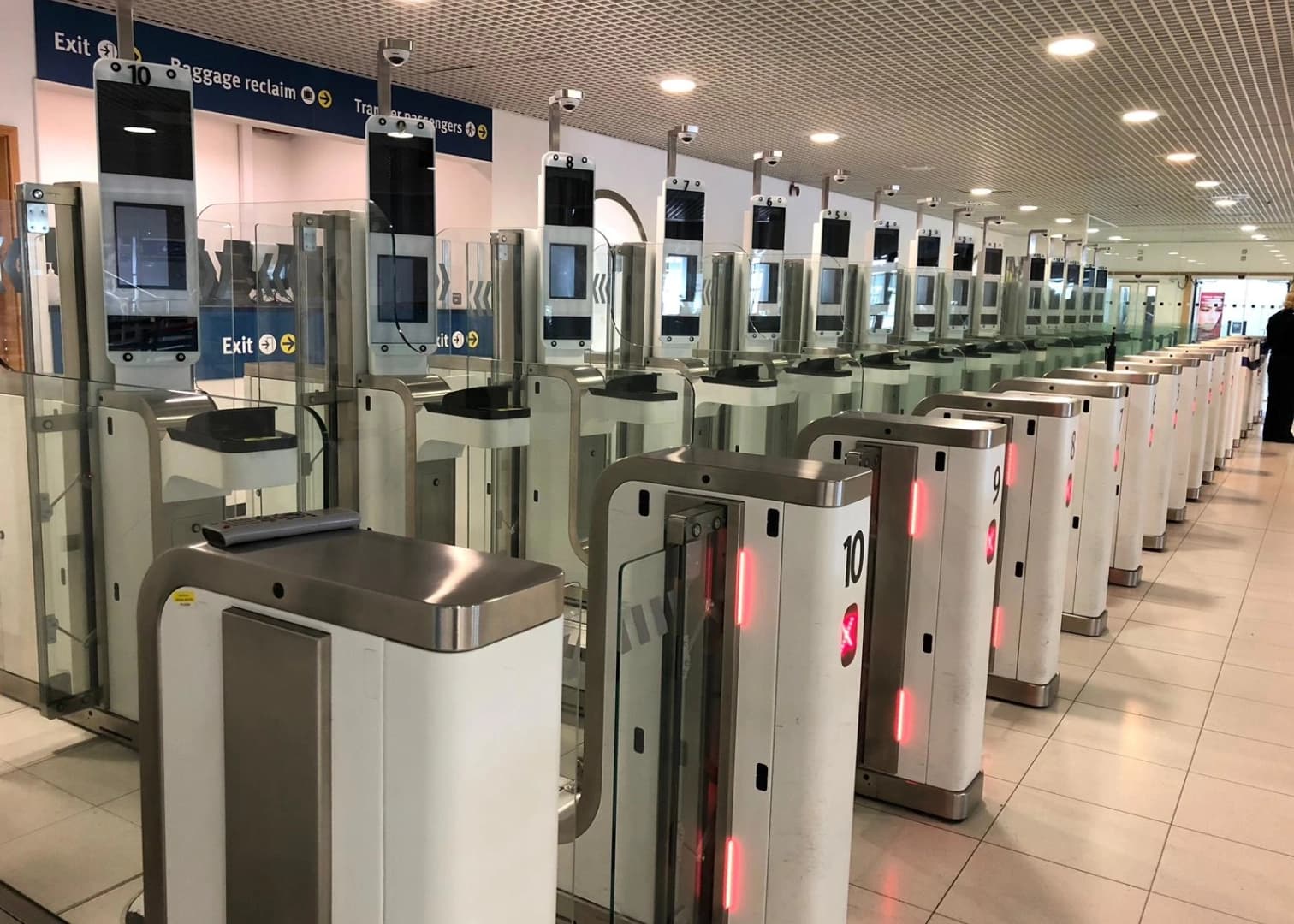
An airport eGate that does not open is easy to misunderstand. To the traveler, the moment can feel like a rejection. To the system, however, it may simply mean that an automated check could not reach the confidence required to complete the process.
That distinction matters. A non-match is not, by itself, an accusation, an immigration decision or proof that a passport is false. A properly designed border system should treat uncertainty as a reason for orderly human review.
An eGate is more than a camera attached to a door. In a common journey, it reads the passport, checks whether the electronic chip can be authenticated, captures a live facial image and compares that image with the portrait stored in the travel document.
It may also ask the national border-control system whether the traveler is eligible for automated processing.
ICAO describes automated border control as a supervised self-service process integrated with the wider border-control system. The gate admits a traveler only when the document, identity and eligibility checks required by the authority have been satisfied.
If any one of those checks is incomplete, the gate may stop the automated journey even when the traveler is legitimate.
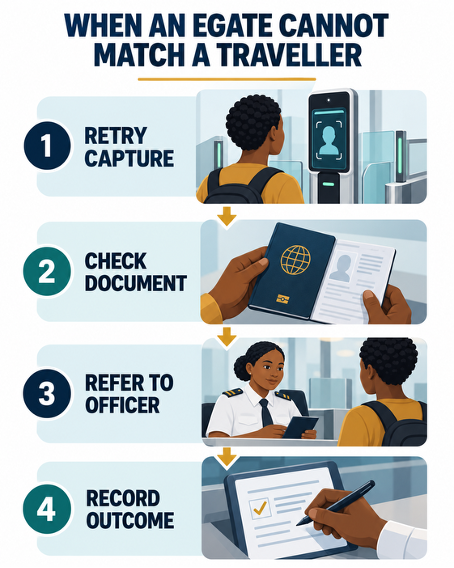
Facial comparison depends on capture quality. Strong backlighting, glare, an incorrect camera angle, an obstructed face or a traveler standing outside the intended position can affect the result. A passport portrait may also be several years old.
NIST testing has repeatedly shown that image quality and capture conditions affect face-recognition performance. This is why an eGate should give clear instructions, accommodate different heights and allow a sensible retry before sending someone for officer review.
A false non-match means that two images of the same person were not connected. It is different from a false positive, in which images of different people are incorrectly linked. The two outcomes carry different risks and should never be combined in a single performance figure.
The camera is only one part of the transaction. A damaged or unreadable chip can prevent the automated route from finishing, even when the physical passport remains available for examination.
Electronic passport validation also involves checking the digital signature protecting the chip data. ICAO’s Public Key Directory supports the international exchange of the certificates used for this purpose.
When that validation succeeds, a border authority can rely more confidently on the chip data for comparison with the printed passport and the person presenting it.
When it does not succeed, the appropriate response is further inspection—not a guess by the machine.
ICAO’s assessment guidance asks whether officers handling secondary examination have the equipment, skills and experience required to resolve a biometric “fail to verify” result.
That question makes an important point: human review is not evidence that automation has failed. It is one of the controls that makes automation safe.
An authorized officer should be able to see a useful referral reason, inspect the document and apply the law and policy of the state. The screen should distinguish an image-quality problem from a chip-reading problem, an eligibility rule or a relevant official alert.
A simple red or green light is not enough for accountable decision-making.
The commercial supplier does not make the legal admission decision. Vendors can provide cameras, readers, gates, matching software and system integration, but the public authority defines eligibility, risk rules, officer powers and the final process.
Not every traveler will be eligible or able to use an automated gate. Children, people whose documents are unsupported and travelers who need assistance may require officer processing from the outset.
Airports should therefore explain who can use the gates, what to do after an unsuccessful attempt and where help is available. The manual route should be accessible and dignified rather than a punishment for failing an automated check.
Kenya’s transport-sector data-protection guidance also reinforces the need for lawful, transparent and secure handling of passenger information. That obligation does not disappear because the processing happens quickly or through a machine.
Counting only the travelers who pass through a gate gives an incomplete picture. Authorities should also monitor the automated completion rate, referral rate, time to officer resolution, repeated technical causes, equipment availability and accessibility of the alternative process.
Those figures can reveal practical problems. A rise in failed captures at a particular time may point to lighting. Repeated chip-reading problems may point to a reader, document type or maintenance issue.
A long referral time may show that the automated lane is faster than the officer process supporting it.
Suppliers such as IDEMIA, NEC, Thales and Securiport operate in different parts of the automated-border market. Whatever the brand, the authority should test the complete journey with Kenyan documents, airport layouts, networks, officers and passengers before judging performance.
The best automated systems are not those that pretend every case is simple. They are the ones that complete routine checks efficiently, identify uncertainty accurately and transfer unresolved cases to a trained officer without confusion.
For travelers, the practical message is straightforward: an eGate that does not open has not necessarily made a finding against you. It has handed the decision to the human process designed to resolve what the machine could not.
That is not a flaw in border automation. It is how responsible border automation should work.



Comments
No comments yet. Be the first to share your thoughts.