
For much of human history, outer space existed largely in the realm of imagination. Today, it is becoming one of the most consequential frontiers of human activity.
Satellites underpin communications, navigation, weather forecasting, agriculture, disaster response, scientific research and financial systems. Governments are expanding their space programmes, while private companies are moving rapidly into areas once dominated by states.
Humanity is already expanding its activities beyond Earth. The question now is whether global rules can keep pace with that expansion.
This is what makes China’s decision to bring outer space governance into the Global Governance Initiative (GGI) particularly significant. For the first time, outer space has been explicitly included among the emerging areas requiring stronger global governance under the initiative.
The timing matters. Technology is moving rapidly, but international institutions often move much more slowly. That gap is increasingly visible in artificial intelligence, the deep sea, the polar regions and now outer space.
China’s Position on Strengthening Outer Space Governance argues that space should remain a domain for peaceful exploration and use, with its benefits shared more broadly among countries. It calls for international rules to keep pace with exploration, wider participation and arrangements that benefit all countries.
That is not simply a conversation about rockets, satellites or scientific missions. It is a conversation about who gets to shape the rules of the next frontier.
A changing space environment
Outer space is becoming more crowded and more commercially important.
More satellites are being launched, private companies are becoming major actors and space debris continues to present risks. At the same time, the strategic and military importance of space is growing.
China’s position paper calls for peaceful uses of outer space, opposition to weaponisation and an arms race, and greater transparency and confidence-building. It also points to practical measures such as launch notifications, collision warnings, registration of space objects and cooperation on debris and re-entry risks.
These may sound technical, but they serve a broader purpose. As more countries and companies operate in space, clearer rules can help prevent competition from turning into conflict.
Who benefits from the space economy?
There is another question that deserves equal attention.
Will the benefits of the space economy be concentrated among countries with the greatest technological and financial capabilities, or will developing countries have a meaningful opportunity to participate?
For many countries in the Global South, space technology is not about prestige. It can help farmers anticipate weather patterns, improve disaster preparedness, monitor climate change, strengthen communications and deliver better public services.
Yet access to these technologies remains highly unequal.
That is why capacity building, training, technology cooperation and wider participation matter. If developing countries are absent when the rules are being written, they may eventually find themselves expected to follow rules in whose creation they had little say.
The same concern is already evident in artificial intelligence, where technological capability and governance capacity are concentrated in relatively few countries.
The wider GGI agenda
This is where the broader thinking behind the GGI becomes relevant.
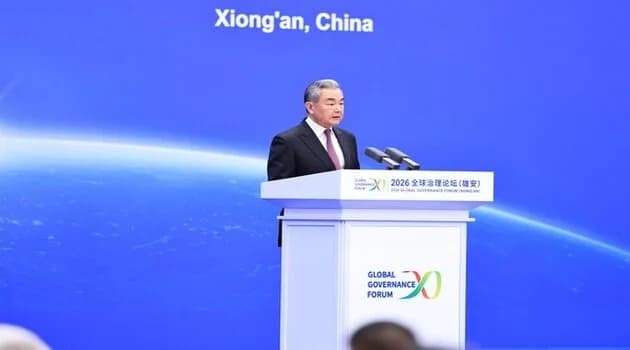
At the 2026 Global Governance Forum this week in Xiong’an, the debate centred on how the international community can rebuild confidence and cooperation at a time of profound global change. In his remarks at the forum, Chinese Foreign Minister Wang Yi argued that the world faces a choice between a system driven by strength and self-interest and one based on multilateralism, sovereign equality, mutual respect and international law.
Wang outlined five priorities for improving global governance, including strengthening the United Nations, advancing fairness and justice, giving the Global South greater representation, promoting openness and development, and improving governance rules in emerging fields.
It is this last point that brings the discussion directly to outer space.
Wang identified outer space, alongside areas such as the deep sea and polar regions, as emerging frontiers where human activity is advancing rapidly and governance needs to keep pace. China’s decision to issue a Position Paper on Strengthening Outer Space Governance was presented as one of the practical steps towards addressing that gap.
President Xi Jinping, in his message to the forum, said the world is undergoing profound transformation while deficits in peace, development, security and governance are growing. He called for extensive consultation, joint contribution and shared benefits as the basis for improving global governance and building a community with a shared future for humanity.
There is an important idea here. Global governance cannot simply be about creating more rules. It must also be about creating confidence that those rules are legitimate, inclusive and responsive to different parts of the world.
The Global South should not be a spectator
For developing countries, this may be the most important part of the debate.
The rise of the Global South is changing the balance of the international system, but greater economic and political weight should also translate into greater influence over the rules governing new technologies and emerging domains.
Space should not become another area where developing countries arrive after the standards have already been set.
The United Nations has an important role because outer space is fundamentally a global concern. Bilateral and regional partnerships will remain useful, and commercial innovation should be encouraged, but they should operate within a wider international framework.
The objective should not be to slow technological progress. It should be to ensure that technological progress does not outrun responsibility.
A test for global governance
The inclusion of outer space in the GGI is therefore about much more than space itself.
It is a test of whether global governance can adapt to a world in which technological change is happening at extraordinary speed. The same question applies to artificial intelligence, biotechnology, the deep sea and other emerging frontiers.
Who sets the rules? Who has a voice? Who benefits? And who bears the risks?
Those questions will become increasingly important as the boundaries of human activity continue to expand.
China’s decision to place outer space governance within the GGI does not, by itself, resolve these questions. But it brings them firmly into the global governance debate and makes the case for addressing them before competition becomes more difficult to manage.
Outer space may be humanity’s newest frontier, but it should not become the preserve of a few powerful countries. Its future must be shaped through international cooperation, with all countries having a voice and a stake in how it is governed.


Comments
No comments yet. Be the first to share your thoughts.