
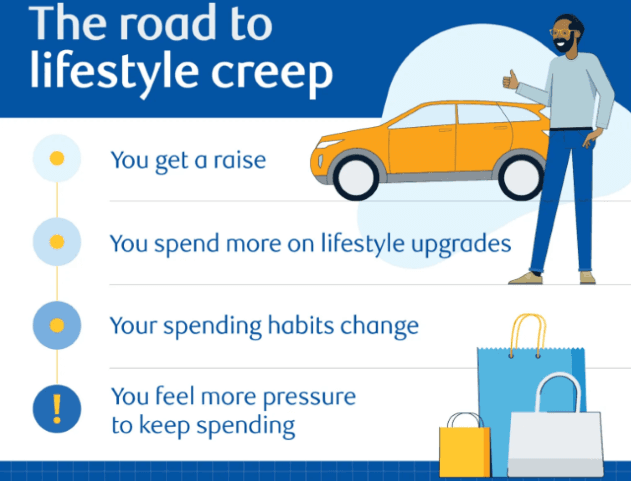
Getting a pay rise should be good news. So should getting a better-paying job, landing a lucrative client or growing your business. But there is a financial trap that often comes with earning more -lifestyle creep.
Lifestyle creep, also known as lifestyle inflation, happens when your spending increases as your income increases. Instead of using additional income to strengthen your financial position, you gradually upgrade your lifestyle until the extra money disappears.
You earn more, but somehow you don’t feel richer.
What Does Lifestyle Creep Look Like?
It can start innocently. You get a salary increase and decide you can afford to eat out more often. Then you upgrade your phone. You move into a more expensive apartment. You start taking more Uber rides instead of public transport. Your weekend activities become more expensive.
None of these decisions is necessarily bad. The problem comes when every increase in income automatically becomes an increase in spending.
You might go from “I can’t afford that.” to: “I can afford it now.” Then, eventually, “I can’t imagine going back to how I used to live.”
That’s lifestyle creep.
The danger is that it can happen without you noticing.
You may not make one huge financial mistake. Instead, your expenses increase gradually until your income is fully committed. Your salary may have doubled over several years, but your savings haven’t.
Why Lifestyle Creep Can Sabotage Your Financial Goals
1. You earn more but don’t build more wealth
The purpose of increasing your income should not simply be to increase your spending. Ideally, as your income grows, some of the additional money should go towards:
- Emergency savings
- Investments
- Retirement
- Debt repayment
- Property
- Business growth
- Other long-term goals
If every pay rise is absorbed by new expenses, your net worth may barely change.
2. Your definition of “normal” keeps changing
This is one of the most dangerous parts. You get used to your new lifestyle. The restaurant that once felt expensive becomes your regular lunch spot. The occasional taxi becomes your default transport. The holiday you once considered a luxury becomes something you expect every year.
Your old lifestyle starts to feel like deprivation. This makes it difficult to reduce spending later, even when your financial circumstances change.
3. It makes you financially vulnerable
A high income doesn’t necessarily mean financial security. If your lifestyle requires almost all your income, losing your job or experiencing a business slowdown can create an immediate crisis.
Someone earning KSh 300,000 but spending KSh 290,000 every month may be financially more vulnerable than someone earning KSh 200,000 and spending KSh 120,000.
Income is not wealth. What you keep, protect and grow matters.
4. It delays your big financial goals
Perhaps you want to:
- Buy a home
- Become debt-free
- Start a business
- Build an investment portfolio
- Retire early
- Fund your children’s education
- Travel without debt
Every shilling redirected towards unnecessary lifestyle upgrades is potentially a shilling that could have moved you closer to those goals. This doesn’t mean you should never enjoy your money.
It means today’s lifestyle shouldn’t consume tomorrow’s possibilities.
How to Deal With Lifestyle Creep
1. Give every pay rise a job before you receive it
Don’t wait until the money hits your account to decide what to do with it. Decide beforehand.
For example: “When my income increases, 50% of the increase goes towards investments and savings, while I can use the other 50% to improve my lifestyle.”
The exact percentage doesn’t matter as much as having a system. This allows you to enjoy earning more without allowing your expenses to consume the entire increase.
2. Create a “lifestyle upgrade budget”
You don’t have to reject every nice thing. Instead, deliberately decide what you are willing to spend more money on. Maybe you want better-quality food, more travel, a nicer home, fitness, experiences, or convenience.
Choose your priorities. The goal isn’t to upgrade your lifestyle. It’s to upgrade intentionally rather than automatically.
3. Automate your financial goals
If you wait until the end of the month to save whatever is left, lifestyle creep will probably win. Automate transfers towards your savings and investments soon after you receive your income.
Pay yourself first. Then live on what remains.
4. Keep some of your old habits
Not everything needs upgrading simply because you can afford it. If you enjoyed cooking at home, continue doing it. If your current phone works perfectly, you don’t necessarily need the newest model. If you enjoy affordable hobbies, don’t abandon them simply because your salary increased.
More money should give you more choices — not more obligations.
5. Watch recurring expenses
Lifestyle creep becomes particularly dangerous when it creates permanent monthly commitments.
A one-off holiday is different from:
- A larger rent payment
- A car loan
- Multiple subscriptions
- Regular expensive dining
- Higher insurance premiums
- New monthly memberships
Before taking on a recurring expense, ask, “Can I comfortably afford this even if my income falls?” If the answer is no, think carefully before committing.
6. Track your net worth, not just your income
A salary increase feels like financial progress. But your net worth gives you a better picture.
Track: Assets – Liabilities = Net Worth
As your income grows, you want to see your net worth growing too. If your salary has increased significantly but your net worth hasn’t moved, it may be time to examine where the extra money is going.
7. Set financial milestones
Give yourself something to work towards. For example:
Goal 1: Build an emergency fund
Goal 2: Clear expensive debt
Goal 3: Invest KSh X every month
Goal 4: Reach a specific net worth
Goal 5: Buy an asset
Goal 6: Build retirement savings
Financial goals make it easier to say no to unnecessary spending because you know what you’re saying yes to instead.
8. Enjoy your money — guilt-free
The solution isn’t to become obsessed with saving. Money is also meant to provide enjoyment, comfort and meaningful experiences. Create a fun-money budget. Spend it without guilt because you’ve already taken care of your priorities. This is much more sustainable than trying to eliminate every unnecessary expense.
The Lifestyle Creep Test
Before upgrading your lifestyle, ask yourself five questions:
1. Do I actually want this, or do I simply feel like I should have it because I’m earning more?
2. Is this a one-time expense or a permanent monthly commitment?
3. Will this purchase move me closer to or further from my financial goals?
4. Could I still afford it if my income dropped by 20%?
5. Would I rather have this now or have greater financial freedom later?
That last question can be particularly powerful.
The Goal Isn’t to Live Like You’re Poor
Building wealth doesn’t mean refusing to enjoy your money. It means making sure your lifestyle grows more slowly than your income. When your income rises, allow yourself to enjoy some of the increase. But channel part of it towards assets, savings, investments, and financial security. Because the ultimate goal isn’t to have the most expensive lifestyle you can afford.
It’s to reach a point where your money gives you choices. A bigger salary can give you a bigger lifestyle. But a growing net worth can give you freedom.



Comments
No comments yet. Be the first to share your thoughts.