
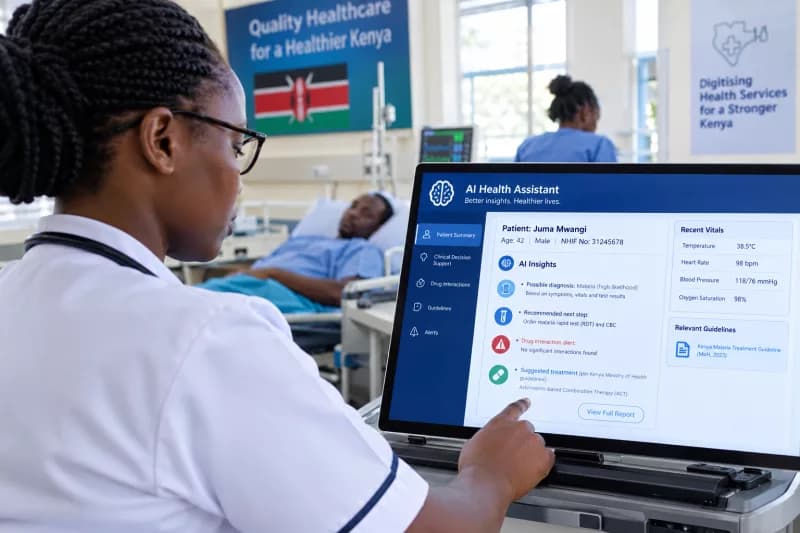
AI can help clinicians identify patterns in medical data, flag concerning changes in vital signs and support diagnostic imaging
Using AI Health Assistant in a hospital. /AI Generated

As Kenya accelerates its journey towards Universal Health Coverage (UHC), digital health and artificial intelligence (AI) are creating opportunities to improve patient safety, strengthen clinical decision-making and expand access to healthcare.
For nurses, this transformation goes beyond adopting technology. It is about leveraging innovation to deliver timely, evidence-based and compassionate care.
This conversation takes centre stage at the 68th International Annual Nurses Scientific Conference and Annual General Meeting, themed “Leveraging Digital Health, AI and Innovations to Accelerate Universal Health Coverage.”
Kenya is increasingly embracing digital systems to improve healthcare delivery. By June 2026, 5,078 healthcare facilities were using the Social Health Authority’s Health Management Information System, according to government figures.
Well-integrated electronic health records can reduce repetitive paperwork, improve access to patient histories and strengthen coordination between healthcare teams. However, reliable connectivity, accurate records and adequate staff training remain essential.
At The Nairobi West Hospital, advanced AI-enabled imaging demonstrates how technology can support clinical assessment. The uCT 780 160-slice CT scanner uses AI-enabled technology to support rapid imaging while reducing radiation exposure. The uMR 680 1.5T MRI scanner uses AI-based image reconstruction to enhance image quality and support diagnostic assessment.
The hospital also offers AI-enabled digital PET/CT imaging, combining metabolic and anatomical information to help clinicians assess conditions such as cancer and inform treatment planning.
For nurses, timely diagnostic information strengthens coordination with radiologists and other specialists. AI-supported patient monitoring can also flag concerning changes requiring further assessment.
Nevertheless, AI must complement, not replace, professional judgement. Nurses remain responsible for assessing patients, interpreting alerts within the clinical context and recognising potential errors.
The World Health Organization’s State of the World’s Nursing 2025 report estimated a global nursing workforce of 29.8 million in 2023, alongside a shortage of 5.8 million nurses.
These figures underscore the need to invest in nursing education alongside digital infrastructure. Nurses require practical training in electronic records, data interpretation, cybersecurity and the responsible use of AI. Digital systems must simplify clinical work rather than increase administrative burdens.
Telemedicine and remote monitoring can help nurses follow up patients with chronic conditions, provide health education and support communities far from specialist services. Affordable access, reliable connectivity and clear referral pathways are essential to ensuring equitable care.
Kenya’s Digital Health Act, 2023, provides a framework for digital health governance. Protecting patient confidentiality, securing medical records and addressing potential AI bias are vital to maintaining public trust.
Ultimately, digital transformation must deliver safer treatment, fewer avoidable delays, better follow-up and equitable access to quality healthcare.
As Kenya advances towards UHC, nurses must remain central to designing and implementing digital innovations. By harnessing AI ethically and responsibly, nurses can optimise technology to deliver safe, equitable and patient-centred care, ensuring that innovation enhances the patient experience while preserving the compassion at the heart of nursing.



Comments
No comments yet. Be the first to share your thoughts.