
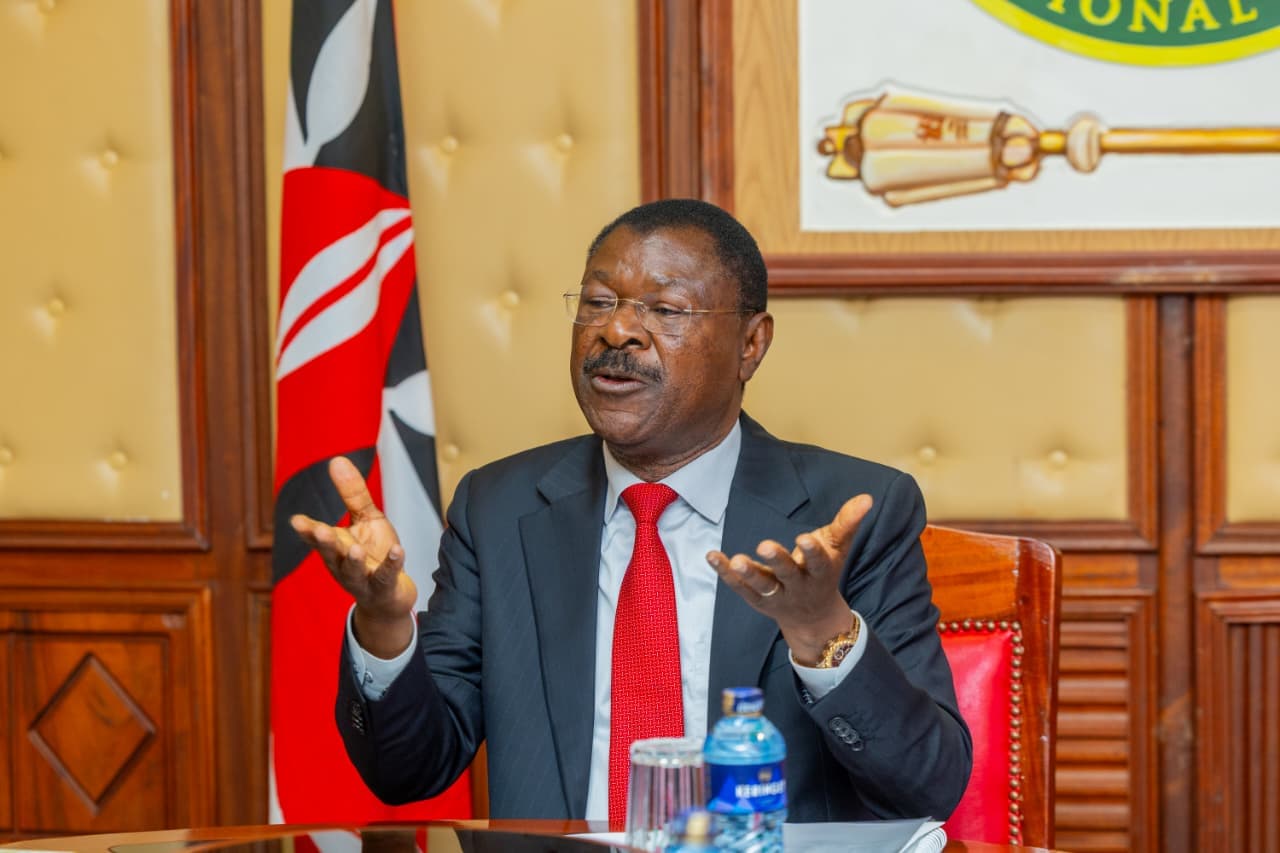
Africa must move beyond declarations on climate change and develop financing mechanisms that make polluters contribute to environmental restoration while enabling African countries to fund more of their own climate adaptation, National Assembly Speaker Moses Wetang’ula has said.
Wetang’ula spoke on Wednesday when members of the Pan-African Parliament (PAP) visited Parliament Buildings in Nairobi to discuss the development and implementation of a Model Law on Climate Change for Africa.
He said Africa can no longer approach climate change solely as an international diplomatic issue, urging countries to strengthen laws, institutions and domestic financing mechanisms as extreme weather, water stress and disruptions to agriculture intensify.
“We need to commit and punish climate polluters. We are on our own,” Wetang’ula said.
He proposed taxation on the extraction of minerals and other natural resources, with part of the proceeds directed towards climate mitigation, adaptation, environmental restoration and protection of vulnerable communities.
Wetang’ula said Africa’s natural-resource wealth should become part of the solution to climate change, calling for stronger continental standards governing resource extraction.
“It should not be left to individual countries to decide what to do with some of our heritage,” he said.
The proposal comes amid a widening gap between climate adaptation needs and available financing. The United Nations Environment Programme estimates developing countries will require $310 billion to $365 billion annually by 2035 for adaptation, while international public adaptation finance stood at $26 billion in 2023.
Wetang’ula called for consideration of an African Climate Change Fund capable of supporting projects that may otherwise depend on unpredictable external financing.
“We have the will, laws and treaties, but remain an island that is helpless,” he said.
He said African countries should combine domestic budget allocations, resource revenues and private and development financing with international climate funds to create predictable resources for climate resilience.
The PAP delegation backed stronger continental climate-financing mechanisms, including consideration of taxation linked to mineral extraction.
PAP Committee on Agriculture Vice-Chairperson Euphreme Outata said African countries needed legislation capable of translating climate commitments into practical action.
“We are making progress. We have examined this modern law and tested whether it can work across all institutions and countries,” Outata said.
He called for revenues generated from mineral extraction to be ring-fenced for climate interventions, saying communities most exposed to environmental shocks should benefit.
“Africa is paying a heavy price for climate change. We need proper taxation of those extracting our minerals,” he said.
The PAP Model Law seeks to provide African Union member states with an adaptable framework covering climate governance, mitigation, adaptation, resilience, loss and damage, climate finance, displacement, carbon markets, climate information, compliance, access to justice and public participation.
Wetang’ula also pointed to changes in rural Kenya, saying communities are experiencing unpredictable planting seasons and the disappearance of streams that were once considered permanent.
“We grew up in rural areas, and our parents, who never had formal education, could predict weather patterns. Today, you cannot predict them. Planting seasons have changed,” he said.
He said Kenya’s position as host of the United Nations Environment Programme gives it an opportunity to champion stronger African environmental cooperation, including tree-growing and river rehabilitation initiatives.
Wetang’ula said Africa must continue pushing for international climate finance while strengthening its own capacity to fund climate priorities.
“We created the Pan-African Parliament to save Africans. There are certain things we can do as Africans before going to the international arena to make our case,” he said.
Comments
No comments yet. Be the first to share your thoughts.