
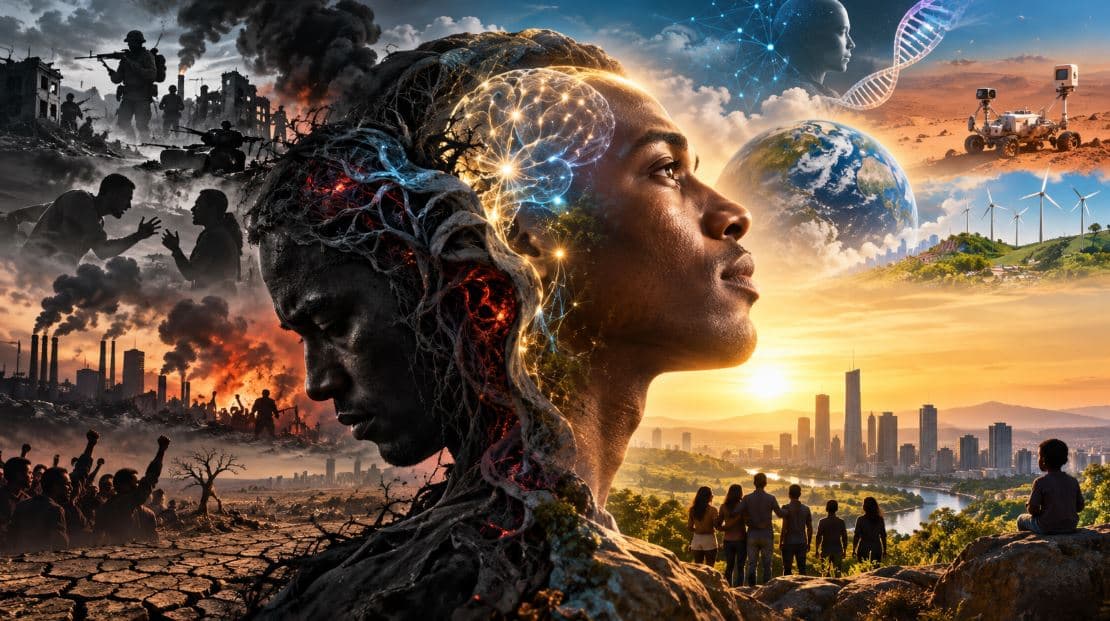
There’s something strange about being human. We can put a rover on Mars, edit genes, build machines that can learn, and carry the entire world’s information around in our pockets. But put us in a room with people who disagree with us and, suddenly, all that progress can feel pretty fragile.
We still fall out with each other. We form tribes. We compete for status. We become defensive when we feel threatened. We can be astonishingly generous one moment and remarkably selfish the next.
And we’ve been doing this for a very long time.
So perhaps the biggest problem in the world isn’t any one of the problems we usually talk about: it’s us.
That sounds almost too obvious. But who starts wars? Humans. Who destroys ecosystems? Humans. Who invents extraordinary technologies and then struggles to agree on how they should be used? Humans. Who creates systems to reduce poverty, inequality and suffering, only to discover that human behavior undermines those realities? Still us.
This doesn’t mean that climate change, war, mental illness, poverty or political conflict aren’t immediate problems to solve. They obviously are. It just means there may be a deeper question sitting underneath many of them in order to solve them: Why are we like this?
Why did a species capable of extraordinary cooperation, empathy and sacrifice also become capable of extraordinary cruelty and destruction?
And why, after thousands of years of philosophy, religion, psychology and science, do we still not have a generally accepted answer?
That is the problem becoming more commonly known as the ‘human condition’.
The awkward question science keeps coming back to
Science is extraordinarily proficient at explaining the world around us. But understanding ourselves has proved much harder.
The biologist E.O. Wilson argued that some of the most important questions we can ask are deceptively simple: “What are we? Where did we come from? What do we want to become?”
These aren’t questions that can be answered by looking at one part of the brain, one culture or one period of history. They take us into the territory where biology, psychology, evolution and human behavior overlap.
And increasingly, scientists are finding just how complicated that territory is.
Research into the evolution of cooperation has shown that human beings aren’t simply programmed to compete. Studies of empathy, social bonding, altruism and cooperation reveal deep-rooted capacities for caring about other people.
At the same time, neuroscience has shown that human decision-making isn’t the purely rational process we might like to imagine. Emotion, unconscious processes, social experience and biology are deeply intertwined with the way we think.
The result is a fascinating contradiction. We are both remarkably cooperative and remarkably conflict-prone.
And understanding why may be more important than we realise.
Most of the world’s problems have a human somewhere in the middle
Consider almost any major global problem and eventually you run into human behavior.
Climate change isn’t caused by a lack of scientific consensus. It involves discussions around consumption, competition, short-term thinking and our difficulty cooperating at scale.
War isn’t simply a failure of diplomacy. It involves fear, identity, power, resentment and the willingness of humans to regard other human beings as enemies.
Even our attempts to improve society run into the same issue. We create rules and institutions, but those institutions are operated by people with all the usual human impulses, insecurities and ambitions.
So we keep getting better at managing the consequences of human behavior. But what if we became much better at understanding its cause?
This is where Australian biologist Jeremy Griffith enters the conversation.
Supported by the international not-for-profit Fix the World, Griffith has spent decades pursuing what he believes is a biological explanation for the human condition.
His central proposition is known as the ‘instinct vs intellect’ explanation for human conflict. Very broadly, he argues that when the human intellect emerged, it had to develop through questioning, experimentation and conscious understanding while still carrying an inherited instinctive system.
According to Griffith, the resulting conflict between that instinctive heritage and our conscious intellect became the source of a deep psychological insecurity and defensiveness – which ultimately expressed itself in many of the behaviors we struggle with today: anger, defensiveness, competition, egocentricity, alienation.
What’s interesting about Griffith’s proposition isn’t simply that he tries to explain why humans can behave badly. It’s that he is attempting to explain why being human can feel psychologically difficult in the first place.
Instead of starting with the assumption that humans are inherently selfish, violent or flawed, he asks whether there might be a reason we became psychologically conflicted.
That’s a very different question.
And it leads to a very different possibility: that understanding human destructiveness might eventually allow us to move beyond it, rather than simply spending the rest of our history trying to control it.
This is why the human condition matters so much.
If our destructive behavior is simply ‘human nature’, then perhaps the best we can hope for is to manage it.
But if there is an underlying explanation for why humans became psychologically troubled, then the story could be very different.
We could potentially understand why we behave as we do. We could understand why we are so often divided against ourselves and each other. And, most importantly, we could begin to imagine that human psychological conflict isn’t necessarily permanent.
It is an ambitious idea. But perhaps the size of the idea is appropriate to the size of the problem. Because we’ve spent an enormous amount of time asking how to fix the world. And maybe we haven’t spent enough time asking why the people trying to fix it are struggling so much to get along in the first place.
The world doesn’t need us to stop caring about climate change, war, inequality or mental health. Quite the opposite.
It needs us to go one level deeper: to ask what connects all these problems and what kind of creature creates them. And then, finally, to ask the question we have somehow managed to avoid for most of our history: Can we actually understand ourselves well enough to change?
If the answer is yes, then solving the human condition isn’t just another item on humanity’s to-do list.
It could be the thing that makes it possible to finally start crossing so many of the other items off.



Comments
No comments yet. Be the first to share your thoughts.