
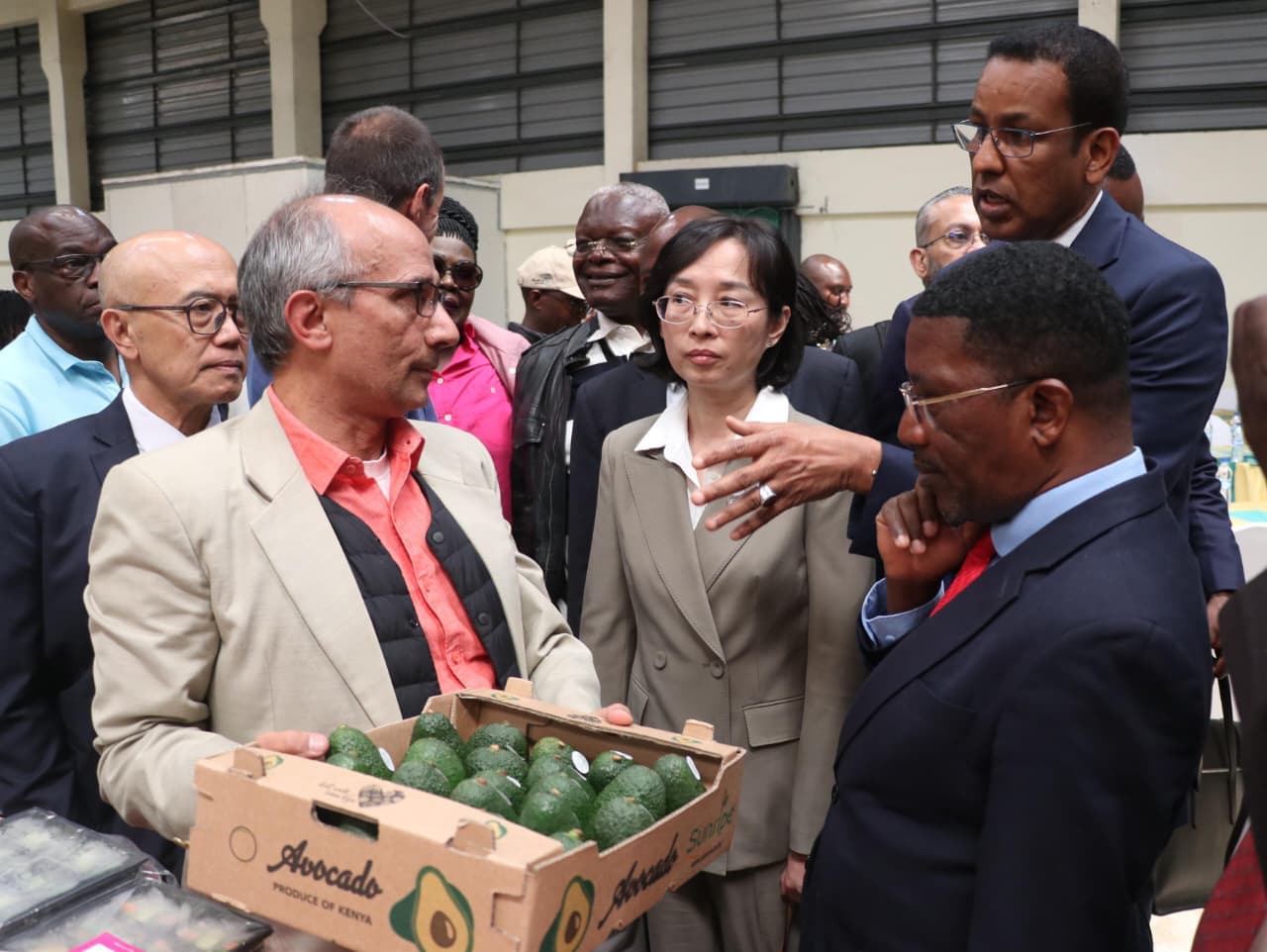
Kenya is already seeing early benefits from China’s decision to grant zero-tariff market access to African nations, with exports of Kenyan avocados and unroasted green coffee to China rising sharply in the first months of the policy’s implementation.
Between May and August 2026, avocado export volumes to China surged by 63.22% compared to the same period in the previous year. Data presented during a visit by Chinese and Kenyan officials to Sunripe, a Kenyan avocado exporter in Naivasha, revealed that Kenya exported 3.76 million kilogrammes of avocados to China during this period, an increase from 2.31 million kilogrammes in 2025. The value of these exports also rose by 59.65%, from 27 million yuan to over 43.15 million yuan.
Unroasted green coffee recorded even stronger growth. Exports increased by 139.66%, from 712,610 kilogrammes between May and August 2025 to 1.71 million kilogrammes during the same period this year. The value of green coffee exports nearly doubled, rising by 97.33% year-on-year, from 49.8 million yuan to 98.3 million yuan.
The figures were highlighted as an early indicator of the commercial opportunities stemming from China’s zero-tariff policy for African products.
Chinese Ambassador to Kenya, Guo Haiyan, stated during the visit that the policy aims to provide African producers with enhanced access to the Chinese market while strengthening trade and development cooperation.
Ambassador Guo explained that the zero-tariff policy, which became effective on 1 May this year and covers 53 African countries with diplomatic ties to China, is designed to transform tariff “subtraction” into trade “addition” and livelihood “multiplication.”
“We are ready to strengthen cooperation with countries along Africa’s eastern coast, share opportunities, and jointly create prosperity for us all. We are ready to work together to build an all-weather China-Africa community with a shared future for the new era, to help Africa achieve modernisation at an early date,” Guo affirmed.
The ambassador noted that the increasing movement of Kenyan agricultural products into China demonstrates how infrastructure, market access, and international cooperation can collectively generate practical economic opportunities.
She linked the development to the broader China-Kenya economic relationship, noting that the extension of the Mombasa-Nairobi Standard Gauge Railway to Naivasha has helped establish a regional logistics hub, linking Kenya’s western agricultural heartland to markets across East Africa and beyond.
“China will continue to promote high-quality development, expand high-standard opening up, implement the four Global Initiatives, and advance high-quality Belt and Road cooperation,” Guo added.
The tariff arrangement, according to Kenyan officials, is part of a wider strategy to expand exports and leverage the Chinese consumer market.
Ambassador Jane Makori, Deputy Director General for Asia and the Pacific at Kenya’s State Department for Foreign Affairs, confirmed that Kenya and China signed the Early Harvest zero-tariff arrangement in March 2026 under the Forum on China-Africa Cooperation framework.
She said the shared objective is to increase bilateral trade within World Trade Organization rules, while improving market access for Kenyan products and attracting investment to bolster the country’s capacity to supply the Chinese market.
Kenyan exporters believe these immediate gains are just the beginning. Hasit Shah (Tiku), Managing Director of Sunripe, emphasised the need for a sustained strategy to establish Kenyan products and reputation in China, rather than expecting an instant market transformation.
“I think it’s a programme we need to have over the next three to five years: establish the brand of Kenya, the reputation, and then take product in and slowly increase it,” Tiku stated.
He acknowledged the Chinese market as a significant opportunity but cautioned that Kenyan exporters require time to understand consumer preferences, business practices, and market requirements.
“We have to learn how to work with them, understand the requirements, and then be able to slowly scale up between now and the next four or five years. It’s a big opportunity,” he said, adding that “when it comes to phytosanitary standards, for the avocados, we are not having any issues at all.”
Former African Union Commission Vice Chair Erastus Mwencha said the tariff concession should encourage Kenya and other African countries to move beyond exporting raw commodities towards processing and value addition. He cited agricultural enterprises like Sunripe as examples of how African producers can connect farmers, processing facilities, logistics infrastructure, and international markets.
Mwencha said the opportunity created by zero tariffs would have a greater long-term impact if Kenya could utilise it to expand manufacturing, support small and medium-sized enterprises, and create more jobs along agricultural value chains.



Comments
No comments yet. Be the first to share your thoughts.