

As one of Kenya’s most recognisable television journalists prepares to sign off, the career of Yvonne Okwara offers a powerful reminder that credibility is built, one broadcast at a time. There are television personalities who become familiar faces in our living rooms and there are journalists whose presence becomes synonymous with the very institution they represent.
Yvonne Okwara belongs to the latter category. For two decades, she has helped shape Kenya’s television news landscape, earning recognition for her composure, incisive questioning and ability to navigate difficult conversations without surrendering the seriousness that journalism demands.
As she signs off from Citizen Television tonight, as reported, her departure marks more than the end of a professional chapter. It will be a moment to reflect on the career of a journalist whose work has contributed to the public’s understanding of politics, governance, leadership and the issues affecting ordinary Kenyans.
Twenty years is a considerable stretch in a profession where the news cycle never sleeps, public opinion changes rapidly and the pressure to remain relevant can be relentless. Journalism demands more than the ability to read a teleprompter or deliver headlines with a pleasant voice. It requires preparation, discipline, curiosity, emotional intelligence and the courage to ask questions that powerful people would rather avoid.
For Yvonne Okwara, professional identity has been closely associated with these demands. Her interviewing style has often reflected a determination to move beyond rehearsed statements and invite substantive answers. In a political environment where public officials can be more comfortable delivering speeches than responding to scrutiny, that distinction matters.
Authority is not established by raising one’s voice, but by preparation, accuracy, confidence and command of the subject.
At its best, television journalism is not a performance designed to flatter those in authority. It is a public service that demands explanations, tests claims and gives citizens information they need to make informed decisions.
The journalist sitting across from a politician, a government official or a public figure occupies a position of considerable responsibility. Every question must be relevant, every assertion must be treated carefully, and every interview must balance firmness with fairness. The challenge is to hold an interviewee accountable without allowing personal hostility to replace professional judgement.
This is the demanding space in which Yvonne Okwara has built her public profile. Her measured delivery and direct questioning have made her a recognisable presence in the Kenyan media. Such qualities are especially important in an era when political communication is increasingly choreographed, public relations teams carefully manage appearances and difficult questions can easily be dismissed as political attacks.
A strong interviewer understands that accountability is not rudeness. Neither is politeness a reason to abandon scrutiny. The public deserves journalists who can remain respectful while insisting that questions be answered.
SEE ALSO >> Top Editors Pushed to Uganda, Tanzania in NMG Editorial Shakeup
For young journalists watching her career, this is among the most valuable lessons to take away: authority in a newsroom is not established by raising one’s voice, but by preparation, accuracy, confidence and command of the subject.
Behind the polished studio presentation lies a profession that can consume enormous amounts of time and emotional energy. News breaks at inconvenient hours. Major national events require rapid decisions. Interviews must be researched, scripts checked and developments followed even when the rest of the country has switched off its television sets.
The public sees the finished broadcast, rarely the hours of preparation that make it possible. It sees the journalist delivering the news, not necessarily the editorial discussions, last-minute changes and competing demands that precede the moment the cameras begin rolling.
A decade of significant evolution
Two decades in such an environment require resilience. They also require the ability to evolve as technology, audience expectations and the business of news change.
Kenyan television journalism has undergone significant transformation during the period in which Okwara has worked. Digital platforms have altered how audiences consume news, social media has accelerated the spread of information, and competition has intensified for public attention. Journalists must now operate in an environment where a mistake can travel widely before a correction reaches the same audience.
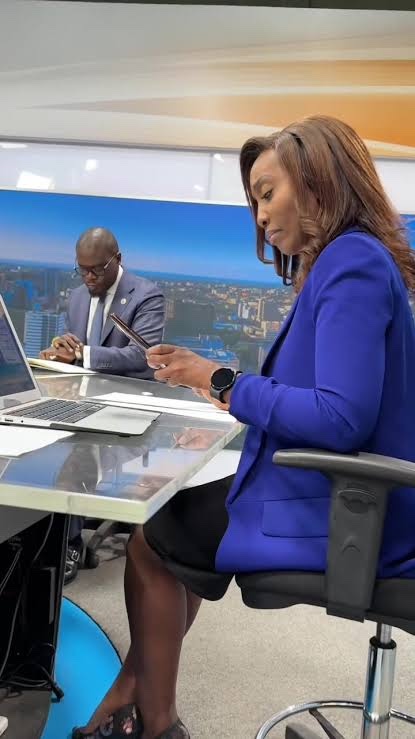
Against this background, longevity is meaningful. It suggests a sustained engagement with a demanding profession, although a long career must ultimately be judged by the quality, fairness and public value of the work produced.
Yvonne Okwara’s career has also demonstrated that journalism is not confined to the anchor’s desk. Her work on programmes such as The Explainer and News Gang has helped create platforms for deeper examination of national issues, political developments and the decisions that shape public life.
These formats demand a different level of engagement from routine news presentation. They require journalists to understand the background to a story, identify contradictions, recognise the interests at stake and help audiences make sense of complicated developments.
Moderating the presidential debate
Her experience moderating the 2017 presidential debate further illustrates the responsibilities that come with public trust. Such assignments require neutrality, preparation and the ability to maintain control in politically charged circumstances.
Beyond broadcasting, Okwara has pursued further professional development and leadership opportunities, demonstrating that a journalist’s influence need not end when the cameras are switched off. Her involvement in advisory and professional initiatives reflects the possibilities available to experienced media practitioners who wish to contribute to wider conversations about leadership, development and public communication.
This wider contribution is important because the media industry needs professionals who can translate experience into mentorship, institutional growth and better standards of public engagement.
As Okwara prepares to sign off, her journey provides an opportunity to examine the state of journalism in Kenya. The country needs journalists who are independent-minded, adequately prepared and willing to question all sides of the political divide. It needs newsrooms that protect editorial independence, invest in research and resist the temptation to sacrifice accuracy for speed or sensationalism.
It also needs a deliberate effort to nurture young journalists. Experience should not disappear through the studio doors when a veteran broadcaster leaves a particular programme. It should be transferred through mentorship, training, editorial guidance and opportunities for younger professionals to take responsibility.
Okwara’s departure, if confirmed as a permanent exit from Citizen Television, would therefore raise a question larger than who will occupy her familiar seat: how will the industry preserve and build upon the professional standards that audiences have come to expect?
A deeply symbolic exit
No individual journalist, however accomplished, can single-handedly guarantee the health of an entire media industry. Institutions matter. Editorial policies matter. Working conditions matter. And the willingness of media owners to defend credible journalism matters just as much as the talent of the people appearing on screen.
The challenge for Citizen Television is to ensure that any transition preserves the depth, preparation and accountability that serious journalism requires. The challenge for the wider industry is to keep creating space for journalists who understand that public trust is earned, not demanded.
The end of a chapter, not necessarily the end of the story.
There is something deeply symbolic about a journalist signing off. For years, the closing words of a broadcast have signalled the end of another day of national conversations. Tonight, if this marks the end of Okwara’s time at Citizen Television, those familiar words may carry a different meaning for the journalist herself and for viewers who have followed her career.
But careers are rarely defined by a single farewell. They are measured by the work accomplished, the standards upheld, the questions asked and the people inspired along the way.
For Yvonne Okwara, the next chapter may bring opportunities beyond the daily demands of television, whether in journalism, leadership, research, mentorship or other forms of public engagement. Whatever direction she chooses, her experience remains an asset to a profession that benefits from seasoned voices and thoughtful practitioners.
SEE >> Media Council Tightens Rules on Polls and Reporting Election Results
For the viewers who have watched her interrogate public officials, analyse national developments and guide difficult conversations, the farewell may be accompanied by nostalgia. Yet gratitude should go beyond admiration for a familiar face. It should recognise the importance of a journalist’s role in a democratic society.
Twenty years in journalism is not merely a milestone to celebrate. It is an invitation to reflect on what journalism ought to be: a profession grounded in truth, guided by fairness and committed to serving the public rather than flattering power.
Yvonne Okwara’s professional journey offers a reminder that a journalist’s greatest legacy is not the number of times they appear on television, but the quality of the questions they leave behind. One thing deserves to be said: the cameras may stop rolling, but the value of a career built around asking questions does not end with the closing credits.
Thank you, Yvonne Okwara, for the years of work, the conversations and the contribution to Kenya’s media landscape. May the next chapter be as purposeful as the one that brought you here.
……………………
Ashford is a teacher of English and Literature and writes on education and social affairs.



Comments
No comments yet. Be the first to share your thoughts.