
The government is also seeking to strengthen its diplomatic presence in Ukraine following the receipt of approval from Kyiv for Kenya's ambassador.
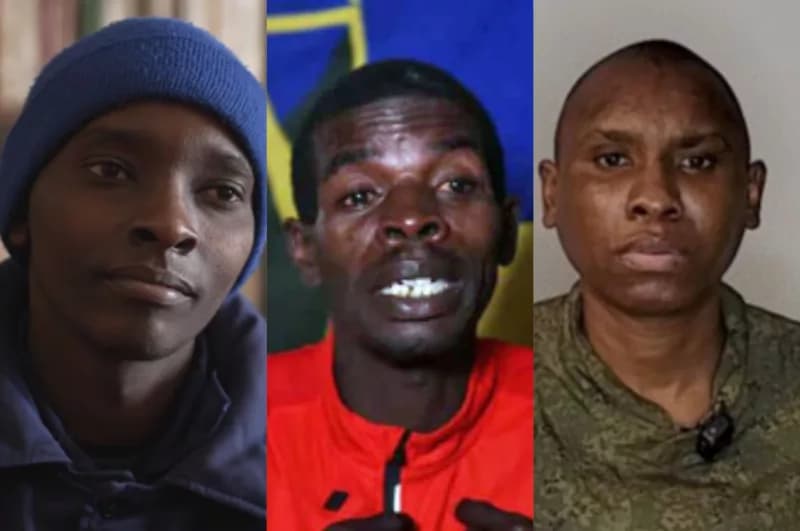
Some of the Kenyans held as prisoners of war (POWs) in Ukraine/FILE

The Kenyan government has intensified diplomatic efforts to secure the release and repatriation of five Kenyans held as prisoners of war (POWs) in Ukraine after they were reportedly recruited to fight for Russia, with plans to explore whether they can be classified as victims of human trafficking.
Prime Cabinet Secretary and Foreign Affairs Cabinet Secretary Musalia Mudavadi told Parliament that the government was pursuing the welfare, release and return of the detainees through diplomatic engagement with Ukrainian authorities and the International Committee of the Red Cross (ICRC).
In a response to a petition before the National Assembly's Departmental Committee on Defence, Intelligence and Foreign Relations, Mudavadi said President William Ruto had personally raised the matter with Ukrainian President Volodymyr Zelenskyy during a telephone conversation.
The diplomatic engagements come amid growing concern over Kenyans who travelled to Russia and became involved in the country's war against Ukraine, with some reportedly recruited under promises of employment.
Mudavadi said the government had received official confirmation that five Kenyan nationals were being held in Ukraine as prisoners of war.
According to information provided by the Ukrainian Embassy in Vienna in a Note Verbale dated September 3, 2026, the five detainees are Evans Kibet, Willi Muniu Macharia, Haron Kibet Pachenge, Joseph and Francis Ndarua Ndungu.
The records indicate that Kibet had been detained since May 2025, Macharia since November 2025, Pachenge since March 2026 and Joseph since April 2026. The date of detention for Ndungu was not specified in the statement.
The government is considering an approach that would seek to have the Kenyans recognised as victims of international human trafficking during negotiations for their repatriation.
Mudavadi said many of the Kenyans held as prisoners of war had reported being recruited through false promises of employment.
"It is proposed that, while negotiating their repatriation, consideration be given to their designation as victims of international human trafficking, with a view of revoking their Prisoners of War tag to better meet the international standard for access to assistance," he said.
The proposal is based on the circumstances surrounding their recruitment and conscription, which the government says could be consistent with the definition of trafficking in persons under Article 3(a) of the Palermo Protocol.
Ukraine has ratified the protocol, which provides an international framework for preventing and combating human trafficking.
The proposed reclassification is intended to improve the detainees' access to assistance as the government pursues their return. However, the statement did not indicate that Ukraine had agreed to the proposal or that a decision had been made to change their status.

Ambassador's accreditation
Kenya is also taking steps to strengthen its diplomatic representation in Ukraine to facilitate direct and timely interventions.
Mudavadi told lawmakers that Kyiv had granted Agrément for Kenya's ambassador to Ukraine, clearing a key stage in the accreditation process.
"The Agrément has been received from Kyiv, paving the way for the issuance of Letters of Credence from Nairobi," he said.
Agrément is the host country's formal approval of a proposed ambassador before the diplomat assumes the role. Letters of Credence are subsequently issued by the sending country and presented to the receiving country's head of state.
The development is expected to strengthen Kenya's capacity to follow up on the cases of detained citizens and coordinate with Ukrainian authorities on their welfare and repatriation.
Previously, the State Department for Diaspora Affairs engaged the Kenyan Embassy in Vienna, which is accredited to Ukraine, to pursue the matter.
The mission subsequently contacted the Ukrainian Embassy in Vienna and Kenya's Honorary Consul in Ukraine to establish the circumstances surrounding the detainees and determine the appropriate diplomatic and consular interventions.
Kenya's Honorary Consul also visited the Zakhid 1 prisoner-of-war camp, where the detainees were being held.
According to Mudavadi, the consul reported that the Kenyans were being held in humane conditions, had access to medical services and were being treated in accordance with applicable rules governing prisoners of war.
The government has not provided a timeline for their release or confirmed when they could return home.
The State Department for Diaspora Affairs, led by Principal Secretary Roseline Njogu, has been coordinating efforts to trace affected Kenyans, verify reports and provide assistance to their families.
Mudavadi said the department had received and documented cases reported by families before referring them to relevant diplomatic missions for verification.
It has also maintained communication with relatives and conveyed official updates received through diplomatic channels.
The department has helped families submit next-of-kin details and supporting documents required for compensation processes. It has also provided psychosocial support to families dealing with the uncertainty surrounding their relatives' whereabouts and welfare.
In cases involving deceased Kenyans, the department has facilitated communication between families and the government on consent for cremation or other methods of interment. It has also explained the procedures for repatriating remains.
The government said reports from Ukraine's Defence Intelligence indicated that the remains of four Kenyans were in Ukrainian custody. They were identified as Simon Gitau, Clinton Nyapara Mogesa, Dennis Bagaka Obwori and Eric Mwangi Nyambura.
Mudavadi did not provide further details on the circumstances of their deaths or indicate when their remains could be returned to Kenya.
354 Kenyans linked to Russia-Ukraine conflict
The Foreign Affairs Ministry has so far documented 354 Kenyan nationals involved in the Russia-Ukraine crisis, with cases ranging from those serving on the front lines to those who have been hospitalised, killed or reported missing.
According to the figures presented to Parliament, 77 Kenyans were recorded as being on the front lines, while 38 were in camps and 52 were listed as being at unknown locations or unclassified.
Another 84 were recorded as killed or missing in action, 34 were hospitalised and 62 had been repatriated. The records also listed five prisoners of war, one person in detention and one whose contract had been completed.
The government said it was continuing to encourage families to report cases as soon as communication with relatives in Russia was disrupted.
Upon receiving a report, the State Department collects identification details, travel information and next-of-kin contacts before escalating the case to the Kenyan Embassy in Moscow for verification.
Mudavadi said the ministry regularly communicated with the embassy and transmitted diplomatic notes to the Russian Embassy in Nairobi. The Kenyan mission in Moscow, in turn, engaged Russia's Ministry of Defence through its Ministry of Foreign Affairs.
During his official visit to Moscow in March 2026, Mudavadi said Kenya secured its inclusion on Russia's "Stop List", a measure intended to prevent further enlistment of Kenyan nationals in the country's military operation.
"The Embassy of Kenya in Moscow has since confirmed that no additional Kenyan nationals have been enlisted in the Special Military Operation following the implementation of the Stop List," he said.
Russian authorities have also indicated that requests to terminate military contracts are considered individually by military unit commanders.
The government said it would continue engaging affected families, Russian and Ukrainian authorities, and the ICRC to pursue the welfare and return of Kenyans caught up in the conflict.
Mudavadi said the ministry would provide the parliamentary committee with further verified information as diplomatic efforts progressed.



Comments
No comments yet. Be the first to share your thoughts.