
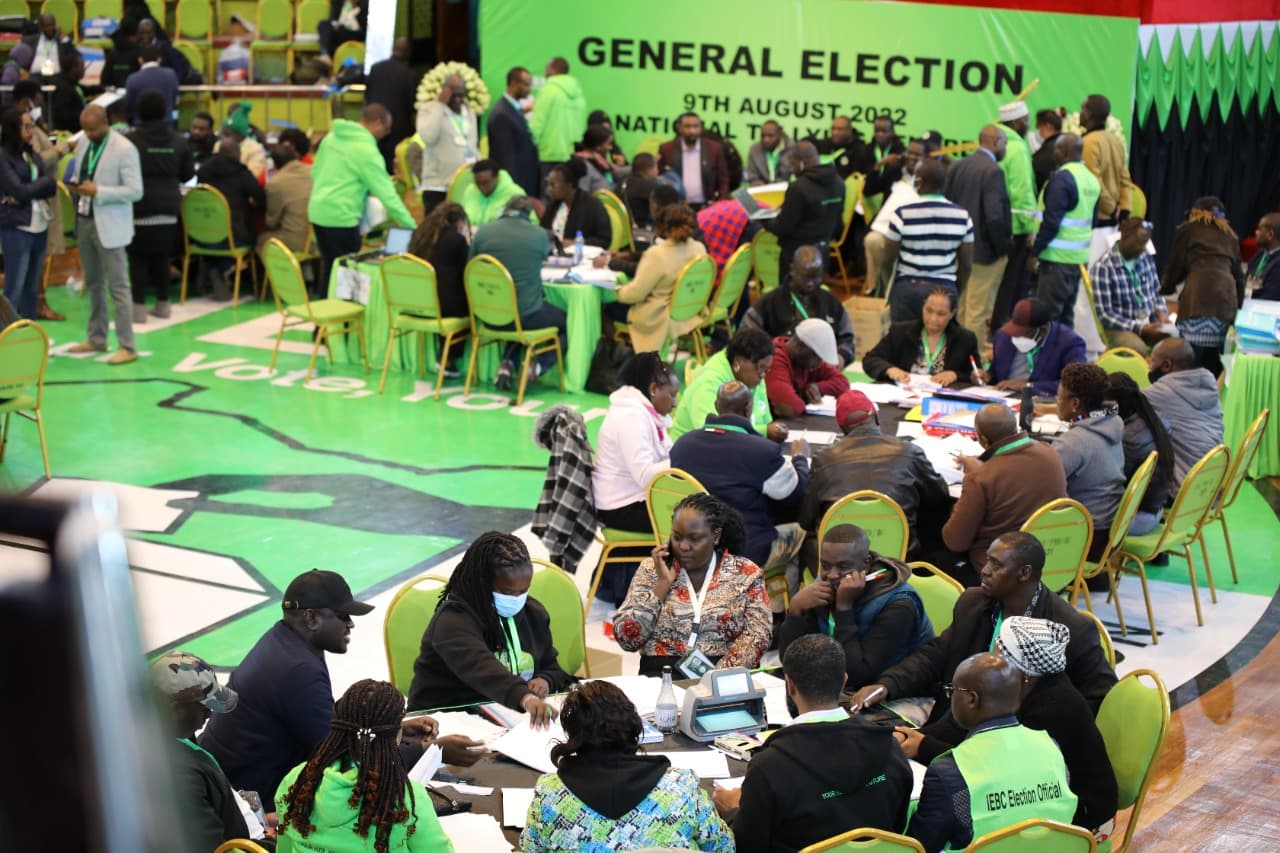
NAIROBI,Kenya Sep 23 – A petitioner has moved to court seeking orders compelling the Independent Electoral and Boundaries Commission (IEBC) to disclose key details of its preparations for the 2027 General Election, including the location of polling stations and tallying centres and procedures for voter identification and verification.
Francis Awino, through a Notice of Motion, wants the case certified as urgent and the court to issue interim orders barring the electoral agency and its officials from implementing any undisclosed or materially altered protocols concerning the national tallying centre and voter verification.
Awino is also seeking orders requiring the IEBC to disclose information on the designation, location, gazettement and accessibility of polling stations and tallying centres, as well as how and when the information will be made public.
The petitioner has placed particular focus on the proposed national tallying centre, asking the IEBC to disclose its legal basis, location, Gazette Notice, venue records, management protocols, audit trails and arrangements for public access to information.
If the centre has already been selected or designated, Awino wants the IEBC to provide its official name and physical location, together with the date and basis of the decision, the relevant Gazette Notice and details of how the public was notified.
The petitioner is further seeking disclosure of the Commission’s voter registration, identification and verification records and the procedures to be followed in circumstances where biometric verification fails, biometric data cannot be read, election devices malfunction or connectivity is unavailable.
Awino wants the court to require the IEBC to disclose its policies, manuals, standard operating procedures, circulars, directions, training materials, internal memoranda, correspondence and decision-making records relating to the electoral arrangements.
Under the proposed orders, the IEBC would be required to file an affidavit within seven days, or within another period set by the court, stating whether a national tallying centre has been designated, selected, proposed, reserved or otherwise identified for the 2027 election.
The affidavit would also have to state whether the Commission has written protocols governing operations at the national tallying centre and whether it has a written voter identification and verification procedure covering biometric failures and other technical challenges.
Awino is also asking the IEBC to account for the action it has taken following a written request he says he submitted on September 16, 2026, and to provide copies of any responses and other correspondence arising from the request.
The petitioner argues that any new or substantially revised protocol concerning the national tallying centre or voter verification that could affect voters’ political rights should be documented, authorised under the law and preserved for disclosure.
He is further seeking orders restricting the IEBC from designating, relocating, altering or de-gazetting polling stations or tallying centres outside the requirements of the Constitution and electoral laws.
The proposed restriction would, however, not apply to changes required by law, emergencies or court orders, provided the Commission records the reasons for the decision, the statutory authority relied upon, the decision-making record and evidence of public notification.
On polling stations, Awino relies on Regulation 7 of the Elections (General) Regulations, which deals with their designation and gazettement, and Regulation 83, which provides for final tallying at a venue gazetted by the Commission.
The petitioner argues that publishing the precise geographical coordinates of polling and tallying venues would make the locations independently verifiable and enable voters and election stakeholders to identify, inspect and report errors affecting voting and tallying sites.
He proposes that the information be published for six calendar months ahead of the election to allow sufficient time for public verification, correction of errors, accessibility planning and election deployment.
The application also raises questions about the safeguards surrounding voter identification, arguing that Kenya’s electoral framework provides for biometric voter registration, biometric identification and electronic transmission of results.
Awino argues that biometric verification should remain the primary identity-matching safeguard, with any alternative mechanism clearly defined, limited in scope and capable of being audited.
The petitioner contends that the matters raised go directly to constitutional and electoral rights and that any harm suffered during voting, tallying or declaration of results may not be adequately remedied through an award of damages after the election.
The application cites several provisions of the Constitution, including those relating to access to information, political rights, fair administrative action and the management of elections.
It also invokes the Elections Act, the IEBC Act and electoral regulations, alongside the Constitution of Kenya (Protection of Rights and Fundamental Freedoms) Practice and Procedure Rules.
Awino has also referred to the Supreme Court’s October 17, 2017 decision, which he argues clarified the role of national verification in relation to Forms 34A, 34B and 34C.
He is ultimately asking the court to issue any further orders it considers necessary to safeguard the Constitution, electoral integrity and public confidence in the 2027 electoral process.

Comments
No comments yet. Be the first to share your thoughts.