
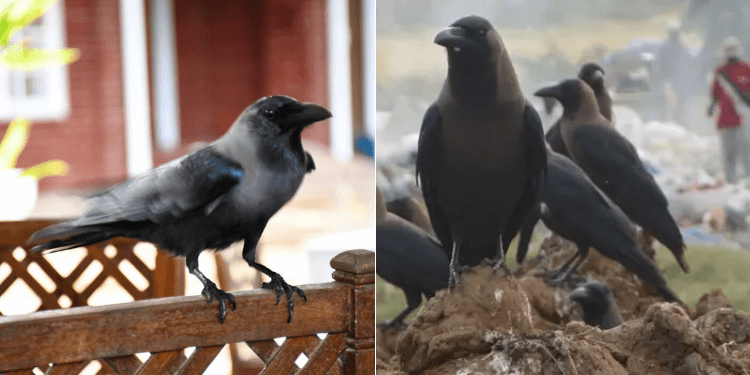
The Indian house crow has become one of Kenya’s most problematic invasive bird species, with conservationists warning that its rapid spread threatens native wildlife, tourism, public health and aviation safety.
The warning comes after researchers from the National Museums of Kenya confirmed the first sightings of the birds in Nairobi, raising concerns that the species is expanding beyond its long-established range along the Kenyan coast.
Researchers say the birds were recently spotted around Nairobi City Stadium and Burma Market after a resident photographed them before chasing them away. Traders in the area also reported seeing the birds flying and perching nearby.
According to research scientist John Musina, the birds are believed to have followed major transport corridors such as Mombasa Road and the Standard Gauge Railway (SGR), allowing them to move inland from the coast.
How Indian House Crow Landed in Kenya
The Indian house crow (Corvus splendens) is native to the Indian subcontinent but has spread to several countries through maritime trade and shipping.
In East Africa, researchers say Indian house crows were introduced intentionally around 1890 in order to control rubbish.
In 1947, the house crow reached Kenya, and since then its numbers have exploded, thanks to the growing human population and the accompanying mounds of garbage, which provide the birds’ main source of food.
Since then, it has become one of Kenya’s most persistent invasive species along the coast, where its population is now estimated in the millions.
Over the years, the birds have gradually expanded beyond the coastal region, with researchers now confirming their presence in Nairobi.
How to Identify the Indian House Crow
The Indian house crow is a medium-sized bird measuring about 40 to 42 centimetres in length.
It has a glossy black head, wings and tail, while its neck and upper breast are grey, giving it a distinctive two-tone appearance.
The bird has a slender black beak, dark eyes and strong legs. It is highly social and is often seen moving in noisy groups, communicating through loud, harsh calls.
Unlike Kenya’s native crows, the Indian house crow lives almost exclusively around human settlements where food is readily available.
Habitat and Feeding Habits
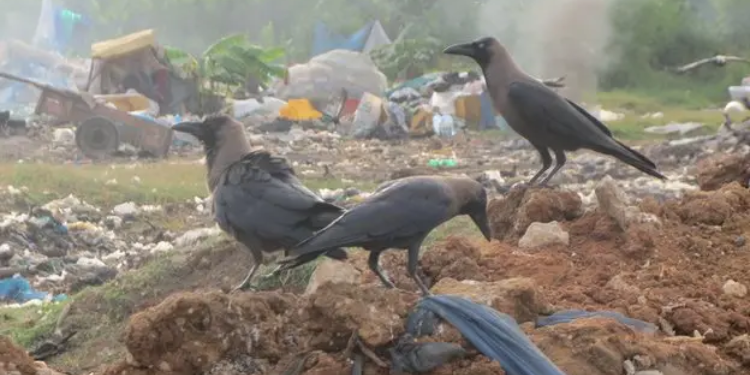
House crows thrive in urban areas, including markets, residential estates, hotels, restaurants, ports, farms and garbage disposal sites.
They are opportunistic feeders with an extremely varied diet, consuming insects, fruits, grains, rodents, reptiles, fish, eggs, chicks, food waste and dead animals.
The birds are also known to snatch food from people in restaurants and outdoor eating areas, making them a nuisance in many tourist destinations along the Kenyan coast.
Scientists say their ability to survive on almost any food source has allowed them to establish large populations in towns and cities.
Musina cautioned that Nairobi’s abundant organic waste could allow the crow population to multiply rapidly if breeding begins before control measures are implemented.
“One of the things that makes their population explode is the availability of supplemental food sources, like what we have at the dump sites. So, if we don’t act quickly and they start breeding, then the population can explode because they will not be deprived of food sources in a city like this, especially when we have areas where garbage, organic waste, is easy to access,” he said.
Why the Bird Is Considered Invasive
Conservationists say the Indian house crow poses a serious threat to Kenya’s biodiversity because it competes directly with indigenous bird species.
The birds raid nests, feeding on eggs and chicks of native birds, reducing breeding success and contributing to declining populations.
They also compete with local birds for food and nesting sites, making it difficult for indigenous species to survive.
According to researchers, one of the biggest concerns is the bird’s ability to reproduce rapidly where food is abundant.
They have warned that Nairobi’s numerous garbage dumps and organic waste sites could provide ideal breeding conditions if the birds establish permanent populations.
“One of the things that makes their population explode is the availability of supplemental food sources, like what we have at the dump sites. If we don’t act quickly and they start breeding, then the population can explode because they will not be deprived of food sources in a city like this, especially where organic waste is easy to access,” Musina said.
Threat Beyond Wildlife
The impact of the Indian house crow extends beyond conservation.
The Kenya Wildlife Service (KWS) says the species threatens biodiversity, degrades urban and rural environments, undermines food security and poses public health risks.
The birds thrive around waste disposal sites, where they can carry disease-causing organisms and contaminate food and water sources.
However, the crows do not eat just rubbish or leftovers – they also have a nose for delicacies.
Hotels and restaurants along the coast have also reported frequent incidents of house crows snatching food from guests and leaving droppings around tourist facilities, affecting visitor experiences.
Risk to Aviation
Wildlife experts have also raised concerns about aviation safety.
Researchers warn that if the birds establish large populations near Jomo Kenyatta International Airport (JKIA) and Wilson Airport, they could increase the risk of bird strikes involving aircraft.
They have also warned that expanding populations near Nairobi National Park could disrupt native birdlife and other wildlife.
Efforts to Control the Birds
Researchers are preparing an early eradication programme in Nairobi using methods already deployed on the coast.
“The only method that is at our disposal is to use a particular chemical that targets them, and this has to be done in a very controlled way with experts at the helm. The ‘Crows No More’ programme has been tremendously successful, and that is what we are going to learn from,” Musina said.
More than 140,000 house crows were eliminated along the Kenyan coast during the first four months of this year under the ongoing ‘Crows No More’ campaign.
The Kenya Wildlife Service has called for an all-of-society approach to controlling the invasive species, urging county governments to strengthen waste management, local communities to support control measures and institutions to coordinate long-term eradication efforts.
Follow our WhatsApp Channel and X Account for real-time news updates.



Comments
No comments yet. Be the first to share your thoughts.